EloElo Raises $80 Million to Expand AI Microdramas
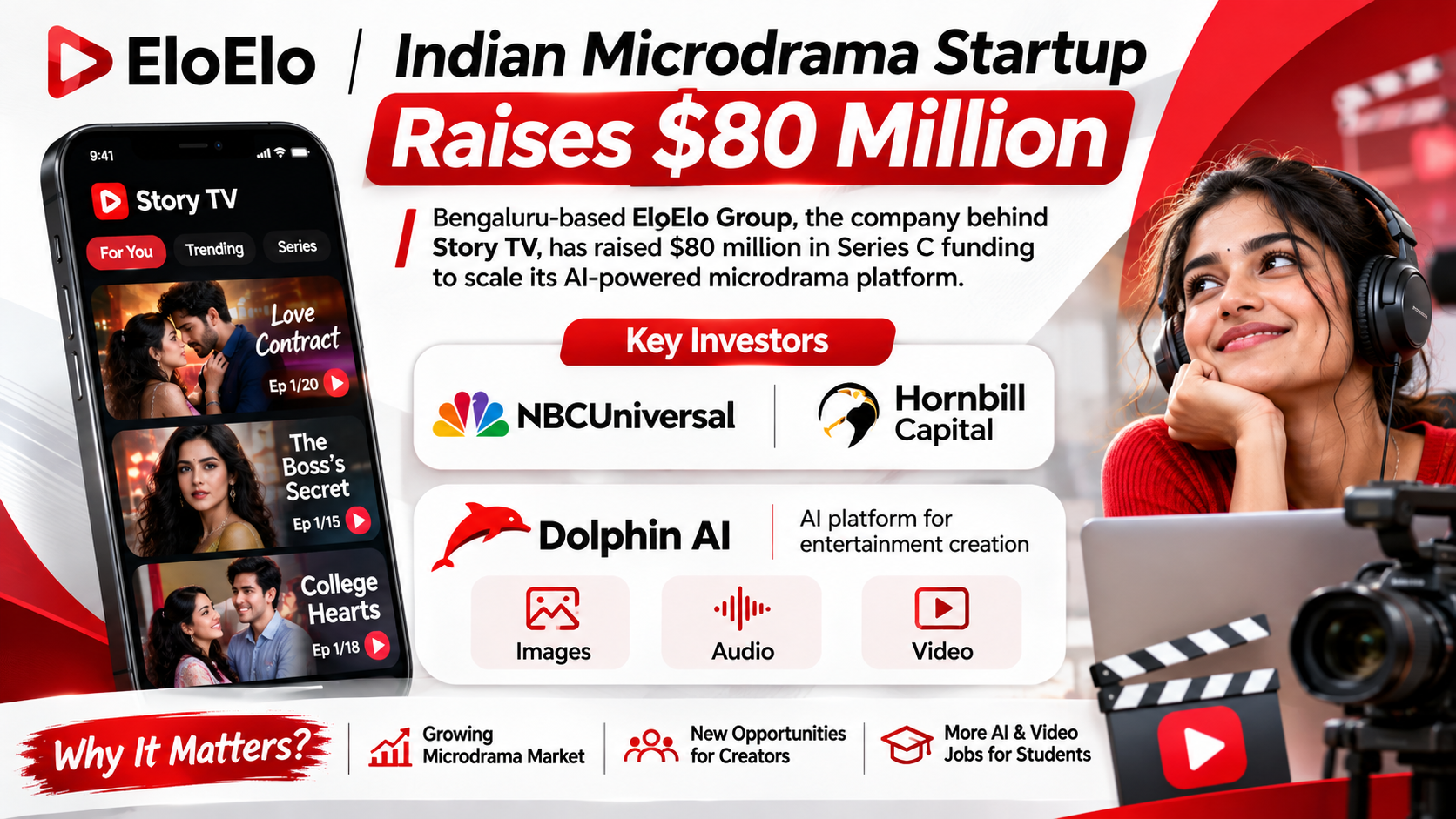
Indian startup EloElo raises $80 million in Series C funding to expand Story TV, develop Dolphin AI and transform mobile entertainment through AI-powered microdramas.
EloElo Raises $80 Million: How AI Is Transforming India's Microdrama and Entertainment Industry
Introduction: A new chapter for India's digital entertainment industry
India's digital entertainment industry is experiencing a major transformation. Short-form videos, Instagram Reels, YouTube Shorts and mobile-first entertainment platforms have changed how people consume content. Now, another format is attracting attention: microdramas.
Microdramas are short, episode-based stories designed primarily for smartphone screens. Unlike traditional television serials, which may run for several minutes or longer per episode, microdramas deliver compact storytelling through vertical videos. They often include romance, suspense, family drama, comedy and thriller elements.
One Indian company making a significant move in this emerging market is Bengaluru-based EloElo Group, the company behind Story TV.
The company has reportedly raised $80 million in Series C funding, with NBCUniversal and Hornbill Capital among the investors. This investment highlights growing interest in India's mobile entertainment market and the possibilities of combining artificial intelligence with digital storytelling.
But this announcement is about more than funding. EloElo is also investing in AI technology through its Dolphin AI platform, which aims to support the creation of images, audio and videos for entertainment production.
Let's understand what happened, why investors are interested in this market, how AI could change entertainment production and what opportunities this development may create for Indian students and creators.
1. What happened? EloElo secures $80 million in funding
EloElo Group has raised $80 million in a Series C funding round. The Bengaluru-based company operates Story TV, a platform focused on short, serialized vertical entertainment.
The investment includes participation from NBCUniversal and Hornbill Capital.
A Series C funding round generally indicates that a company has moved beyond its earliest development stages and is seeking capital to expand its business, improve its products, reach additional customers and strengthen its market position.
For EloElo, this funding is an opportunity to develop its microdrama business, invest in technology and explore international markets.
The investment also reflects increasing attention toward mobile-first entertainment formats.
Smartphone users increasingly consume content in short sessions. Instead of waiting for a television programme or watching an entire movie, audiences can follow a story through several short episodes.
This creates a different business opportunity for entertainment companies.
Rather than depending entirely on traditional long-form productions, companies can experiment with shorter stories designed specifically for mobile audiences.
2. What exactly is a microdrama?
A microdrama is a short fictional story presented through multiple episodes, usually in a vertical video format.
Think of it as a television serial redesigned for smartphones.
For example, imagine a story about two people who meet unexpectedly, fall in love and face a family conflict.
Instead of presenting the complete story in a traditional television episode, the platform divides it into short chapters.
Each chapter ends with an interesting moment that encourages viewers to watch the next episode.
Popular microdrama themes include:
Romantic relationships and love stories.
Family conflicts and emotional drama.
Mystery and suspense.
Crime and thriller stories.
Comedy and entertainment.
College life and friendship.
Business, ambition and revenge stories.
The biggest advantage is convenience.
Viewers can watch an episode while travelling, during a break or whenever they have a few minutes available.
For platforms, this format creates opportunities to attract repeat viewers through continuing storylines.
3. Why is Story TV an important part of this development?
Story TV is EloElo's mobile entertainment platform, focused on serialized vertical dramas.
The platform represents a shift in how entertainment companies approach storytelling.
Traditional entertainment production often involves large teams, expensive equipment, lengthy production schedules and distribution arrangements.
Mobile-first storytelling can provide a different production model.
Content can be designed specifically for smartphone screens, with shorter scenes, faster storytelling and more frequent episode releases.
This does not mean that quality production becomes unnecessary. Strong characters, interesting scripts, good acting, editing and sound design remain important.
However, the format creates opportunities to experiment with different storytelling techniques.
For example, a creator could test multiple story concepts, study audience engagement and develop additional episodes based on viewer interest.
For EloElo, expanding Story TV could help strengthen its position in the growing microdrama market.
4. Dolphin AI: Bringing artificial intelligence into entertainment production
One of the most interesting parts of EloElo's strategy is its investment in AI through Dolphin AI.
Artificial intelligence is increasingly being used in creative industries.
AI tools can help generate visual concepts, create audio assets, assist with video production and support different stages of content development.
Dolphin AI is intended to support entertainment creation through images, audio and video.
Consider a simple example.
A creator wants to produce a short romantic drama consisting of ten episodes.
Traditionally, the creator may need to complete several stages manually:
Develop the story concept.
Write the script.
Create a storyboard.
Plan the scenes.
Arrange visual assets.
Record dialogue and audio.
Edit the footage.
Prepare the final videos.
AI-assisted production could help with certain stages.
For example:
Image generation: AI can help create visual references, character concepts and scene ideas.
Audio generation: AI tools can assist with voice-related production, sound assets and audio workflows.
Video generation: Generative video tools can help creators experiment with visual scenes and creative concepts.
Story development: AI assistants can help organise ideas, generate story variations and prepare preliminary scripts.
The goal is not necessarily to remove humans from creative production.
Instead, AI can become an assistant that reduces repetitive work and helps creative teams experiment more quickly.
Human creativity, direction, storytelling and quality control remain essential.
5. Why are investors interested in the microdrama market?
The investment in EloElo reflects interest in the potential of mobile entertainment.
There are several reasons why this format is attracting attention.
A. Smartphone-first audiences
India has a large smartphone user base.
Mobile devices have become an important way for people to access entertainment, social media, educational content and digital services.
Vertical video fits naturally into smartphone usage because viewers do not need to rotate their devices.
B. Shorter entertainment experiences
Many users prefer content that can be consumed in smaller sessions.
Microdramas provide a structured story without requiring viewers to commit to a full-length movie or television episode.
C. Repeat engagement
Serialized content encourages audiences to return.
When an episode ends with an unexpected development, viewers may want to watch the next episode to discover what happens.
This creates opportunities for platforms to develop regular viewing habits.
D. Multiple monetization opportunities
Entertainment platforms can explore different revenue models.
These may include advertising, subscriptions, premium episodes and other digital content offerings.
However, successful monetization depends on audience retention, content quality, user acquisition costs and the overall business model.
E. International expansion
Short-form serialized entertainment is not limited to one country.
Companies can explore new markets by adapting stories, languages, characters and cultural references for different audiences.
For EloElo, international expansion represents an opportunity to take its mobile entertainment strategy beyond India.
6. How AI could change the future of video production
AI is changing several stages of the video production process.
In the past, producing professional-looking videos often required specialised software, experienced editors and considerable production resources.
Today, generative AI tools are making certain creative tasks more accessible.
Consider the following areas:
Pre-production: AI can help brainstorm story ideas, create outlines and generate visual references.
Character development: Image-generation systems can help creators explore character appearances, costumes and visual styles.
Scene planning: AI-assisted tools can help prepare storyboards and shot lists.
Video creation: Generative video platforms can help experiment with scenes and visual concepts.
Audio production: AI can assist with voice workflows, sound design and audio editing.
Post-production: Editing assistants can help organise footage, generate captions and speed up selected editing tasks.
However, AI-generated content still requires careful review.
Character consistency, visual continuity, accurate dialogue, copyright considerations and production quality remain important challenges.
For a company creating serialized dramas, maintaining consistent characters across multiple episodes is particularly important.
A viewer should recognise the same character from one episode to another.
This is one reason why AI-assisted production needs a combination of technology and professional creative supervision.
7. What does this mean for India's AI startup ecosystem?
EloElo's funding is also interesting from a startup perspective.
India's technology ecosystem includes companies working in software, fintech, education, enterprise AI, cloud computing and digital entertainment.
The growing combination of AI and entertainment creates another area for innovation.
Startups may develop products for:
AI-powered video editing.
Automated subtitle generation.
Digital character creation.
AI voice production.
Storyboarding and script assistance.
Video recommendation systems.
Content analytics.
Creative workflow automation.
These opportunities are not restricted to companies building large AI models.
Small startups can also create useful applications by combining existing AI models with specialised workflows.
For example, a startup could build a tool that helps regional-language creators convert a story into a storyboard, generate subtitles and prepare short promotional videos.
Another company could develop analytics software that helps entertainment platforms understand which episodes retain viewers.
The important opportunity is identifying a real production problem and developing a useful solution.
8. Career opportunities for students and freshers
This development is especially relevant to students interested in computer science, artificial intelligence, software development and digital media.
The combination of AI and entertainment creates several possible career directions.
AI/ML Engineer
AI/ML engineers develop and improve machine learning systems.
Useful skills include Python, machine learning, deep learning, model evaluation and data processing.
Backend Developer
Backend developers build the systems that power applications and digital platforms.
Useful skills include Java, Python, APIs, databases, authentication and cloud services.
AI Application Developer
These developers integrate AI models into practical applications.
Useful skills include Python, API integration, prompt engineering, model deployment and application development.
Data Engineer
Entertainment platforms generate data about views, watch time, engagement and user behaviour.
Data engineers build systems to collect, process and organise this information.
Useful skills include SQL, Python, data pipelines and cloud platforms.
Video Technology Developer
These developers work on video processing, streaming, media infrastructure and content delivery.
Useful skills include video encoding, computer networks, cloud computing and multimedia technologies.
Creative AI Specialist
Creative AI specialists combine visual storytelling with AI-powered production tools.
They may work on storyboards, image generation, video generation, editing workflows and creative experimentation.
9. Practical projects students can build
Reading about AI developments is useful, but building projects is a better way to understand the technology.
Here are five project ideas inspired by the microdrama industry.
Project 1: AI Story Generator
Create a simple application that generates short story ideas based on a selected genre.
Technologies: Python, an LLM API and Streamlit.
Project 2: AI Storyboard Generator
Build a tool that converts a short script into a sequence of scene descriptions and visual references.
Technologies: Python, language models and image-generation APIs.
Project 3: Video Caption Generator
Develop an application that generates subtitles from uploaded audio or video.
Technologies: Python, speech recognition and video-processing libraries.
Project 4: Short Video Analytics Dashboard
Create a dashboard that analyses synthetic video performance data, including views, average watch time and engagement.
Technologies: Python, Pandas, SQL and Power BI.
Project 5: Regional Language Story Assistant
Develop a simple application that converts story ideas into different Indian languages.
Technologies: Python, language models and translation APIs.
These projects can help students demonstrate practical skills through portfolios and technical interviews.
10. Challenges that AI-powered entertainment companies must solve
Although the opportunity is promising, the industry also faces challenges.
Content quality: AI can assist production, but generating consistently engaging stories requires strong creative direction.
Audience retention: Producing many short videos does not guarantee that viewers will continue watching.
Production consistency: Characters, backgrounds, clothing and visual styles must remain consistent across episodes.
Copyright and ownership: Companies must consider the rights associated with training data, generated assets, scripts, music and other creative material.
Language and localisation: India's audience is multilingual. Content must connect with different regional cultures and viewing preferences.
Monetization: Platforms need sustainable revenue models that balance user experience with business growth.
Competition: The mobile entertainment industry includes social platforms, streaming services, independent creators and specialised short-video applications.
Solving these challenges will be important for companies hoping to build sustainable businesses.
11. What should aspiring creators learn from EloElo?
The biggest lesson is that the future of content creation may involve a combination of storytelling, technology and business strategy.
Simply knowing how to generate an AI image or video may not be enough.
Creators should understand how to develop ideas, build stories, edit content, analyse performance and reach the right audience.
A useful learning roadmap is:
Learn basic storytelling and scriptwriting.
Understand image and video generation tools.
Practise professional video editing.
Learn AI-assisted audio and subtitle workflows.
Study social media analytics.
Experiment with short serialized storytelling.
Build a portfolio of original projects.
Students interested in technical careers should additionally learn Python, APIs, machine learning, databases and cloud computing.
Combining technical knowledge with creative skills can open up opportunities across multiple industries.
Conclusion: AI and storytelling are becoming powerful partners
EloElo's $80 million Series C funding marks an important development for India's microdrama and digital entertainment ecosystem.
Its investment in Story TV, together with its Dolphin AI initiative, highlights the growing intersection of mobile entertainment and artificial intelligence.
The larger opportunity is not limited to producing shorter videos.
It involves building new production workflows, improving content creation, developing intelligent applications and discovering new ways to engage audiences.
For Indian students, developers and creators, this is a reminder that AI opportunities exist beyond traditional software companies.
The next generation of opportunities may emerge where technology meets creativity.
Learning AI tools, software development, video production and digital storytelling today can help prepare you for tomorrow's changing entertainment industry.
The future of entertainment may not just be about watching stories. It may also be about using AI to create them.