cinematic AI Model Fatigue Is Here: Too Many Models, Too Little Time
AI models are launching faster than companies can evaluate them. Here’s why choosing the right model now matters more than choosing the smartest one.
By singamankitha
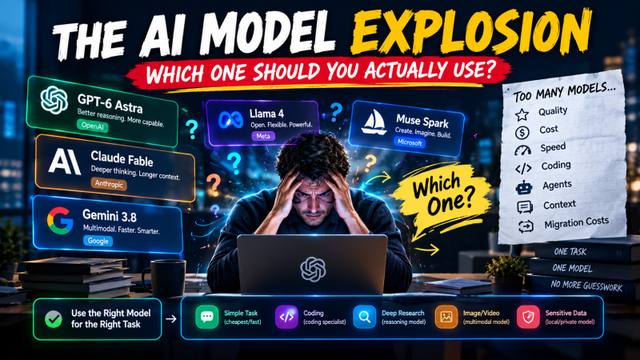
AI Model Fatigue Is Here: Too Many Models, Too Little Time
The AI industry has a new problem.
There are too many models.
OpenAI, Anthropic, Google, Meta and other AI companies are releasing increasingly capable models at a rapid pace. For businesses and developers, keeping up is becoming a job of its own.
A new model arrives.
Then another.
Then a cheaper version.
Then a faster version.
Then a model optimized for coding.
Then one designed for reasoning.
Then another with a larger context window.
And suddenly, the question is no longer:
“Which AI model is the smartest?”
The question is:
“Which AI model should I actually use?”
This growing problem is increasingly being described as AI model fatigue.
The AI Model Explosion
Not long ago, choosing an AI model was relatively simple.
A company might evaluate a handful of major options and select one as its default.
That is becoming harder.
Today's organizations may need to compare models across:
Accuracy
Reasoning
Coding
Cost
Speed
Context length
Tool use
Agent performance
Multimodal capabilities
Reliability
Privacy
Migration costs
And these characteristics can change every time a new model launches.
A model that was considered the best option several months ago may no longer be the obvious choice today.
The Problem Isn't Lack of Choice
It is too much choice.
Imagine a company running thousands or millions of AI requests every month.
Even a small difference in price can become significant.
A slightly faster model could improve user experience.
A stronger coding model could save developers hours.
A cheaper model could reduce operating costs.
A model with better reasoning could improve complex workflows.
But moving from one model to another isn't always easy.
Companies may need to change prompts, evaluate outputs, modify integrations, retest applications and retrain employees.
The cost of switching models can therefore be much larger than simply changing an API endpoint.
Stop Asking Which Model Is “Best”
This is where the AI conversation needs to change.
There may not be one universally best model.
The better question is:
Best for what?
A company might use one model for customer support, another for coding, another for research and another for image generation.
The optimal model can depend on the task.
For a simple classification task, paying for an expensive reasoning model may make little sense.
For a complicated research problem, the cheapest model may not be sufficient.
For software development, a coding-focused model could be more useful than a general-purpose chatbot.
For private or sensitive information, the most important requirement may be where the model runs and how data is handled.
The future may therefore belong less to one-model companies and more to multi-model systems.
The Rise of the Personal Model Router
One practical solution is to build a model-routing system.
Instead of asking:
“Which model should I use for everything?”
ask:
“Which model should handle this particular task?”
A simple routing system could look like this:
Simple task
↓
Fast, inexpensive model
Coding task
↓
Coding-focused model
Deep research
↓
Reasoning model
Image or video
↓
Multimodal model
Sensitive information
↓
Private or locally deployed model
This approach treats AI models like specialized tools rather than competing brands.
Think of AI Models Like Employees
Imagine hiring a company with five employees.
You wouldn't ask all five employees to perform exactly the same job.
You would give each person work based on their strengths.
One person handles accounting.
Another handles software.
Another handles sales.
Another performs research.
Another creates designs.
AI models can increasingly be treated the same way.
Instead of searching for one model that does everything reasonably well, companies can build systems where different models perform different jobs.
Model Switching Has a Cost
There is another reason model fatigue matters.
Every new model creates pressure to evaluate it.
A company may need to ask:
Is it better?
Is it cheaper?
Is it faster?
Does it follow instructions more reliably?
Does our existing prompt still work?
Does it break our current workflow?
Does it work with our tools?
Is migration worth the engineering effort?
This creates a new operational burden.
The AI industry has effectively created a continuous benchmarking problem.
Companies don't just need to build AI applications anymore.
They increasingly need to manage an evolving AI model portfolio.
The Benchmark Trap
Benchmarks can make this even more confusing.
A model might lead on one benchmark while another performs better on real-world tasks.
One model may be excellent at mathematics.
Another may be better at coding.
Another may be faster.
Another may be dramatically cheaper.
Another may work better with long documents.
This means a leaderboard position doesn't necessarily tell a company which model will work best for its application.
The most useful benchmark may ultimately be the company's own workload.
Instead of asking:
“Which model ranks highest?”
companies should ask:
“Which model produces the best results for our actual users at an acceptable cost?”
Build Your Own AI Scorecard
One practical response to model fatigue is to create a simple internal scorecard.
For every model, measure:
Quality
How accurate are the outputs?
Cost
How much does each successful task cost?
Latency
How quickly does it respond?
Reliability
How often does it fail or require retries?
Coding
How well does it handle software tasks?
Reasoning
How well does it handle complicated problems?
Agents
How reliably does it use tools and complete multi-step workflows?
Privacy
What happens to the data being processed?
The result is much more useful than simply asking which model is “number one.”
The Best Model Could Change Every Week
This is perhaps the biggest change.
AI model selection is becoming less like buying software once and more like managing a constantly changing technology stack.
A company might choose one model today.
Next month, a new model could offer better performance at a lower price.
A month later, another model could become the better option for a specific workflow.
This creates an ongoing optimization problem.
The organizations that adapt quickly may benefit from the competition between AI companies.
But organizations that constantly chase every new release can also waste enormous amounts of time.
The solution is not to test every model.
The solution is to build a process for determining when a new model is worth testing.
AI Model Fatigue Could Become a Competitive Advantage
Model fatigue sounds like a problem.
But it can also create an opportunity.
Businesses that develop strong model-selection systems may be able to take advantage of improvements without constantly rebuilding their applications.
Instead of tightly connecting an application to one model, companies can create an abstraction layer that allows models to be swapped.
Then the workflow becomes:
Application
↓
Model router
↓
Best available model for the task
This gives businesses flexibility.
If one model becomes expensive, another can be tested.
If a new model performs better, it can be added.
If a provider has an outage, traffic can potentially be redirected.
The AI application becomes less dependent on a single model provider.
The Future May Be Multi-Model
The AI industry may eventually stop thinking about models as products that compete for one permanent winner.
Instead, models could become components inside larger systems.
One application might call several different models during a single workflow.
For example:
User request
↓
Router
↓
Reasoning model
↓
Coding model
↓
Verification model
↓
Fast model
↓
Final response
The user may not even know which models were involved.
They simply receive the result.
That could be the next stage of AI software.
The New Question
The AI industry's most important question may no longer be:
“Which model is smartest?”
It may be:
“Which model is right for this task?”
And that is a much more useful question.
Because businesses don't buy intelligence for its own sake.
They buy outcomes.
They want better software.
Lower costs.
Faster customer service.
More accurate research.
Better products.
Higher productivity.
The model is simply one component used to achieve those outcomes.
AI Model Fatigue Is a Sign of a Maturing Industry
Ironically, model fatigue may be a sign that the AI industry is becoming more mature.
When there were only a few major models, everyone could focus on model capabilities.
As the number of models grows, the conversation naturally shifts toward economics, reliability, integration and specialization.
That is what happens in mature technology markets.
The question moves from:
“What can this technology do?”
to:
“How should we deploy it?”
AI is increasingly entering that second phase.
The New AI Skill: Model Selection
For developers, businesses and AI users, one of the most valuable skills may soon be knowing how to choose between models.
Not memorizing every model release.
Not chasing every benchmark.
Not automatically switching whenever a new model appears.
Instead:
Understand the task.
Measure the requirements.
Test the relevant models.
Compare quality, cost and speed.
Choose the model that fits the job.
That's the beginning of an effective AI strategy.
The Future of AI May Be a Team of Models
The next generation of AI applications may not depend on a single “super model.”
They may use a collection of specialized models working together.
One handles reasoning.
One handles coding.
One handles vision.
One handles fast everyday requests.
One verifies the output.
One manages sensitive workloads.
And a routing system decides which model should be used.
The winning strategy may therefore not be:
“Find the smartest AI.”
It may be:
“Build the smartest AI system.”
And that system could contain many different models.
The Bottom Line
AI model fatigue is becoming a real challenge as model releases accelerate.
For users, the answer isn't to chase every new launch.
It is to become more strategic.
Don't ask which AI is the smartest.
Ask:
Which AI is best for this specific job, at this specific cost, with this specific level of reliability?
Because in a world filled with increasingly capable AI models, the competitive advantage may no longer come from having access to the best model.
It may come from knowing when to use each one.