Unified.to Gives Coding Agents 100+ Agent Skills
Unified.to has released 100+ free Agent Skills that give coding agents reusable instructions for integrations, OAuth setup and common development workflows.
Source: https://unified.to/blog/september_2026_product_update
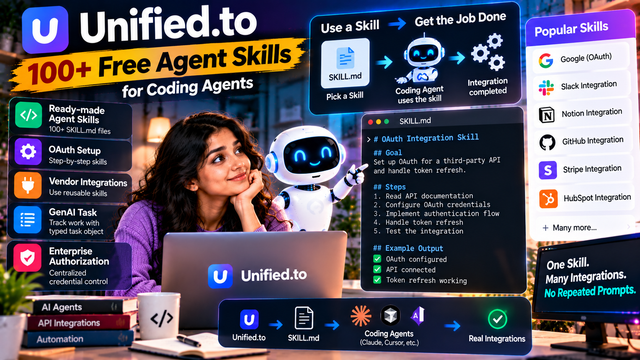
Coding agents are getting a new way to handle repetitive integration work. Unified.to has published more than 100 free Agent Skills in the form of reusable SKILL.md files that teach coding agents how to build common integrations and complete specific development workflows.
The idea is simple but important: instead of asking an AI coding agent to figure out the same API integration from scratch every time, developers can give the agent a reusable skill containing the instructions it needs.
Unified.to says its Agent Skills cover common integration tasks and include the endpoints, authentication, pagination, SDK usage and synchronization patterns an agent needs to build against its API. More than 80 of the published skills focus on registering OAuth2 applications through vendor developer portals.
That changes the workflow from:
“AI, figure out how to integrate this API.”
to:
“AI, load this skill and follow the integration workflow.”
A SKILL.md file can effectively act as a reusable instruction package. Once installed, compatible coding agents such as Claude Code, Cursor, Codex, GitHub Copilot and Windsurf can use these skills for development work. Unified.to also provides installation through its open-source skills CLI.
The update goes beyond reusable instructions. Unified.to has also introduced a typed GenAI Task object for applications that delegate work to cloud coding agents. A task can contain instructions, status, repository information, branches, pull-request results and other details about the work performed by an agent. The system supports multiple agent integrations, including Claude Agents, Cursor, Devin, Google Jules, Codegen and others.
Unified.to has also added Enterprise-Managed Authorization, giving organizations a way to centrally control authorization policies while allowing employees to connect their accounts within those policies.
Together, these changes point toward a bigger shift in AI-assisted software development.
Prompt engineering is increasingly becoming reusable infrastructure.
Instead of repeatedly writing long instructions for an AI agent, developers can package expertise into skills that agents can load and reuse. That makes the agent more consistent and can reduce the amount of repetitive context developers need to provide.
For developers and students learning AI automation, SKILL.md is therefore worth watching. It represents a practical bridge between simple prompts and structured agent workflows.
The future of coding agents may not be about giving them better prompts every time. It may be about giving them a growing library of reusable skills.