New Relic AI Evaluation: Monitor AI Quality and Safety
New Relic AI Evaluation helps developers monitor AI response quality, detect security risks,troubleshoot RAG applications,and improve production AI reliability.
Source: https://www.expresscomputer.in/news/new-relic-ai-evaluation-ai-observability/139739/
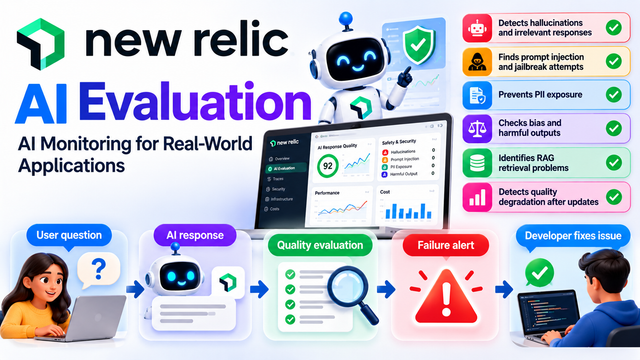
New Relic AI Evaluation: A New Approach to Monitoring AI Quality and Safety
Introduction
Artificial intelligence is becoming an important part of modern software. Businesses are adding AI chatbots, virtual assistants, document search systems, coding assistants, and retrieval-augmented generation (RAG) applications to their products. These systems can answer questions, summarize information, and help users complete tasks.
However, deploying an AI application introduces a new challenge. A traditional application can often be monitored by checking whether its servers are running, how quickly its pages load, and whether its APIs return errors. An AI application requires additional checks because it can appear technically healthy while producing an incorrect, irrelevant, biased, or unsafe answer.
New Relic introduced AI Evaluation on October 9, 2026, as part of its AI Observability platform, according to Express Computer. The capability connects AI response evaluation with application performance, security monitoring, execution traces, and cost information.
The goal is to help development teams understand not only whether an AI application is running, but also whether it is delivering useful and appropriate results.
What Is New Relic AI Evaluation?
New Relic AI Evaluation is designed to help teams assess the quality and safety of AI applications operating in production environments.
Production refers to the environment in which real users interact with a deployed application. An AI chatbot may perform well during a small demonstration but encounter unfamiliar questions, unexpected instructions, incomplete information, or unusual user behaviour after launch.
AI evaluation helps teams identify these problems by assessing the application's responses against selected quality and safety criteria.
New Relic's AI Observability approach connects evaluation results with telemetry from the application. Telemetry is information collected about a system's operation, including traces, performance measurements, errors, and resource usage.
When these signals are connected, developers can investigate an AI failure in greater detail. For example, if a chatbot produces an inaccurate answer, a developer may need to examine the model response, the retrieved documents, the sequence of tool calls, and the application's latency or cost.
This broader view can make troubleshooting more informative than relying on response text or infrastructure alerts alone.
What Problems Can AI Evaluation Help Detect?
1. Hallucinations and irrelevant responses
AI hallucinations occur when a model produces information that is incorrect, unsupported, or misleading. An answer can sound convincing even when the information behind it is unreliable.
Imagine a college chatbot that provides the wrong examination date or invents an eligibility requirement. The application may return a response successfully, but the answer could still mislead a student.
AI evaluation can assess responses for relevance, correctness, and alignment with expected information. Depending on the evaluation method and available reference data, it can help teams identify responses that deserve further investigation.
Evaluation does not guarantee that every false statement will be detected. Its effectiveness depends on the criteria, reference information, and testing approach.
2. Prompt injection and jailbreak attempts
Prompt injection occurs when instructions supplied through user input or external content attempt to manipulate an AI system into ignoring its intended rules. Jailbreak attempts similarly seek to bypass restrictions placed on a model.
For example, a user might try to persuade a customer-support agent to reveal confidential instructions or perform an action outside its permissions.
AI security monitoring can help teams identify suspicious inputs and potentially unsafe outputs. Developers should also use appropriate access controls, input handling, tool permissions, and other security measures.
Evaluation is one layer of protection, not a replacement for secure system design.
3. Exposure of personally identifiable information
Personally identifiable information, or PII, includes information that can identify a person, such as certain account details, contact information, or government-issued identifiers.
An AI assistant connected to internal company records must handle such information carefully. If it exposes a private record to an unauthorized user, the consequences may include privacy violations and loss of trust.
AI evaluation can help identify potential PII exposure in model inputs and outputs. Organizations should combine these checks with data minimization, permission controls, secure storage, and appropriate privacy policies.
4. Bias and harmful outputs
AI applications may generate unfair, offensive, or harmful content. The risk depends on the model, its training and configuration, the information provided, and the task being performed.
For instance, a recruitment assistant should not unfairly favour or disadvantage applicants because of irrelevant personal characteristics.
Evaluation criteria can help teams assess outputs for specified forms of bias and harmful content. Human review remains important for complex situations where fairness and context cannot be captured adequately by a simple score.
5. Retrieval problems in RAG applications
Retrieval-augmented generation, commonly called RAG, combines information retrieval with AI-generated responses. Before answering a question, a RAG application retrieves relevant content from documents, databases, or other knowledge sources.
Consider a business chatbot that answers questions using a company's internal policies. If the retrieval system selects an outdated policy or misses the relevant document, the model may generate an incorrect answer even if its language sounds natural.
Evaluation can help teams investigate whether retrieved information is relevant and whether the final response uses the available evidence appropriately.
Developers should examine retrieval quality, document freshness, ranking, access permissions, and how the model uses retrieved information.
6. Quality degradation after model updates
AI systems can behave differently after a model change, prompt adjustment, knowledge-base update, or workflow modification.
A new model might improve performance on one type of question while producing worse results on another. This is why developers need regression testing: checking that a change has not damaged functionality that previously worked.
AI evaluation can help teams compare response quality over time and identify potential degradation. A consistent evaluation process is particularly useful for applications that change frequently.
How Does the Monitoring Workflow Work?
A simplified workflow looks like this:
User question → AI response → Quality evaluation → Failure alert → Developer investigates and fixes the issue.
First, a user submits a question to the AI application. The application processes the request and returns a response.
Next, configured evaluation checks assess the response against relevant criteria. Depending on the system and configuration, these checks may examine accuracy, relevance, safety, privacy, or other quality dimensions.
If a problem is identified, the team can investigate the associated application traces and supporting telemetry. These details may help reveal whether the failure came from retrieval, model behaviour, a tool call, an application error, or another component.
Finally, the developer makes an appropriate change and tests the application again.
This process creates a feedback loop that supports ongoing improvement. It is especially useful when a system serves many users and developers cannot manually inspect every interaction.
How Is AI Evaluation Different from Traditional Monitoring?
Traditional application monitoring primarily focuses on technical health. It helps teams identify issues such as slow responses, unavailable servers, failed requests, infrastructure problems, and elevated resource usage.
AI evaluation adds another layer: the quality and safety of the actual AI behaviour.
For example, a conventional monitor might report that a chatbot responded in 400 milliseconds without generating a server error. An AI evaluation system might separately identify that the answer was irrelevant or unsupported.
Both perspectives matter. A technically healthy system can still deliver poor results, while an accurate model can still provide a bad user experience if its application is slow or unreliable.
Connecting these perspectives can help teams understand the relationship between response quality, application behaviour, security signals, and operating costs.
Why This Matters for Indian Businesses and Startups
Indian companies are developing AI-powered customer support, enterprise search, education tools, financial services, healthcare applications, and business automation workflows.
As adoption grows, reliability becomes an important consideration. An incorrect answer from a casual experimentation tool may be inconvenient, but an incorrect response from a business-critical application can affect customers, employees, and operational decisions.
For startups, structured evaluation can help establish quality checks before an AI product reaches a larger audience. For established businesses, observability can support troubleshooting across more complex systems.
Companies handling sensitive information must also consider applicable privacy requirements, access controls, auditability, and security practices.
AI evaluation is not a guarantee of compliance or complete protection. Instead, it can contribute to a broader process of identifying risks, investigating failures, and improving system behaviour.
Opportunities for Students and Developers
This development also provides a useful learning opportunity for students interested in computer science, AI, machine learning, and cybersecurity.
Students can practise building a small chatbot, testing it with different questions, recording incorrect answers, and measuring how often it follows the intended instructions.
Those interested in RAG can create a document-question-answering application and test whether it retrieves the correct source before generating an answer.
Developers can also explore evaluation datasets, automated testing, tracing, prompt-injection defence, privacy checks, and regression testing.
These skills are relevant because real-world AI engineering involves more than writing prompts. Developers must understand how systems behave after deployment and how to identify failures systematically.
Limitations and What to Watch Next
Automated evaluation has limitations. A quality score depends on what is measured, how the evaluation is configured, and whether the tests represent real-world usage.
Some responses require contextual judgement, while subtle hallucinations may be difficult to identify without reliable reference information. Security threats can also evolve, so evaluation rules need regular review.
Teams should avoid treating a single score as proof that an application is completely safe or accurate. Human review, application-level security, monitoring, and repeated testing remain important.
It will be useful to watch for independently documented customer results, measurable changes in defect detection, the practical cost of evaluation, and how well the system supports different models and RAG architectures.
Conclusion
New Relic AI Evaluation highlights a significant shift in AI development: monitoring an AI application requires examining the quality of its decisions and responses, not just its technical availability.
By connecting response evaluation with application traces, performance, security, and costs, the approach aims to help developers understand why AI systems fail and where improvements may be needed.
For businesses, the lesson is to establish measurable quality and safety requirements before scaling AI applications. For students, it is an opportunity to learn AI testing and observability. For developers building chatbots, RAG systems, and AI-powered software, continuous evaluation can become an important part of maintaining reliable production systems.
As AI becomes more deeply integrated into everyday software, the ability to observe, evaluate, and improve its behaviour will be an increasingly valuable engineering skill.
Source: Express Computer — New Relic AI Evaluation and AI Observability.