Microsoft Warns of AI Data-Centre Supply Chain Risks
Microsoft is warning that restrictions on Chinese optical transceivers could disrupt AI data-centre expansion. Discover why networking hardware, supply chains, and infrastructure matter for the future of AI.
By Gangothri
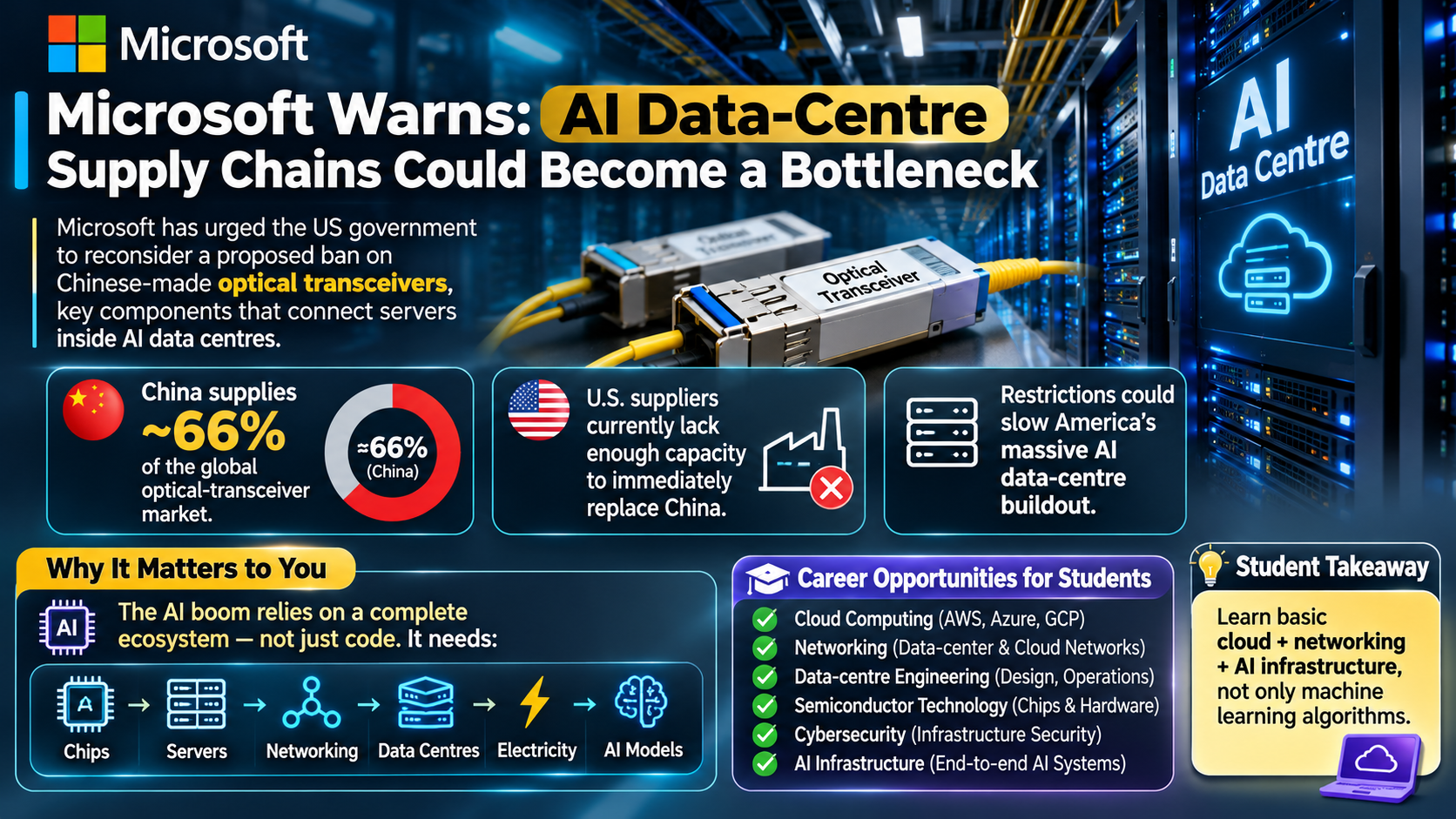
Microsoft Warns AI Data-Centre Supply Chains Could Become a Major Bottleneck
Artificial intelligence is growing rapidly, and companies around the world are investing billions of dollars in AI models, powerful servers, advanced chips, and massive data centres. However, an important challenge is emerging behind this technology boom: the physical infrastructure required to operate artificial intelligence systems may become difficult to obtain.
Microsoft is reportedly urging the United States government to reconsider a proposed restriction on Chinese-made optical transceivers, according to a Reuters report published on November 10, 2026.
Optical transceivers are small but essential networking components that help servers communicate with one another using light signals. They play a major role in modern cloud infrastructure and AI data centres, where thousands of servers need to exchange enormous amounts of information quickly.
The concern is that China currently supplies approximately two-thirds of the global optical-transceiver market. If restrictions are introduced before alternative suppliers can meet demand, companies building AI infrastructure could face supply shortages, higher costs, and construction delays.
This development highlights an important reality: the future of artificial intelligence will depend not only on advanced software and machine-learning models but also on the availability of physical hardware, networking equipment, electricity, and reliable global supply chains.
1. What exactly is happening?
Microsoft is concerned about a proposed US restriction involving Chinese-made optical transceivers used in data-centre infrastructure.
The company reportedly believes that restricting these components could create difficulties for the expansion of AI data centres in the United States.
The reason is relatively straightforward. China currently has a major position in the global optical-transceiver manufacturing market. According to the figures cited in the report, Chinese suppliers account for approximately 66% of worldwide supply.
Meanwhile, US manufacturers may not currently have enough production capacity to immediately replace Chinese suppliers if restrictions are introduced.
This creates a difficult situation for technology companies.
On one side, governments want to protect important technology infrastructure and reduce dependence on foreign suppliers. On the other side, companies need access to affordable components to build and operate data centres.
Microsoft's reported position highlights the importance of considering supply-chain capacity before introducing restrictions that could affect essential technology components.
The discussion is not simply about one company or one product. It concerns the relationship between national security, international trade, manufacturing capacity, and the future growth of artificial intelligence.
2. What are optical transceivers?
To understand why Microsoft is concerned, it is important to understand what an optical transceiver actually does.
An optical transceiver is a networking device that converts electrical signals into optical signals and optical signals back into electrical signals.
In simple terms, it allows computers and servers to communicate using light travelling through optical fibre cables.
Imagine a large AI data centre containing thousands of servers. These servers must constantly exchange information. One server might process a part of an AI model, while another server handles a different calculation.
All these systems need to communicate quickly and reliably.
Optical transceivers help make this communication possible.
They are commonly used in high-speed networking equipment, including switches, routers, and data-centre interconnections.
Their main functions include:
Converting electrical information into light signals.
Sending information through optical fibre cables.
Converting incoming light signals back into electrical information.
Supporting high-speed communication between servers.
Helping data centres transfer enormous quantities of information.
Without efficient networking components, even powerful servers may struggle to work together effectively.
This is particularly important for AI systems because advanced AI workloads often require multiple processors and servers to exchange information continuously.
3. Why do AI data centres need so many networking components?
Modern AI systems are becoming increasingly complex.
Training a large language model can require thousands of specialised processors working together. These processors may be distributed across many servers and connected through high-speed networking systems.
For example, when a company trains a large AI model, different computers may process different portions of the training workload.
Those computers need to exchange information about calculations, model parameters, and intermediate results.
If communication between servers becomes slow, the entire training process can become less efficient.
This is why data-centre networking is such an important part of AI infrastructure.
The performance of an AI data centre depends on several connected components:
1. GPUs and AI accelerators: These process the mathematical calculations required for training and running AI models.
2. Servers: These provide the computing systems that contain processors, memory, storage, and networking connections.
3. Networking switches: These direct information between connected devices and servers.
4. Optical transceivers: These enable high-speed communication through optical fibre connections.
5. Storage systems: These store datasets, model files, and other information needed by AI applications.
6. Electricity and cooling: These provide the power and temperature management required to operate large computing facilities.
Every component contributes to the overall performance of the system.
A shortage of one essential component can affect the entire infrastructure project.
4. Why is China's position in optical-transceiver manufacturing important?
China has developed a significant manufacturing position in several technology supply chains.
According to the Reuters report cited in this story, Chinese manufacturers supply approximately two-thirds of the global optical-transceiver market.
This level of market concentration creates a potential supply-chain risk.
When a particular country or group of manufacturers supplies a large share of an important component, other countries may find it difficult to replace that supply immediately.
Manufacturing capacity cannot be created overnight.
Companies need factories, specialised machinery, skilled workers, suppliers, testing facilities, quality-control systems, and investment.
Even if alternative manufacturers are available, they may not have sufficient production capacity to meet sudden increases in global demand.
This is particularly important because demand for AI infrastructure is growing rapidly.
Cloud providers, technology companies, research institutions, and enterprises are investing in facilities that require advanced networking hardware.
If access to optical transceivers becomes restricted, companies may have to search for alternative suppliers, negotiate new contracts, or delay infrastructure expansion.
The issue therefore demonstrates why manufacturing capability is becoming strategically important in the global AI economy.
5. Why is Microsoft concerned about the proposed restrictions?
Microsoft is one of the major companies investing in cloud computing and AI infrastructure.
Its cloud services and AI products depend on large-scale data centres containing servers, networking equipment, storage systems, and other specialised hardware.
A restriction on an important component could make infrastructure expansion more complicated.
There are several possible concerns.
A. Limited alternative manufacturing capacity
If Chinese suppliers currently provide a large share of the market, alternative manufacturers may not be able to immediately produce enough components to replace them.
Building new manufacturing capacity requires time and significant investment.
B. Higher infrastructure costs
If supply becomes limited, companies may need to pay more for available components.
Higher hardware costs could increase the overall expense of building and maintaining AI data centres.
C. Delays in data-centre construction
Data-centre projects depend on the availability of many components.
Even if a company has sufficient funding, land, electricity, and servers, a shortage of essential networking hardware could delay the completion of a facility.
D. Greater uncertainty for technology companies
Technology companies plan infrastructure investments years in advance.
Uncertainty about access to important components can make purchasing decisions, supplier agreements, and expansion plans more difficult.
These are potential risks associated with supply-chain restrictions. The actual impact would depend on the final policy, available alternatives, and how quickly manufacturers can increase production.
6. The connection between AI, chips, networking, and data centres
One of the biggest lessons from this development is that artificial intelligence is not only a software industry.
People often associate AI with applications such as ChatGPT, Claude, Gemini, image generators, and coding assistants.
However, these applications depend on a much larger technology ecosystem.
Consider the following chain:
Chips → Servers → Networking → Data Centres → Electricity → AI Models
Each stage has an important role.
Chips
GPUs and specialised AI processors perform the calculations required by AI systems.
Servers
Servers combine processors, memory, storage, and other components into systems that run applications and AI workloads.
Networking
Networking equipment connects servers and allows them to exchange information.
Data centres
Data centres provide the physical facilities where servers and networking equipment operate.
Electricity
Large computing facilities require reliable electricity to operate continuously.
AI models
The final result is the AI software that users interact with through websites, mobile applications, APIs, and enterprise platforms.
A weakness in any part of this chain can affect the entire system.
This is why optical transceivers, despite being much less visible than GPUs or AI models, are important to the future of artificial intelligence.
7. How could this affect the global AI industry?
The growing demand for AI infrastructure is creating pressure across the technology supply chain.
Companies are competing to secure GPUs, memory, networking equipment, storage systems, electricity, and data-centre capacity.
A supply-chain disruption involving optical transceivers could add another challenge to this environment.
Some possible consequences include:
More investment in alternative suppliers: Companies may look for manufacturers in different countries to reduce dependence on a limited number of suppliers.
Greater attention to domestic manufacturing: Governments may encourage local production of important networking and semiconductor components.
Higher importance of supply-chain planning: Technology companies may diversify suppliers and maintain better visibility into component availability.
More research into networking technology: Manufacturers may invest in faster, more efficient optical communication technologies.
Increased infrastructure costs: If demand exceeds available supply, component prices and project costs could come under pressure.
These are possible industry responses rather than confirmed outcomes. The extent of any impact will depend on future policy decisions and manufacturing developments.
8. What does this mean for India?
This development is particularly relevant to India because the country is expanding its digital infrastructure, cloud ecosystem, semiconductor ambitions, and AI capabilities.
India's technology industry has traditionally been strong in software services, IT consulting, and application development.
However, the growth of AI is increasing the importance of infrastructure-related capabilities as well.
Indian companies and startups need access to reliable cloud services, networking equipment, computing capacity, and data-centre infrastructure.
If global hardware supply chains experience disruption, Indian businesses could also face indirect effects through higher equipment costs, procurement delays, or changes in cloud infrastructure pricing.
At the same time, this situation highlights potential opportunities.
India can explore stronger capabilities in:
Semiconductor manufacturing and supporting industries.
Optical communication and networking technology.
Data-centre infrastructure and operations.
Cloud computing and infrastructure services.
Hardware testing and quality assurance.
Energy-efficient computing and cooling systems.
India does not need to manufacture every component immediately to benefit from this opportunity. It can also build expertise in testing, integration, software-defined networking, infrastructure management, and specialised engineering services.
The broader lesson is that a strong AI ecosystem needs both software innovation and reliable physical infrastructure.
9. Career opportunities for Indian students
For computer science and AI students, this news offers an important career lesson.
Learning machine-learning algorithms is valuable, but it should not be the only area of technical preparation.
The AI industry needs professionals who understand how computing systems communicate, operate, and scale.
Here are some useful career areas.
1. Cloud computing
Cloud engineers work with platforms such as Amazon Web Services, Microsoft Azure, and Google Cloud Platform.
They help organisations deploy applications, manage computing resources, configure infrastructure, and maintain reliable cloud services.
Useful topics include virtual machines, storage, networking, cloud security, and deployment.
2. Computer networking
Networking professionals work with the communication systems connecting computers, servers, and data centres.
Important topics include:
OSI and TCP/IP models.
IP addressing and subnetting.
Routing and switching.
DNS and DHCP.
Network security.
Fibre-optic communication fundamentals.
These subjects provide a foundation for understanding large-scale data-centre networks.
3. Data-centre engineering
Data-centre professionals help design, operate, monitor, and maintain computing facilities.
Their responsibilities may involve server infrastructure, networking, power systems, cooling, hardware maintenance, and operational reliability.
4. Semiconductor technology
Semiconductor engineers work with the technologies used to manufacture chips and electronic components.
Students interested in hardware can explore digital electronics, computer architecture, embedded systems, semiconductor fundamentals, and hardware testing.
5. Cybersecurity
Large data centres contain valuable information and computing resources.
Cybersecurity professionals protect networks, servers, applications, and cloud environments from attacks and unauthorised access.
6. AI infrastructure engineering
AI infrastructure engineers help build and manage the systems required to train, deploy, and operate AI models.
This area combines knowledge of cloud platforms, GPUs, distributed computing, networking, Linux, containers, and AI workloads.
It is an especially useful direction for students interested in both software and infrastructure.
10. A practical learning roadmap for students
Students do not need to learn everything at once.
A structured learning plan can help build the required foundation.
Step 1: Strengthen computer networking
Start with the OSI model, TCP/IP, IP addressing, routing, switching, and network troubleshooting.
Step 2: Learn Linux fundamentals
Understand Linux commands, file permissions, processes, services, package management, and basic shell scripting.
Step 3: Explore cloud computing
Choose one beginner-friendly cloud platform and learn how to create virtual machines, configure storage, deploy applications, and manage basic networking.
Step 4: Understand server infrastructure
Learn about CPUs, GPUs, RAM, storage, server architecture, and how multiple computers work together.
Step 5: Explore containers and distributed systems
Study Docker fundamentals, container deployment, distributed computing, and how applications scale across multiple machines.
Step 6: Connect infrastructure with AI
Try deploying a simple machine-learning application or connecting an AI API to a cloud-hosted application.
This will help you understand how software, networks, servers, and AI models work together.
11. Project ideas to build practical skills
Students can strengthen their understanding by building small projects.
Here are five beginner-friendly ideas:
Project 1: Cloud-hosted AI chatbot
Build a simple chatbot using an AI API and deploy it on a cloud platform. Learn application deployment, API integration, and cloud configuration.
Project 2: Network monitoring dashboard
Create a basic dashboard that monitors network connectivity, response times, and system status.
Project 3: Server performance monitoring tool
Use Python to collect CPU usage, memory usage, disk usage, and other system metrics.
Project 4: Cloud file-storage application
Build a small application that uploads, stores, and retrieves files using cloud storage services.
Project 5: AI infrastructure cost estimator
Create a simple tool that estimates computing, storage, and networking costs for a hypothetical AI application.
These projects can help students demonstrate practical knowledge during internships and technical interviews.
12. What should technology companies watch next?
The optical-transceiver issue is one example of a larger challenge facing the AI industry.
As data centres become larger, companies will need to pay greater attention to the availability of specialised hardware.
Several developments deserve attention:
Whether the proposed US restrictions move forward.
Whether alternative optical-transceiver manufacturers increase production.
Whether companies diversify their hardware suppliers.
Whether optical networking technologies become more efficient.
Whether governments invest more in domestic technology manufacturing.
Whether data-centre construction costs increase because of component shortages.
The outcome could influence how quickly companies expand their AI infrastructure and how they plan future investments.
Conclusion: The future of AI depends on more than algorithms
Microsoft's reported concerns about Chinese-made optical transceivers reveal an important part of the AI revolution that many people overlook.
Behind every AI chatbot, image generator, coding assistant, and intelligent application is a complex infrastructure system involving chips, servers, networking equipment, electricity, and data centres.
If even one essential component becomes difficult to obtain, the effects can reach across the technology industry.
For Indian students, the message is clear: do not focus only on building AI models. Develop a broader understanding of cloud computing, computer networks, Linux, distributed systems, cybersecurity, and AI infrastructure.
The next generation of technology professionals will need to understand not only how AI works, but also how the systems supporting AI are built, connected, secured, and operated.
The future of artificial intelligence will be shaped by both intelligent software and the infrastructure that makes it possible.