India's AI Market Is Shifting From Hype to Real and cinematical ROI
India's AI conversation is moving beyond tool adoption towards measurable business results, efficiency and growth.
By @admin
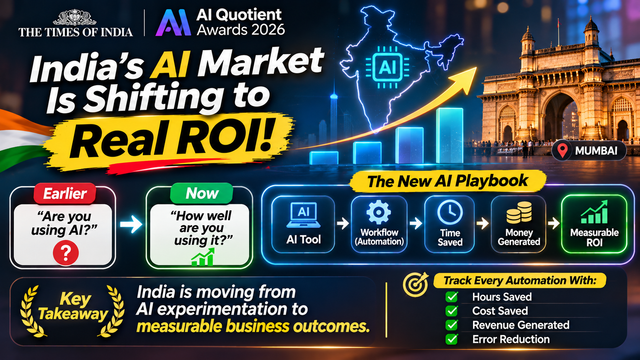
India's AI Market Is Shifting From Hype to Real ROI: Why Business Results Matter More Than AI Tools
India's artificial intelligence ecosystem is entering an important phase. Over the past few years, businesses have been experimenting with AI chatbots, content generators, predictive analytics, automation platforms and machine learning systems. Many organisations have tested new tools, launched pilot projects and explored how AI could change their operations.
But an important question is now becoming central to the conversation: What measurable result is AI actually delivering?
That was one of the major themes of The Times of India's AI Quotient Awards 2026, held in Mumbai on September 10. The event brought together enterprises, startups and technology leaders to recognise organisations using AI to create measurable business impact.
The discussion reflected a broader shift in how businesses are evaluating artificial intelligence. Instead of simply asking whether an organisation uses AI, decision-makers increasingly want to understand how effectively it uses the technology and whether it improves real business outcomes.
This shift could influence how Indian companies invest in AI, how startups build products and how professionals develop their skills.
1. The AI conversation is changing in India
When generative AI tools became widely accessible, businesses quickly began exploring their possibilities.
Marketing teams experimented with AI-generated content. Customer-support departments tested chatbots. Developers started using coding assistants. Businesses explored document processing, data analysis and automated reporting.
These experiments helped organisations understand what AI could do.
However, adopting a tool and successfully transforming a business are two different things.
A company might introduce an AI chatbot but still have customers waiting too long for support. A marketing agency might generate hundreds of social media posts but fail to increase sales. A business might automate a report without improving the decisions made from that report.
This is why the discussion is moving towards measurable outcomes.
The important questions are becoming:
- How many working hours did the automation save?
- Did the business reduce operating costs?
- Did customer response times improve?
- Did revenue or conversion rates increase?
- Were errors reduced?
- Can the solution work reliably at a larger scale?
AI adoption becomes much more meaningful when organisations can answer these questions with evidence.
2. What happened at the AI Quotient Awards 2026?
The Times of India's AI Quotient Awards 2026 took place in Mumbai on September 10.
The awards recognised enterprises, startups and leaders using artificial intelligence to create meaningful business impact. The programme covered 34 awards across four broad tracks: Industry Awards, Functional AI Excellence, Maturity-Based Awards and Special Jury Awards.
The categories covered several areas of business and technology, including:
- Banking, financial services and insurance
- Retail and commerce
- Healthcare and wellness
- Manufacturing and supply chains
- Media and content
- Software and digital platforms
- Marketing and personalisation
- Customer experience
- Operations and efficiency
- Decision intelligence
- Responsible AI and social impact
The event's message was broader than celebrating companies that had adopted new technology. It focused on recognising organisations that were translating AI capabilities into practical results.
The judging framework also reflected that approach. Business value, technical innovation, scalability, governance and human-machine collaboration were among the important evaluation considerations.
In other words, having an AI feature is not enough. Organisations need to demonstrate that the technology works, creates value and can be deployed responsibly.
3. From AI tools to complete business workflows
One of the biggest mistakes businesses make when adopting AI is focusing too much on individual tools.
A business owner might ask which AI chatbot is best, which image generator produces the best results or which automation platform is trending.
Those questions can be useful, but they are not the starting point for a successful AI strategy.
The better starting point is identifying a repetitive business problem.
Consider a small digital marketing agency.
Its employees may spend hours every week collecting leads, organising customer information, preparing campaign reports and following up with potential clients.
Instead of simply purchasing an AI subscription, the agency could build a complete workflow:
Step 1: Capture leads
Collect enquiries from website forms, social media and other permitted channels.
Step 2: Organise information
Store the lead's name, contact details, requirements and source in a CRM system.
Step 3: Qualify enquiries
Use an AI model to classify the enquiry based on the customer's requirements and potential suitability.
Step 4: Prepare responses
Generate a relevant draft response for a team member to review.
Step 5: Follow up
Schedule reminders and send approved follow-up messages through authorised integrations.
Step 6: Measure performance
Track how many leads were processed, how much staff time was saved and how many enquiries became customers.
This is much more valuable than simply saying that the agency uses AI.
The technology is connected to an actual business process, and its performance can be evaluated.
4. How should businesses measure AI ROI?
Return on investment, commonly called ROI, measures whether the value generated by an investment justifies its cost.
For AI projects, businesses should track both financial and operational improvements.
Here are four useful measurements.
A. Hours saved
Suppose a business employee spends 10 hours every week preparing reports. An automation reduces the task to three hours.
The business saves seven working hours per week.
Across a team of five employees, that could mean 35 working hours saved every week, assuming the same improvement applies to each person.
The business can then decide how to use that additional capacity.
B. Cost saved
Consider a company spending ₹30,000 per month on a repetitive process.
After introducing an automation, its software and operating expenses are ₹8,000 per month, while the remaining human review costs ₹7,000.
The total new cost is ₹15,000.
The monthly saving is therefore ₹15,000, assuming the comparison includes all relevant costs.
But businesses must also account for implementation, maintenance, training and monitoring. Ignoring those expenses can make an automation look more profitable than it really is.
C. Revenue generated
AI can also support revenue growth.
For example, an e-commerce company could use AI to analyse customer behaviour and improve product recommendations. A marketing agency could automate lead qualification and help its sales team respond faster.
However, an increase in sales should not automatically be credited to AI. Businesses should compare results against a suitable baseline and consider other factors that may have influenced revenue.
D. Errors reduced
Automation can reduce manual data entry and repetitive mistakes.
A company processing hundreds of invoices might use document extraction to capture important information before a human verifies it.
Useful measurements include incorrect records, processing time, rejected transactions and the number of documents requiring manual correction.
Accuracy matters because a fast automation that produces unreliable results can create additional work rather than remove it.
5. Why Indian startups and small businesses should pay attention
Large enterprises may have dedicated AI departments, infrastructure budgets and specialist teams. Small businesses usually operate with tighter budgets and fewer employees.
That makes practical AI adoption particularly important for smaller organisations.
A small business does not necessarily need to build its own large language model. It may get more value from connecting existing AI services to its daily operations.
For example:
A local retail business could automate product descriptions, customer enquiry classification and stock alerts.
A digital marketing agency could streamline content planning, lead management, reporting and campaign analysis.
An educational institute could organise student enquiries, generate practice material and support administrative workflows.
A service business could automate appointment reminders, enquiry routing and customer feedback analysis.
The important point is that these systems should solve specific problems. They should also include appropriate human review, data protection and error-handling processes.
For Indian businesses, the opportunity is not simply to use more AI. It is to use AI where it produces a clear improvement.
6. The next opportunity: AI agents and automation
The move towards measurable AI outcomes also creates an opportunity for AI agents.
Traditional software often follows predefined steps. An AI-powered agent can interpret a request, use connected tools and complete parts of a workflow within defined permissions.
For example, a business might ask an AI assistant to prepare a weekly sales report.
The system could retrieve authorised sales data, calculate totals, identify unusual changes and prepare a summary for a manager.
But a reliable system still needs safeguards.
It should have controlled access to business data, clear permissions, activity logs, validation checks and human approval for sensitive actions.
An AI agent that produces a report is useful. An agent that produces an incorrect report and sends it to customers without review can create serious problems.
This is why successful AI automation is not just about connecting tools. It requires workflow design, testing, monitoring and accountability.
7. What students and aspiring AI professionals should learn
This shift also changes what students should focus on.
Learning the names of popular AI tools is not enough to build a long-term career.
Businesses need people who can identify problems, design workflows, connect APIs, manage data and evaluate whether an AI system is producing reliable results.
A useful learning path could include:
1. AI fundamentals: Understand what language models, machine learning systems and AI agents can and cannot do.
2. Programming: Learn Python, JavaScript or another language suitable for building applications and integrations.
3. APIs: Understand how different services communicate with one another.
4. Automation platforms: Learn how to connect applications and design repeatable workflows.
5. Databases: Understand how business information is stored, retrieved and protected.
6. Evaluation: Measure accuracy, reliability, cost, response time and business impact.
7. Deployment: Build systems that can operate reliably beyond a personal demonstration.
A strong portfolio should show complete projects with measurable outcomes.
For example, instead of writing "I know AI automation" on a resume, demonstrate a lead-management workflow and explain how much processing time it saved in a realistic test.
That is a much stronger way to communicate practical ability.
8. The real future of AI in India is measurable impact
The AI Quotient Awards 2026 highlighted an important change in India's AI conversation.
The first wave of adoption was about discovering what the technology could do. The next phase is about integrating it into products, operations and business decisions.
That does not mean experimentation is finished. Businesses still need to test new ideas and explore emerging capabilities.
But experiments should lead to something useful: better customer experiences, lower costs, faster processes, improved decisions or new sources of revenue.
For startups, this means building solutions around actual customer problems rather than launching another product simply because it contains AI.
For established companies, it means evaluating AI projects with clear performance indicators and responsible governance.
For students and developers, it means learning to build complete systems instead of stopping at prompts and demonstrations.
And for creators, it means showing audiences how AI can solve real problems rather than producing endless lists of trending tools.
The next important question for every business is not simply, "Are you using AI?" It is: "What measurable result is AI delivering?"