India's AI Data Centre Capacity Set to Grow 5X by 2030
India's data centre capacity could reach 7.5 GW by 2030, attracting over ₹3 trillion in investment. Discover how AI infrastructure expansion could transform technology careers, cloud computing and India's digital economy.
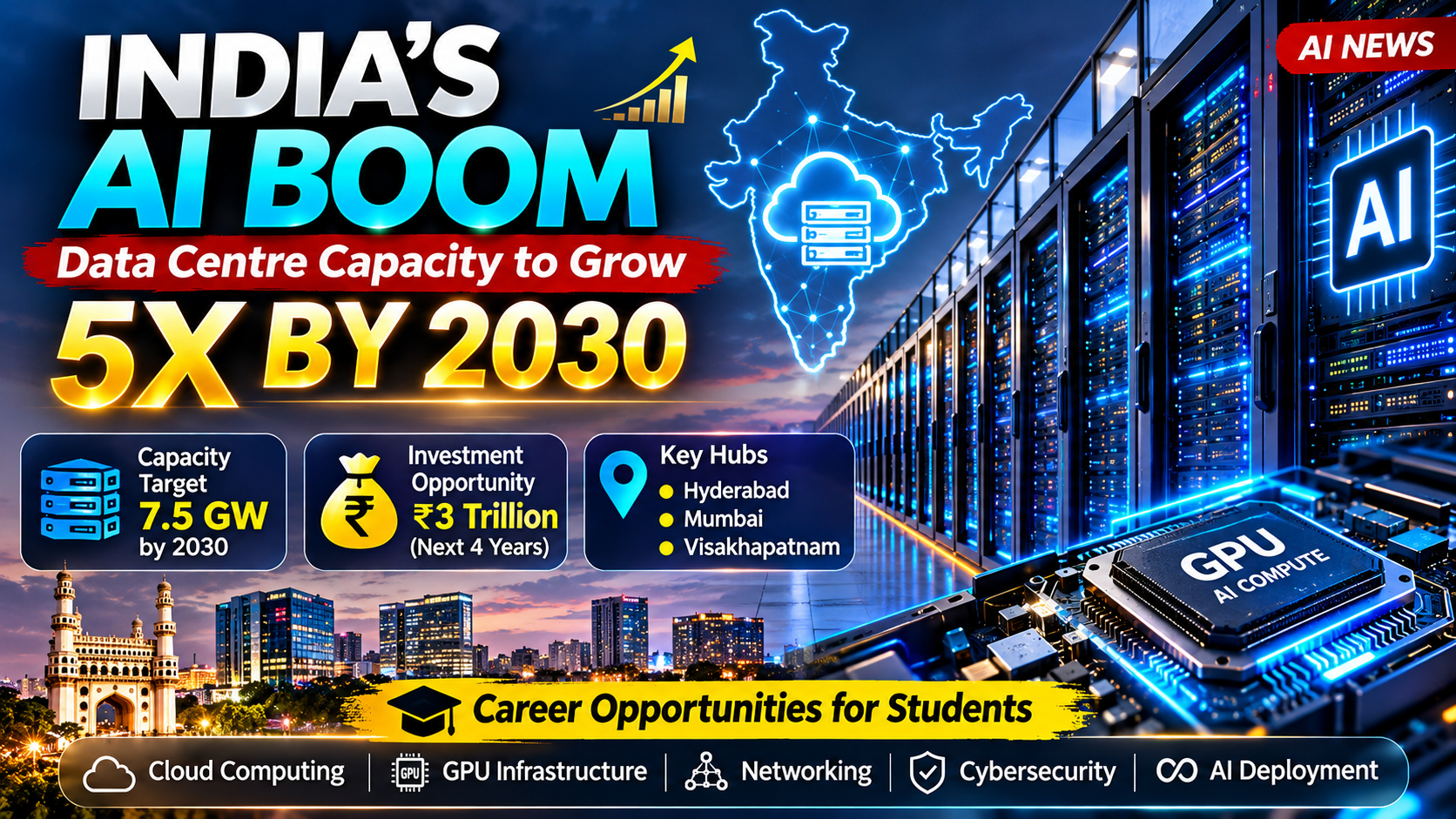
India's AI Data Centre Boom: Capacity Could Grow 5X by 2030 as ₹3 Trillion Investment Approaches
Published: November 2026
Reading time: Approximately 10–12 minutes
Category: India AI | AI Infrastructure | Technology Careers
Introduction: The infrastructure behind India's AI revolution
Artificial intelligence is rapidly changing how people work, study, communicate and do business. From AI chatbots and image generators to autonomous agents and enterprise automation, AI-powered applications are becoming part of everyday life.
However, there is something important that many people overlook: AI cannot operate at a massive scale without powerful physical infrastructure.
Behind every AI-generated image, chatbot response, automated business workflow and advanced machine-learning model, there are computers, processors, storage systems, networks and enormous amounts of electricity.
These systems operate inside specialised facilities known as data centres.
India is preparing for a major expansion of this infrastructure. According to a Crisil Ratings estimate reported by Mint on November 6, 2026, India's data centre capacity could increase five-fold to approximately 7.5 gigawatts (GW) by March 2030. The expansion could attract more than ₹3 trillion in investment over the next four years.
This development is significant because it connects India's AI ambitions with infrastructure investment, employment opportunities, cloud computing, semiconductor technology and digital transformation.
It also raises an important question for students and technology professionals: Are the next major opportunities in AI going to come from building AI applications, or from building the infrastructure that makes those applications possible?
The answer could involve both.
1. What exactly is happening in India's data centre industry?
India's data centre industry is entering a new phase of expansion.
Companies are investing in facilities that can store enormous quantities of information, process complex workloads and support the growing demand for digital services.
The reported projection suggests that India's total data centre capacity could reach approximately 7.5 GW by March 2030, representing a five-fold increase.
The investment opportunity is estimated to exceed ₹3 trillion over four years.
This expansion is being driven by three major developments:
A. Growing artificial intelligence demand
Modern AI systems require significantly more computing resources than many traditional applications.
Training advanced AI models requires powerful processors, specialised GPUs, large datasets and high-performance computing systems.
Even after training, AI models need computing resources to generate responses for millions of users.
This process is called inference.
As more businesses adopt AI assistants, automated customer support, recommendation systems and generative AI applications, the demand for computing infrastructure increases.
B. Digital transformation of businesses
Indian companies are increasingly moving their operations towards digital platforms.
Banks, hospitals, educational institutions, e-commerce companies, telecom operators and government organisations depend on digital infrastructure.
They need reliable facilities to store data, operate applications, process transactions and maintain business continuity.
C. Increasing cloud computing adoption
Businesses do not always want to purchase and maintain their own expensive servers.
Instead, they use cloud platforms to access computing power, storage and software through the internet.
Cloud service providers need data centres to deliver these services.
As cloud adoption increases, infrastructure providers need to expand their facilities.
These three developments are creating demand for larger and more advanced data centres across India.
2. Why are data centres becoming essential for AI?
Imagine asking an AI assistant to generate a detailed image.
The application receives your request, processes it using an AI model and returns the generated result.
This requires computing resources.
Now imagine millions of people making similar requests simultaneously.
A normal computer cannot efficiently handle such a workload.
Large-scale AI applications depend on specialised infrastructure containing thousands of connected computing systems.
A modern AI data centre may include:
GPU servers for AI model training and inference.
CPU servers for general computing tasks.
High-speed networking equipment.
Large-scale storage systems.
Cooling infrastructure.
Backup power systems.
Security and monitoring equipment.
GPUs are particularly important because they can perform many mathematical operations simultaneously, making them useful for AI workloads.
Companies also need high-speed connections between servers so that large AI workloads can be distributed efficiently.
Without reliable infrastructure, even an excellent AI model may struggle to serve millions of users.
This is why data centres are becoming a strategic part of the global AI economy.
3. Why are companies investing more than ₹3 trillion?
The projected investment is not simply about constructing buildings.
A data centre is a highly specialised technology facility.
Developers need to invest in land, electrical systems, networking equipment, cooling technology, security systems and computing infrastructure.
Some of the major investment areas include:
Land and construction
Large facilities require suitable locations with reliable infrastructure, connectivity and access to electricity.
GPU and server infrastructure
AI-focused facilities need powerful servers equipped with specialised processors.
These systems can be expensive, especially when designed for high-density AI computing.
Electricity and power management
Data centres operate continuously and consume substantial amounts of electricity.
They need dependable power supplies, backup systems and efficient electrical distribution.
Cooling technology
High-performance servers generate considerable heat.
Without proper cooling, equipment may overheat, lose performance or become damaged.
Networking and connectivity
AI workloads often involve transferring large amounts of data between servers and external systems.
High-speed networking is therefore essential.
The investment opportunity extends beyond data centre operators.
Construction companies, electrical equipment manufacturers, networking providers, cooling technology companies and cybersecurity firms may also benefit from the expansion.
4. Hyderabad, Mumbai and Visakhapatnam could become important locations
One particularly interesting aspect of the reported development is its geographical impact.
According to the Mint report, Hyderabad, Mumbai and Visakhapatnam are expected to account for a significant share of upcoming capacity.
These cities are important because data centres need more than available land.
They require reliable electricity, high-speed connectivity, access to skilled professionals and a suitable business environment.
Hyderabad
Hyderabad has an established technology and enterprise ecosystem.
Its IT sector, engineering talent, connectivity and business infrastructure make it an important location to watch.
The city's potential role in data centre expansion could create opportunities across cloud engineering, networking, infrastructure management and cybersecurity.
Mumbai
Mumbai is an important financial and commercial centre.
Its concentration of financial institutions, enterprise businesses and connectivity infrastructure creates demand for secure and reliable data centre services.
Visakhapatnam
Visakhapatnam is another location to watch as India's digital infrastructure expands.
Its potential contribution to the data centre ecosystem could support regional technology development and infrastructure investment.
However, the actual pace of development will depend on electricity availability, connectivity, approvals and project execution.
For students in Telangana and other technology hubs, this is an important industry trend to follow.
5. The biggest challenge: Electricity and cooling
AI infrastructure requires enormous computing power.
But computing power creates two major challenges: electricity consumption and heat generation.
Data centres must operate continuously. An interruption in electricity can affect applications, business operations and critical digital services.
This makes power reliability one of the most important considerations for infrastructure developers.
Cooling is equally important.
Thousands of processors operating together generate heat. Advanced cooling systems are required to maintain suitable operating temperatures.
Some facilities use specialised air-cooling arrangements, while others explore liquid-cooling technologies for high-density computing environments.
Energy efficiency is becoming an important consideration for the industry.
Companies need to balance computing performance with electricity costs, environmental impact and operational reliability.
India's ability to expand AI infrastructure will therefore depend not only on financial investment but also on improvements in power generation, grid connectivity and efficient cooling technology.
6. What does this mean for India's AI industry?
India's AI ambitions cannot depend entirely on software applications.
The country also needs the infrastructure required to build, train, deploy and operate AI systems.
More domestic data centre capacity could support:
Indian startups building AI-powered products.
Businesses deploying machine-learning applications.
Cloud providers expanding their services.
Universities conducting advanced AI research.
Companies processing large datasets.
Organisations deploying enterprise AI agents.
Greater infrastructure availability could create more options for businesses that need computing resources.
However, additional capacity does not automatically mean cheaper AI services.
Pricing will also depend on electricity costs, hardware availability, competition, operating expenses and demand.
India will need investment in both computing infrastructure and the technical talent required to operate it.
7. Career opportunities: Skills students should start learning
This development is especially important for engineering students.
Many students believe that entering the AI industry means learning prompt engineering or building chatbot applications.
Those skills can be useful, but the AI industry includes several other career paths.
The growth of data centres creates opportunities in infrastructure, software, hardware, networking, security and cloud engineering.
Here are six skill areas worth exploring.
1. Cloud computing
Cloud engineers work with computing platforms, virtual machines, storage systems and cloud-based applications.
Students can begin with:
Cloud fundamentals.
Virtual machines.
Storage and databases.
Cloud networking.
Deployment and monitoring.
Popular learning platforms include AWS, Microsoft Azure and Google Cloud.
2. Linux and operating systems
Linux is widely used in servers and computing infrastructure.
Students should understand:
Linux commands.
File permissions.
Process management.
Shell scripting.
Server administration.
System monitoring.
Learning Linux provides a strong foundation for cloud engineering and infrastructure management.
3. Computer networking
Data centres depend on reliable communication between servers, storage systems and external networks.
Important topics include:
TCP/IP.
DNS.
Routing and switching.
Network security.
Load balancing.
Firewalls.
Networking knowledge is valuable for infrastructure and cybersecurity roles.
4. Python and automation
Python is useful for automating repetitive tasks, managing infrastructure and developing AI applications.
Students can practise writing scripts for:
System monitoring.
Log analysis.
Automated reporting.
API integration.
Infrastructure management.
5. GPU and AI infrastructure
Students interested in advanced computing can explore GPU architecture, parallel computing, CUDA fundamentals and distributed computing.
These technologies help developers understand how AI workloads use specialised hardware.
6. Cybersecurity
Large data centres store and process important information.
Security professionals help protect systems against unauthorised access, data breaches and cyberattacks.
Students can begin with networking fundamentals, Linux, system security and ethical cybersecurity practices.
8. A practical learning roadmap for engineering students
Students do not need to master every technology immediately.
A structured learning approach can help build practical skills.
Month 1: Build your foundation
Learn Linux basics, computer networking and Python fundamentals.
Practise using terminal commands and writing small automation scripts.
Month 2: Explore cloud computing
Choose one cloud platform and understand its basic services.
Create a virtual machine, deploy a simple application and learn how cloud storage works.
Month 3: Understand infrastructure
Study servers, CPUs, GPUs, networking, storage and cooling concepts.
Explore how modern data centres organise their systems.
Month 4: Build a practical project
Create a simple server monitoring dashboard using Python.
Track CPU usage, memory consumption, disk space and network performance.
Display the results through a basic dashboard.
Month 5: Explore AI deployment
Learn how to deploy a simple machine-learning application through a cloud environment.
Understand APIs, model inference and application monitoring.
Month 6: Prepare for opportunities
Build a GitHub portfolio, document your projects and practise technical interviews.
Look for internships and entry-level opportunities in cloud engineering, infrastructure, DevOps, networking and cybersecurity.
The objective is not simply to collect certificates.
It is to demonstrate that you can build, deploy, monitor and troubleshoot real technology systems.
9. Opportunities for startups and entrepreneurs
The data centre expansion could also create opportunities for Indian startups.
Not every startup needs to construct its own data centre.
Entrepreneurs can build products and services around the infrastructure ecosystem.
Some possibilities include:
AI infrastructure monitoring
Develop software that helps organisations monitor server performance, computing usage and system health.
Cloud cost optimisation
Create tools that help businesses understand and reduce unnecessary cloud expenditure.
Cybersecurity solutions
Build security monitoring and vulnerability management products for enterprise infrastructure.
Data centre cooling management
Explore software-based monitoring systems that help operators improve cooling efficiency.
AI deployment services
Help small and medium businesses deploy AI applications using cloud platforms and APIs.
These opportunities require technical knowledge, customer understanding and practical problem-solving.
10. Risks and challenges India must address
Despite the positive outlook, the expansion is not guaranteed to happen without challenges.
Electricity availability is a major concern because large computing facilities need dependable power.
Grid connectivity and infrastructure approvals can affect construction timelines.
High-density AI computing also increases cooling requirements and operating costs.
Another important challenge is the availability of trained professionals.
Building a data centre requires specialists across electrical engineering, networking, server administration, security and cloud operations.
India must also consider data protection, cybersecurity, environmental sustainability and responsible use of resources.
The industry needs to grow in a way that balances technological development with long-term infrastructure sustainability.
11. What should students and technology professionals do now?
The most important lesson from this development is that AI is becoming a complete technology ecosystem.
There are opportunities in software development, AI research, data engineering, cloud platforms, networking, cybersecurity and hardware infrastructure.
Students should avoid focusing on only one popular AI tool.
Instead, they should develop strong fundamentals and build projects that demonstrate their technical ability.
For example, a student who understands Python, Linux, networking and cloud computing can explore several different technology roles.
Someone interested in AI research can explore GPU computing and distributed systems.
Someone interested in business can investigate cloud cost management and AI deployment services.
The industry is changing, and professionals who understand how different technology components work together may have an advantage.
Conclusion: India's next AI opportunity may be built on infrastructure
India's projected five-fold increase in data centre capacity by 2030 represents an important development in the country's technology ecosystem.
The reported investment opportunity of more than ₹3 trillion highlights the growing importance of computing infrastructure.
AI applications may attract public attention, but the infrastructure supporting those applications is becoming equally important.
From GPUs and servers to electricity, cooling and networking, every component plays a role in making large-scale AI possible.
For engineering students, this is an opportunity to look beyond basic AI tools and develop practical technical skills.
For entrepreneurs, it creates opportunities to build services around cloud infrastructure, automation, monitoring and security.
For businesses, it highlights the importance of preparing for an increasingly digital and AI-driven economy.
The next generation of technology professionals will not only use AI. They will also build, deploy, secure and maintain the infrastructure that powers it.
Editorial note: The 7.5 GW capacity projection and investment estimate are reported forecasts attributed to Crisil Ratings, not guaranteed outcomes. Actual expansion will depend on market demand, power availability, investment and project execution.