India Warns of AI-Powered Cyberattacks on Financial Firms
CERT-In has warned about a cyber campaign using publicly available AI tools to automate attacks against Indian financial organisations.
By Gangothri
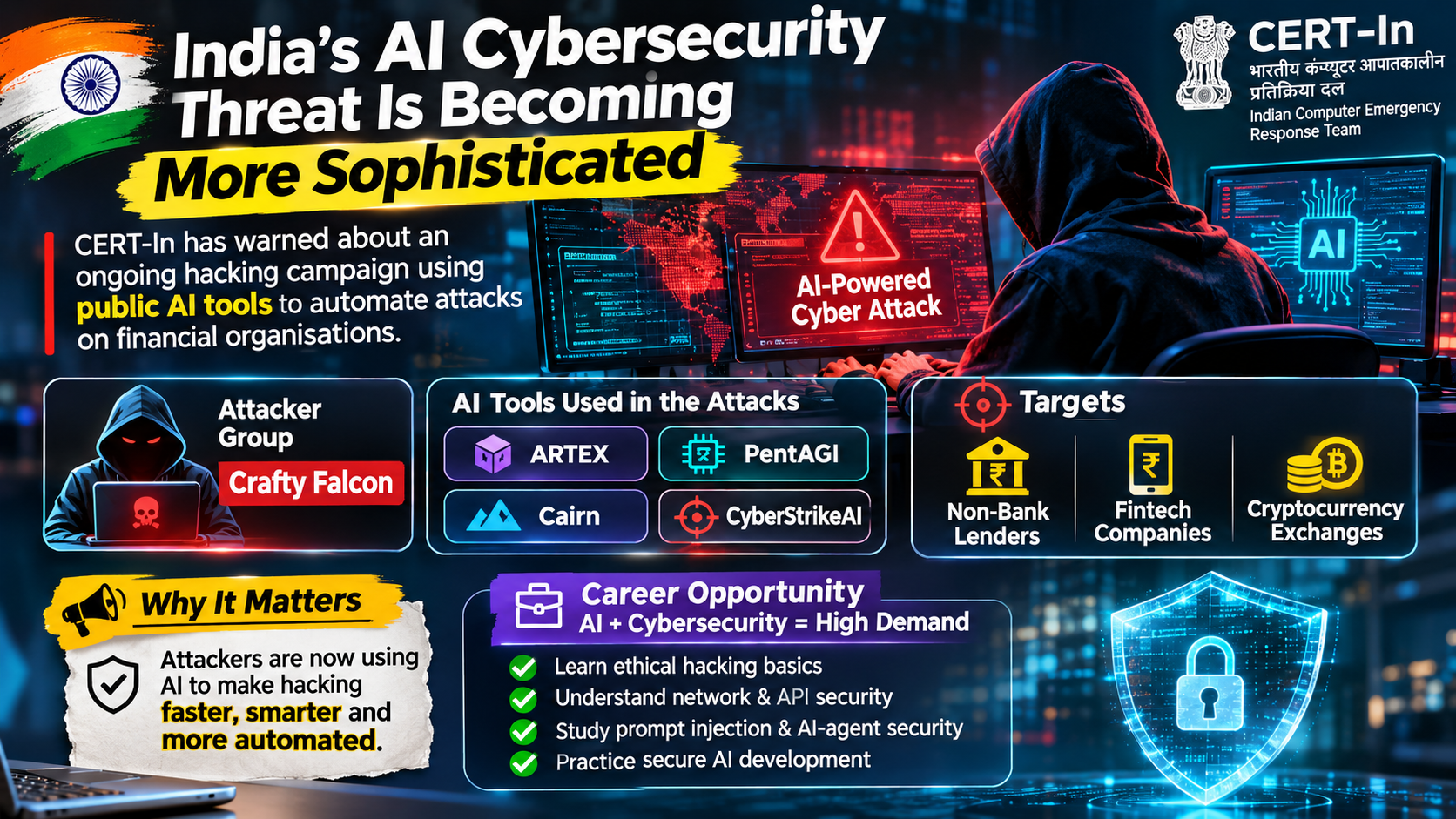
India's AI Cybersecurity Threat Is Becoming More Sophisticated
Artificial intelligence is transforming the way businesses operate. Companies are using AI to automate customer support, analyse information, develop software, detect fraud, and improve productivity. However, the same technology that helps businesses work faster can also be misused by cybercriminals.
India is now facing an important cybersecurity concern involving the use of publicly available artificial intelligence tools to automate attacks against financial organisations.
According to a report by The Economic Times, India's cybersecurity agency, the Indian Computer Emergency Response Team (CERT-In), has warned about an ongoing campaign targeting financial institutions. The campaign, identified in the advisory as Crafty Falcon, reportedly involves the use of AI-powered tools to support cyberattacks.
The organisations reportedly targeted include non-bank lenders, fintech companies, and cryptocurrency exchanges.
The tools mentioned in the report include ARTEX, PentAGI, Cairn, and CyberStrikeAI.
This development highlights a growing challenge for cybersecurity professionals: attackers may increasingly use AI to make certain stages of cyber operations faster, more automated, and easier to coordinate.
It also creates an important opportunity for students and technology professionals to understand the connection between artificial intelligence and cybersecurity.
1. What happened? Understanding CERT-In's warning
CERT-In is India's national agency responsible for responding to computer security incidents and helping organisations address cybersecurity threats.
Its responsibilities include issuing security advisories, sharing information about vulnerabilities, coordinating responses to cyber incidents, and helping improve the security of digital systems.
According to the reported advisory, CERT-In has identified an ongoing campaign in which publicly available AI tools are being used to automate parts of attacks against financial organisations.
The campaign has been identified as Crafty Falcon.
The reported targets include three important areas of the financial ecosystem:
Non-bank financial companies and lenders.
Fintech businesses and digital financial services.
Cryptocurrency exchanges and related platforms.
The use of AI tools is particularly significant because it shows how publicly accessible technology can potentially be incorporated into cyber operations.
The tools named in the report include ARTEX, PentAGI, Cairn, and CyberStrikeAI. Their mention in the advisory does not mean that every tool is malicious in every context. Security tools can have legitimate uses, but their capabilities may also be misused.
The important concern is how attackers combine automation, technical tools, and existing vulnerabilities to target organisations.
2. Why are attackers interested in financial organisations?
Financial organisations are attractive targets because they manage valuable information, digital transactions, customer identities, and sensitive business systems.
A successful cyberattack can cause financial losses, service disruption, data exposure, reputational damage, and regulatory consequences.
Consider a digital lending company.
It may maintain customer records, identity documents, financial information, loan applications, payment details, and internal business systems.
If attackers gain unauthorised access to these systems, the consequences could affect both the company and its customers.
Fintech platforms also operate in an environment where customers expect services to be available continuously. Even a short disruption can affect transactions and customer confidence.
Cryptocurrency exchanges face additional security challenges because they manage digital assets and systems that can be targeted through compromised accounts, vulnerable applications, or stolen credentials.
This makes financial services an important area for cybersecurity investment.
3. How is artificial intelligence changing cyberattacks?
Traditionally, cybercriminals needed technical knowledge and manual effort to perform many stages of an attack.
They might need to research a target, examine publicly available information, prepare convincing messages, identify exposed systems, and organise different stages of an operation.
AI can potentially assist with some of these activities.
For example, generative AI can produce text, summarise information, analyse data, and help automate repetitive tasks. These capabilities can be misused to support malicious activities.
Here are several areas where AI may change the cybersecurity threat landscape.
A. More convincing phishing messages
Phishing involves tricking people into revealing sensitive information or performing unsafe actions.
Attackers may use AI-generated text to create messages that appear more professional, personalised, and convincing.
For example, a fraudulent message pretending to come from a financial institution might imitate the tone of an official customer notification.
AI-generated content can also make it easier to produce messages in different languages.
However, AI-generated phishing is not automatically successful. Organisations still need to examine the delivery method, sender identity, links, attachments, and user behaviour.
B. Faster information gathering
Attackers often collect information about an organisation before attempting an intrusion.
AI systems can assist with summarising publicly available information and organising large amounts of data.
When combined with automation, this may reduce the time required for certain reconnaissance activities.
C. Automation of repetitive tasks
Some cyber operations involve repetitive activities such as reviewing information, organising results, and preparing reports.
AI agents and automation frameworks can potentially assist with these tasks.
This creates a challenge for defenders because security teams may need to respond to a larger number of automated activities.
D. More sophisticated social engineering
Social engineering attacks exploit human behaviour rather than relying only on technical vulnerabilities.
AI can help create realistic messages, impersonation attempts, and other deceptive content.
In some situations, attackers may also misuse voice or image generation technologies to imitate trusted individuals.
Organisations therefore need to strengthen identity verification and employee awareness.
4. What are ARTEX, PentAGI, Cairn, and CyberStrikeAI?
The Economic Times report identifies ARTEX, PentAGI, Cairn, and CyberStrikeAI among the tools mentioned in the reported campaign.
Their appearance in a cybersecurity advisory is a reminder that the modern security ecosystem includes many automated and AI-assisted technologies.
However, it is important to distinguish between a tool's technical capabilities and the way someone uses it.
A security tool may have legitimate applications in authorised testing, research, vulnerability assessment, or defensive security. The same capabilities can become dangerous when used without permission.
For this reason, cybersecurity professionals should understand both the technology and the legal and ethical responsibilities associated with it.
Students should avoid experimenting with unfamiliar tools against real websites, financial platforms, or computer networks without explicit authorisation.
A safe learning environment includes intentionally vulnerable practice applications, isolated virtual machines, and authorised cybersecurity laboratories.
5. Why are fintech companies and cryptocurrency exchanges vulnerable targets?
Financial technology businesses depend on interconnected digital systems.
A typical fintech platform may include:
Customer-facing mobile applications.
Backend servers and databases.
Payment gateways.
Third-party APIs.
Cloud infrastructure.
Identity verification services.
Authentication and access-management systems.
Every connection introduces security responsibilities.
For example, an application may use an API to communicate with a payment service. If the API is incorrectly configured or insufficiently protected, attackers may attempt to exploit the weakness.
Similarly, weak authentication, outdated software, exposed credentials, and insecure cloud configurations can increase an organisation's risk.
Cryptocurrency exchanges have additional responsibilities because they may manage digital wallets, account access, trading systems, and asset-related infrastructure.
This does not mean every fintech company or cryptocurrency exchange is vulnerable. It means that organisations operating complex digital financial systems must continuously assess and improve their security.
6. What could be the impact on India's financial ecosystem?
India has a rapidly developing digital financial ecosystem.
Mobile banking, digital payments, fintech applications, online lending, and financial technology platforms have become important parts of everyday business activity.
As digital services expand, cybersecurity becomes essential for maintaining public trust.
An AI-assisted attack campaign could create several potential risks.
Customer data exposure
Financial organisations store personal and financial information. A security incident could expose sensitive customer records.
Financial fraud
Compromised accounts or systems may create opportunities for unauthorised transactions and fraud.
Service interruptions
Cyber incidents can disrupt websites, mobile applications, internal systems, and customer services.
Increased compliance costs
Organisations may need to invest more in security assessments, monitoring, incident response, and regulatory compliance.
Loss of customer confidence
Customers expect financial platforms to protect their information and transactions. Repeated security incidents can damage trust.
The actual consequences depend on the nature of an attack, whether it succeeds, the systems affected, and how quickly an organisation responds.
7. How should Indian financial companies respond?
Financial organisations need to approach AI-powered threats as part of a wider cybersecurity strategy.
Simply purchasing security software is not enough. Companies need strong processes, trained employees, secure infrastructure, and continuous monitoring.
Some important defensive measures include:
1. Strengthen identity and access management
Organisations should use multi-factor authentication, strong password policies, access controls, and regular reviews of employee permissions.
2. Secure APIs
APIs should use appropriate authentication, authorisation, input validation, rate limiting, and monitoring.
3. Monitor suspicious activity
Security teams should examine unusual login attempts, unexpected data transfers, abnormal account activity, and suspicious network behaviour.
4. Conduct authorised security testing
Regular security assessments can help identify weaknesses before attackers exploit them.
5. Train employees
Employees should learn how to recognise phishing, impersonation attempts, suspicious attachments, and unusual requests for sensitive information.
6. Prepare incident-response plans
Companies need clear procedures for detecting, containing, investigating, and recovering from cybersecurity incidents.
7. Secure AI applications
Organisations using AI systems should examine data access, model permissions, external integrations, prompt injection risks, and the security of connected tools.
A combination of technical controls, employee awareness, and effective incident response is essential.
8. The new career intersection: AI + Cybersecurity
One of the most important lessons from this development is that artificial intelligence and cybersecurity are becoming increasingly connected.
Earlier, students often treated AI and cybersecurity as separate specialisations.
AI focused on machine learning, deep learning, and intelligent applications. Cybersecurity focused on protecting networks, systems, applications, and information.
Today, these areas increasingly overlap.
Organisations need professionals who understand how AI systems work, how they can be attacked, and how to protect them.
Some emerging career areas include:
AI Security Engineer
AI security engineers help protect AI applications, models, data pipelines, and connected systems.
They may work on access controls, secure deployment, model security, and vulnerability assessments.
Security Analyst
Security analysts monitor systems, investigate suspicious activity, analyse alerts, and help organisations respond to cyber threats.
Application Security Engineer
Application security engineers identify weaknesses in software and help developers build safer applications.
Cloud Security Engineer
Cloud security professionals protect cloud infrastructure, storage systems, virtual machines, identities, and network configurations.
AI Red Team Specialist
AI red team specialists test AI systems under controlled and authorised conditions to discover weaknesses such as prompt injection, unsafe tool access, and data leakage.
Threat Intelligence Analyst
Threat intelligence analysts study cyber threats, attacker behaviour, indicators of compromise, and security reports to help organisations prepare defensive strategies.
These roles require practical knowledge, continuous learning, and responsible security practices.
9. What should AI/ML students learn?
Students studying computer science, artificial intelligence, and machine learning can prepare for this growing field without abandoning their existing AI skills.
A useful learning roadmap includes the following areas.
Step 1: Learn computer networking
Start with the fundamentals:
OSI model.
TCP/IP model.
IP addressing and subnetting.
DNS and DHCP.
Routing and switching.
HTTP and HTTPS.
Firewalls and network security.
Networking knowledge helps students understand how systems communicate and where security weaknesses may occur.
Step 2: Learn Linux
Linux is widely used in servers, cloud platforms, and cybersecurity environments.
Learn basic commands, file permissions, processes, services, shell scripting, and system administration.
Step 3: Strengthen Python programming
Python is useful for automation, security analysis, log processing, and AI development.
Students can practise writing scripts that process files, analyse system information, and detect unusual patterns in sample datasets.
Step 4: Understand web and API security
Learn how web applications communicate with backend systems.
Important topics include authentication, authorisation, secure sessions, input validation, API keys, rate limiting, and common web application vulnerabilities.
Step 5: Explore AI security
Understand the risks associated with large language models and AI agents.
Important topics include:
Prompt injection.
Sensitive data leakage.
Insecure tool permissions.
Model misuse.
Unsafe outputs.
AI supply-chain risks.
Secure model deployment.
Step 6: Practise in legal environments
Use authorised cybersecurity training platforms, intentionally vulnerable applications, and isolated lab environments.
Never test attacks against real organisations or systems without permission.
10. What is prompt injection, and why should AI students understand it?
Prompt injection is a security risk that occurs when malicious or untrusted instructions influence the behaviour of an AI system.
Consider an AI assistant that can read documents and summarise them.
A document could contain hidden or misleading instructions intended to manipulate the assistant into ignoring its intended task or revealing information it should not disclose.
This is especially important for AI agents because they may have access to external tools, files, databases, or applications.
If an AI agent has excessive permissions, a successful manipulation could potentially lead to unintended actions.
Developers can reduce these risks by:
Treating external content as untrusted input.
Separating system instructions from user-provided content.
Restricting tool permissions.
Requiring confirmation for sensitive actions.
Limiting access to private information.
Validating outputs before executing important operations.
Monitoring agent activity.
AI security is therefore not just about preventing traditional hacking. It also involves understanding how intelligent systems interpret instructions and interact with external tools.
11. Five practical project ideas for students
Students can build small projects to demonstrate their understanding of AI and cybersecurity.
Project 1: Phishing message detection
Build a Python-based machine-learning application that classifies sample messages as potentially suspicious or legitimate.
Learn text preprocessing, feature extraction, classification, and model evaluation.
Project 2: Network traffic analysis dashboard
Create a dashboard that visualises authorised sample network traffic.
Display traffic volume, connection information, protocols, and unusual patterns.
Project 3: Suspicious login detection
Build a simple system that analyses sample authentication logs and identifies unusual login patterns.
Use Python, data analysis, and basic anomaly detection.
Project 4: Secure AI chatbot
Develop a chatbot that protects sensitive information and uses carefully restricted access to external tools.
Include input validation, secure API-key management, and basic safety checks.
Project 5: AI security awareness application
Create an educational application that teaches users to recognise phishing, suspicious links, impersonation, and unsafe online behaviour.
These projects can help students connect classroom concepts with practical security problems.
12. How can students build a career in AI cybersecurity?
Students do not need to master every topic immediately.
A practical approach is to build a foundation first and then specialise.
During the initial stage, focus on programming, networking, operating systems, and basic security concepts.
Next, explore web security, cloud security, application security, and AI fundamentals.
After that, practise through authorised labs and develop projects that demonstrate your knowledge.
Students can also explore recognised cybersecurity learning resources and entry-level certifications. The best choice depends on their interests, budget, and career goals.
When preparing a portfolio, document what problem each project solves, how it works, what security controls it uses, and what limitations remain.
Employers value practical understanding, responsible behaviour, communication skills, and the ability to explain technical decisions.
13. What should businesses and developers watch next?
The use of AI in cyber operations is likely to remain an important security concern.
Businesses should monitor several developments:
More AI-assisted phishing and impersonation attempts.
Automated vulnerability discovery and security testing.
Attacks targeting cloud infrastructure and APIs.
Prompt injection and AI-agent security risks.
Misuse of publicly available AI tools.
Growing demand for AI security assessments.
Stronger security requirements for financial technology platforms.
Defenders must also adopt AI responsibly.
AI can help security teams analyse alerts, summarise incidents, detect unusual behaviour, and organise threat intelligence. However, automated security decisions should be carefully monitored and validated.
The goal is not to eliminate AI from business operations. It is to develop systems that remain useful while protecting users, information, and infrastructure.
Conclusion: The future needs professionals who understand both AI and security
CERT-In's reported warning about the Crafty Falcon campaign highlights how the cybersecurity landscape is changing.
Publicly available AI tools can potentially make certain cyber operations more automated and sophisticated. Financial organisations, fintech platforms, and cryptocurrency exchanges must therefore pay close attention to emerging threats.
For students, this development creates an important learning opportunity.
Artificial intelligence and cybersecurity are no longer completely separate technology areas. Understanding both can help developers build safer applications, security professionals protect intelligent systems, and businesses adopt AI more responsibly.
Start with Python, computer networking, Linux, and cybersecurity fundamentals. Then explore API security, cloud security, prompt injection, and AI-agent protection.
The next generation of cybersecurity professionals will need to understand not only how attackers use AI, but also how to build AI systems that remain secure, reliable, and trustworthy.