IIT Madras Startup Offers $1 Million for Science Breakthrough
An IIT Madras alumni-founded startup is offering $1 million in prizes to solve five longstanding materials science problems, testing the limits of AI and opening new possibilities for scientific research.
By Gangothri
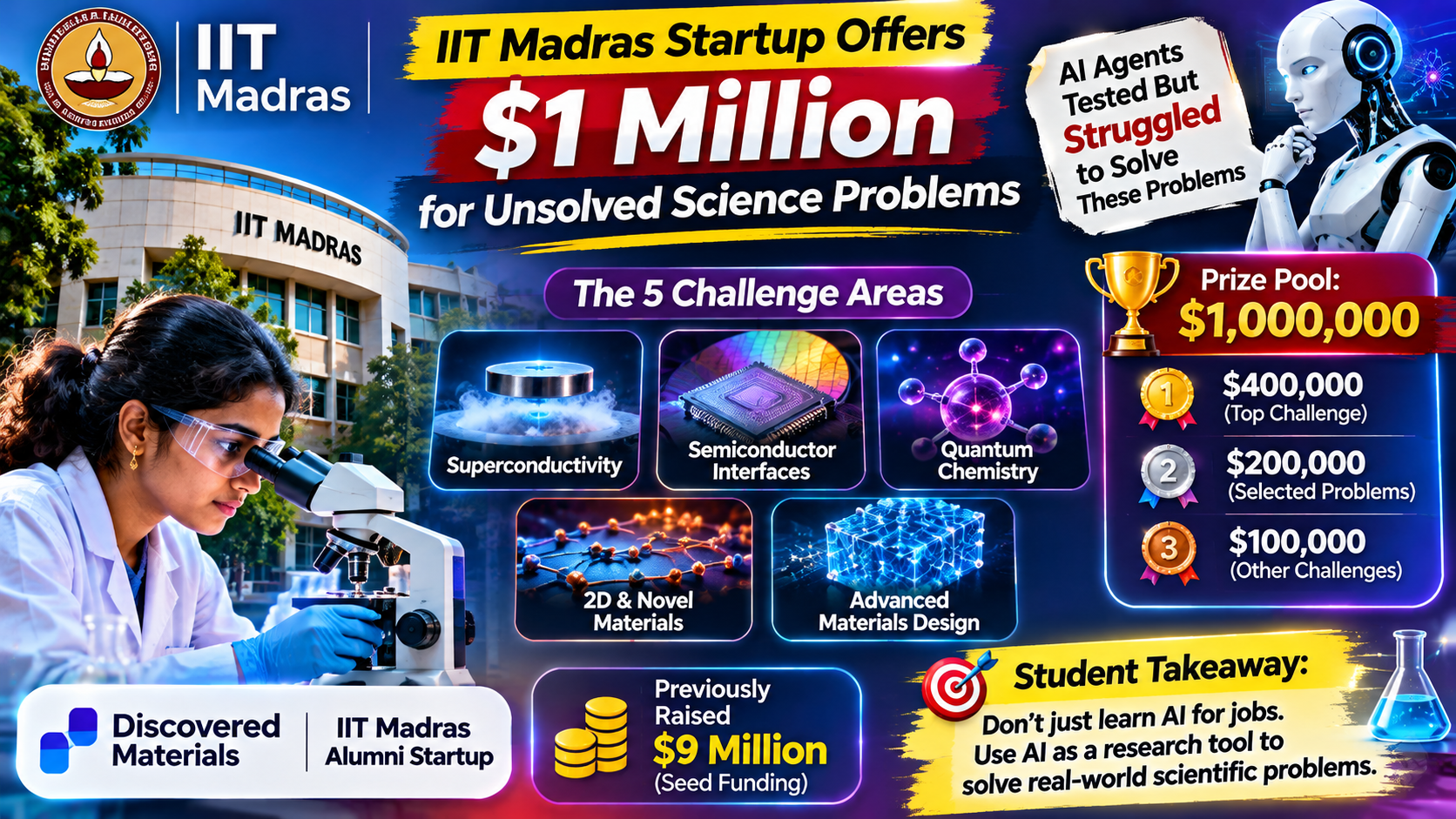
IIT Madras Startup Offers $1 Million to Solve Five Unsolved Science Problems: Can AI Help Discover the Answers?
The world of artificial intelligence is entering a new phase. Until recently, most people associated AI with chatbots, image generation, coding assistants and automated business tools. However, a growing number of technology companies are exploring a much bigger possibility: using artificial intelligence to solve scientific problems that researchers have struggled with for decades.
A new development involving an IIT Madras alumni-founded startup is bringing this possibility into focus.
Discovered Materials, a San Francisco-based startup founded by IIT Madras alumni Advaith Sridhar and Akash Ramdas, has announced a $1 million prize challenge for solving five difficult problems in materials science.
The challenge aims to attract researchers, scientists, engineers and eligible organisations capable of developing scientifically verifiable solutions to longstanding questions.
What makes this announcement particularly interesting is that advanced AI agents were also tested on these problems before the challenge was announced. Despite being given access to research resources and several days to work, the AI systems made little significant progress.
The announcement raises an important question for the technology industry: If today's most advanced AI systems can write code, analyse research papers and solve complex mathematical problems, what happens when they encounter scientific questions that remain unexplained?
Let's explore the startup, the five scientific challenges, the prize money and what this development could mean for AI research and future technology.
1. Who is behind the $1 million science challenge?
The challenge has been launched by Discovered Materials, a startup working on AI-powered methods for discovering new materials, particularly materials that could improve semiconductor technology.
The company was founded by Advaith Sridhar and Akash Ramdas, who met more than a decade ago at the Indian Institute of Technology Madras.
Although the startup operates from San Francisco, its founders' connection to IIT Madras makes this development particularly interesting for India's technology and research ecosystem.
Discovered Materials participated in Y Combinator's Spring 2026 startup batch, an accelerator programme that supports early-stage technology companies.
The company previously raised $9 million in seed funding to advance its research into AI-powered semiconductor material discovery.
Its central idea is to combine artificial intelligence, scientific knowledge and computational methods to identify materials that could be useful in future technologies.
Traditional materials discovery can require years of laboratory experiments, simulations and theoretical research. AI has the potential to help researchers explore possibilities more efficiently by analysing scientific information and identifying promising directions.
However, finding a material that works in practice is much more complicated than generating a prediction. Scientific results must be tested, reproduced and supported by evidence.
The $1 million challenge is designed to encourage progress on some of the most difficult questions in this field.
2. Why is the startup offering $1 million?
The startup has identified five important problems in materials science that have remained difficult for researchers.
Instead of focusing only on developing its own AI tools, the company is offering financial rewards to encourage researchers and teams around the world to solve these problems.
The total prize pool is $1 million.
The reported prize distribution is:
$400,000 for the cuprate superconductivity challenge.
$200,000 for each of two other challenges.
$100,000 for each of the remaining two challenges.
The largest individual reward is therefore $400,000.
The competition is open to eligible individuals, teams and organisations. There is no fixed deadline reported, and a prize will be awarded only when a proposed solution satisfies the relevant scientific criteria.
This is an important distinction. Participants are not being paid simply for submitting an idea or producing an interesting AI-generated explanation.
The proposed solution must meet scientific standards.
The idea is to encourage genuine discoveries rather than impressive demonstrations that cannot be verified.
3. Understanding the five scientific problems
The five challenges cover different areas of materials science, physics, semiconductor technology and computational chemistry.
Some of these subjects may sound extremely complicated, but understanding their basic purpose helps explain why they matter.
Challenge 1: Understanding cuprate superconductivity
The biggest prize, worth $400,000, is connected to cuprate superconductivity.
To understand this problem, first consider how electricity moves through ordinary materials.
When electricity flows through a normal conductor, such as a copper wire, some electrical energy is lost because of resistance. This can produce heat.
Superconductivity is a special physical phenomenon in which certain materials can conduct electricity with zero electrical resistance under appropriate conditions.
Cuprate superconductors are materials containing copper and oxygen structures.
They are particularly interesting because they can exhibit superconductivity at temperatures much higher than conventional superconductors, although they still generally require very low temperatures.
Scientists have studied these materials for decades, but a complete theoretical explanation of their behaviour remains an important scientific challenge.
Why does this matter?
A deeper understanding of superconductivity could help researchers develop improved technologies for:
More efficient electrical systems.
Advanced magnetic devices.
Medical imaging equipment.
Scientific instruments.
Future energy-related applications.
The challenge is not simply to discover another material. It is to develop a theory that explains the underlying physical behaviour.
That makes it one of the most difficult problems in the competition.
Challenge 2: Predicting semiconductor interfaces
The second major area involves semiconductor interfaces.
Modern computer chips are built using extremely small structures and carefully engineered materials.
One important material combination is silicon and silicon dioxide.
The interface between these materials can influence electrical behaviour, device performance and reliability.
Predicting what happens at this boundary is difficult because atomic arrangements, defects and other microscopic effects can influence the final properties.
Researchers want better numerical methods for predicting the structure and behaviour of these interfaces.
Why is this important?
Semiconductor technology is essential for:
Smartphones.
Laptop processors.
Artificial intelligence accelerators.
Data-centre hardware.
Automotive electronics.
Advanced computing systems.
Better predictions could help engineers design and manufacture more reliable electronic devices.
For a technology industry investing heavily in AI chips, this research area has considerable importance.
Challenge 3: Understanding how light changes materials
Another challenge involves understanding how shining light on certain materials changes their behaviour.
Light can influence the electronic and physical properties of materials.
In some materials, illumination can trigger changes that researchers cannot fully explain.
Understanding these effects is particularly interesting in areas involving superconductivity and advanced material behaviour.
A better theoretical explanation could help scientists investigate new ways to control material properties.
Potential research applications include advanced electronic devices, optical technologies and future energy-related systems.
Challenge 4: Predicting heat movement across material interfaces
Heat management is a major problem in modern technology.
High-performance processors, GPUs and AI servers generate significant amounts of heat during operation.
If heat is not managed properly, electronic components can become less efficient, experience performance limitations or suffer damage.
Heat does not always move through materials in a simple way.
The microscopic structure of a material, including its grain boundaries and interfaces, can influence how efficiently thermal energy travels.
The challenge focuses on developing numerical methods that can connect the grain structure of materials with their thermal properties.
A better understanding could support the development of materials that remove heat more effectively.
This is especially relevant as AI computing infrastructure becomes more powerful and energy-intensive.
Challenge 5: Improving quantum chemistry calculations
The fifth challenge focuses on density functional theory, commonly known as DFT.
DFT is a widely used computational method in chemistry and materials science.
It helps researchers study the electronic structure of materials and predict properties based on atomic arrangements.
Scientists use these calculations to investigate molecules, chemical reactions, semiconductors and new materials.
However, existing methods have limitations in accuracy and computational efficiency.
Improving these techniques could allow researchers to study more complicated systems and make better predictions.
This problem is particularly relevant to AI-driven materials discovery because computational chemistry can help identify promising materials before researchers spend time and resources testing them experimentally.
4. Why did advanced AI agents struggle?
Perhaps the most interesting part of this announcement is the reported performance of AI agents on the five problems.
Before launching the challenge, Discovered Materials tested advanced AI models.
The systems were given access to internet resources and other research materials and were allowed to work autonomously for several days.
Despite these capabilities, they made little significant progress on the problems.
This is important because AI capabilities have advanced rapidly.
Modern AI systems can:
Analyse large research documents.
Generate computer programs.
Explain complicated mathematical concepts.
Summarise scientific papers.
Search for relevant information.
Assist with data analysis.
Suggest possible experiments.
However, there is a difference between performing these tasks and making an original scientific discovery.
A scientific breakthrough may require developing a new theory, identifying an unexplained physical relationship, designing a reliable mathematical method or producing evidence that changes existing scientific understanding.
AI can generate possible explanations, but those explanations must be tested.
A convincing answer is not necessarily a correct answer.
The reported results demonstrate that autonomous AI agents still face difficulties when dealing with some open-ended scientific problems.
They do not prove that AI cannot solve these problems in the future. Better models, tools, scientific datasets and experimental feedback could change what is possible.
The challenge provides a way to measure whether AI systems are making meaningful progress rather than simply producing impressive-looking responses.
5. Why materials science matters for the future of AI
Artificial intelligence depends on much more than software.
Every AI system ultimately runs on physical computing infrastructure.
That infrastructure includes processors, memory, storage devices, networking equipment and cooling systems.
The materials used to manufacture these components can influence their performance, efficiency, durability and cost.
Consider an AI data centre.
It may contain thousands of computing accelerators working simultaneously. These systems require advanced semiconductor materials, efficient power delivery and effective thermal management.
If researchers discover materials with better electrical or thermal properties, they could potentially contribute to improvements in future computing systems.
Similarly, better semiconductor interfaces could support more advanced chip manufacturing.
This creates a connection between several industries:
Artificial intelligence.
Semiconductor manufacturing.
Quantum chemistry.
Advanced computing.
Energy technology.
Materials engineering.
The $1 million challenge is therefore not just an academic competition. Its questions are connected to technologies that could influence future industries.
6. What does this mean for Indian students and researchers?
The founders' IIT Madras connection makes this development especially interesting for students in India.
Many engineering students believe that AI careers are mainly about building chatbots, developing websites or creating machine learning applications.
But AI research extends far beyond those areas.
There are opportunities at the intersection of computer science, physics, mathematics, chemistry and engineering.
For example, a computer science student can contribute to scientific computing by developing algorithms that help researchers analyse complex datasets.
An AI and machine learning student can explore models that predict material properties.
A mathematics student can investigate numerical optimisation and computational methods.
A physics student can work on theoretical models and simulations.
A chemistry student can explore computational chemistry and molecular modelling.
The important lesson is that scientific discovery increasingly involves collaboration between different disciplines.
Students do not necessarily need to become experts in every subject. They can build strong foundations in one area and collaborate with researchers from other fields.
7. Technical skills that could become valuable
Students interested in AI-driven scientific research can start exploring several technical areas.
Python programming
Python is widely used for scientific computing, data analysis, machine learning and research automation.
Mathematics
Linear algebra, calculus, probability, statistics and numerical methods are important foundations for understanding scientific models.
Machine learning
Learn regression, classification, neural networks, optimisation and model evaluation.
Scientific computing
Explore numerical simulations, computational modelling and scientific programming.
Quantum chemistry fundamentals
Understand how computational techniques are used to study atoms, molecules and material properties.
Physics and materials science
Build an understanding of electricity, magnetism, atomic structures, thermal properties and semiconductor fundamentals.
AI agents
Learn how AI agents use tools, search information, execute code and perform multi-step research tasks.
A combination of programming, mathematics and scientific understanding can open opportunities in research-focused AI development.
8. Can AI become a scientific researcher?
This announcement highlights an important question about the future of scientific research.
AI systems are becoming increasingly capable of assisting scientists.
They can help identify patterns in data, summarise existing research, suggest possible hypotheses and automate repetitive computational tasks.
However, scientific research requires more than information processing.
Researchers must determine whether a hypothesis is meaningful, whether an experiment is reliable and whether a result can be reproduced.
They also need to understand unexpected outcomes and revise their assumptions when evidence contradicts an existing explanation.
These responsibilities make scientific discovery particularly challenging.
A promising direction is collaboration between human researchers and AI systems.
AI can help researchers explore a wider range of possibilities, while scientists provide domain knowledge, experimental judgement and verification.
The Discovered Materials challenge illustrates why this combination could be important.
Rather than treating AI as a complete replacement for scientists, it encourages a more practical question: How can AI help researchers make discoveries that would otherwise take much longer?
9. What should students learn from this announcement?
There are several useful lessons for students preparing for technology careers.
First, do not limit your understanding of AI to popular applications. Learn how AI works and how it can be applied to real scientific and industrial problems.
Second, build strong mathematical foundations. Advanced AI and scientific computing depend heavily on mathematics.
Third, develop practical programming skills. Python, scientific libraries and computational tools can help students move from theoretical knowledge to experiments.
Fourth, explore interdisciplinary learning. Some of the most interesting technology problems cannot be solved using knowledge from only one engineering branch.
Finally, learn to question AI-generated answers. An AI response may sound convincing without being scientifically correct.
The ability to verify results, evaluate evidence and identify mistakes is becoming an important technical skill.
10. The bigger picture: AI is moving from content generation to scientific discovery
The development of generative AI has already changed how people write, create images, produce videos and develop software.
But scientific research could become one of the most important areas of AI development.
Discovering new materials, improving semiconductor technology and understanding complex physical phenomena could have long-term effects on computing, healthcare, energy and manufacturing.
The Discovered Materials challenge provides a concrete example of this direction.
By offering $1 million across five difficult scientific problems, the startup is encouraging researchers and technology teams to work on questions that have resisted conventional approaches.
The reported difficulty experienced by AI agents also reminds us that current AI capabilities have important limitations.
The future of scientific AI will depend not only on larger models but also on better scientific data, reliable experiments, improved algorithms and collaboration between researchers and machines.
Conclusion
An IIT Madras alumni-founded startup has created an interesting opportunity for the global research community by offering $1 million to solve five longstanding materials science problems.
The challenge covers superconductivity, semiconductor interfaces, light-induced material behaviour, heat transfer and quantum chemistry calculations.
It also highlights an important limitation of current AI systems: being able to generate answers is not the same as making a verified scientific discovery.
For India, the announcement is another reminder of the value of research, interdisciplinary education and deep technology innovation.
For engineering students, the opportunity is to look beyond conventional software development and explore how programming, mathematics and artificial intelligence can contribute to scientific progress.
The next major AI breakthrough may not be another chatbot or image generator. It could be a discovery that changes how we manufacture computer chips, generate energy or understand the physical world.