How to Create Viral Hydraulic Press Videos with AI
Learn how to create realistic hydraulic press crushing videos using AI. Discover how to turn simple object ideas into satisfying glass, metal, phone, cake and ASMR-style crushing videos without owning a hydraulic press.
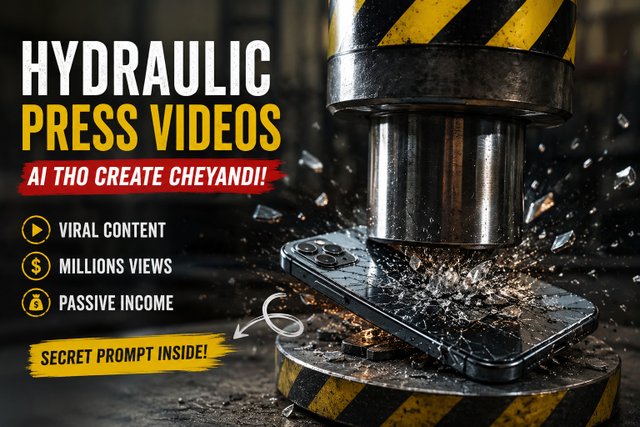
Create a hyper-realistic industrial video in 9:16 vertical aspect ratio of a hydraulic press
crushing a [OBJECT] in a real mechanical workshop environment.
The hydraulic press is a heavy-duty industrial machine made of scratched steel, with oil
stains, grease marks, worn metal texture, and realistic signs of use. The hydraulic press
body is painted industrial yellow or industrial blue, with chipped paint, worn edges,
scratches, and dirty machine surfaces. It is placed on a concrete floor inside a small
mechanical workshop.
Lighting is realistic natural or fluorescent workshop lighting, slightly flat and practical. No
cinematic lighting. No dramatic shadows.
A real [OBJECT] is placed exactly in the center between the top and bottom steel press
plates.
The camera is fixed on a tripod in a straight front-facing angle. Vertical framing for mobile
reel format. No camera movement. No zoom. No cinematic motion.
Real-time recording style. 30fps. 1080p. Documentary look. 9:16 aspect ratio.
The top hydraulic press plate slowly moves downward with steady, powerful force. The
machine vibrates slightly. Real mechanical humming sound is present.
The top and bottom press plates must remain perfectly aligned, straight, and parallel at all
times.
The press continues descending without stopping until the top plate fully meets and firmly
attaches to the bottom plate like two solid steel blocks closing together completely with full
contact.
The [OBJECT] in between must be completely crushed and compressed during this process.
No early stopping. No bouncing back. No unrealistic explosion. No flying debris unless the
material naturally breaks. No exaggerated stretching.
The object must visibly deform under pressure according to real-world physics. It should
compress, flatten, crack, bend, collapse, or break realistically depending on its material
properties.
At the end of the video, the top and bottom steel press plates are fully closed and touching
each other. The [OBJECT] is fully crushed between them.
Sound design: real hydraulic press machine sound, metal creaking, compression noises,
workshop ambience. No music.
How to Create Viral Hydraulic Press Videos with AI
Hydraulic press videos have become popular because they combine visual curiosity, realistic destruction and satisfying sound effects. But creating this type of content traditionally requires a hydraulic press, objects to crush, cameras, lighting and a safe filming environment.
Today, AI video-generation tools can help creators experiment with similar concepts digitally.
You can create scenes involving phones, glass objects, metal objects, cakes and many other items simply by describing what you want to see.
What Are AI Hydraulic Press Videos?
AI hydraulic press videos are digitally generated videos that simulate a powerful hydraulic machine crushing an object.
For example, you could create a scene where:
A smartphone is crushed under a hydraulic press
A glass object breaks under pressure
A metal object bends and deforms
A giant cake gets compressed
Different materials are tested for satisfying ASMR effects
The goal is to make the scene look physically believable and visually satisfying.
What You Need
You don't need a physical hydraulic press to experiment with this type of content.
You'll generally need:
An AI image or video-generation tool
A good text prompt
An object you want to feature
Basic video editing software
Suitable sound effects
The quality of the final result depends heavily on the prompt, reference images, AI model and editing.
Step 1: Choose Your Object
Start with a simple object.
For example:
Smartphone
You can also experiment with:
Glass bottle
Metal cube
Toy car
Diamond-shaped object
Keyboard
Cake
Ice block
Rubber ball
For better results, start with objects that have clearly recognizable shapes.
Step 2: Describe the Hydraulic Press
Don't simply write:
“Crush a phone.”
Instead, describe the entire scene.
Mention:
Industrial hydraulic press
Heavy metal ram
Object placed on a steel platform
Slow compression
Realistic deformation
Material-specific destruction
Close-up camera
Cinematic lighting
Realistic physics
This gives the AI more information about what you actually want.
Step 3: Use an AI Video Prompt
Here's a reusable example:
“Ultra-realistic cinematic hydraulic press crushing a [OBJECT], industrial steel hydraulic press slowly applying extreme pressure, realistic physical deformation, detailed material breaking and compression, tiny fragments moving naturally, macro close-up camera, dramatic industrial lighting, shallow depth of field, realistic shadows, slow-motion destruction, highly detailed textures, satisfying visual style, physically believable motion, vertical 9:16 video.”
Simply replace [OBJECT] with your chosen object.
For example:
[OBJECT] → smartphone
or
[OBJECT] → glass bottle
Step 4: Experiment With Different Materials
This is where you can create multiple variations from the same basic idea.
Glass Crushing
Focus on:
realistic cracks
glass fragments
reflections
sharp breaking sounds
slow-motion impact
Metal Crushing
Focus on:
bending metal
deformation
scratches
pressure marks
heavy mechanical sounds
Cake Crushing
Focus on:
soft compression
cream spreading
realistic texture
satisfying squishing sounds
Ice Crushing
Focus on:
cracks forming
transparent ice
fragments
cold vapor
crisp breaking sounds
Step 5: Add ASMR-Style Audio
The visual isn't everything.
Sound can make crushing videos much more satisfying.
Depending on the object, you can use:
Glass:
cracks, shattering and small fragments.
Metal:
mechanical pressure, bending and heavy impact.
Cake:
soft compression and squishing sounds.
Ice:
cracking and sharp breaking sounds.
Keep the sound synchronized with the moment the object actually gets crushed.
Step 6: Make Short Videos
For social media, you don't necessarily need a long video.
A simple structure could be:
0–2 seconds:
Show the object and hydraulic press.
2–6 seconds:
Press begins moving down.
6–9 seconds:
Main crushing moment.
9–12 seconds:
Show the final result.
The first few seconds are especially important because viewers decide very quickly whether to continue watching.
Step 7: Create Multiple Variations
Instead of making only one video, experiment with different objects.
For example:
Video 1: Smartphone
Video 2: Glass bottle
Video 3: Metal cube
Video 4: Giant cake
Video 5: Ice block
This gives you a repeatable content format while allowing each video to have a different visual payoff.
Can These Videos Make Money?
AI-generated videos can potentially be used as part of a monetized content strategy, but there is no guaranteed number of views or income.
Your results depend on factors such as:
Originality
Audience retention
Platform policies
Content quality
Consistency
Monetization eligibility
Audience engagement
Simply generating an AI video does not automatically produce passive income.
For creators, the better approach is to use AI as a production tool while adding your own creative direction, editing, storytelling and presentation.
Important Tip for AI Video Creators
Don't just generate random crushing clips and upload them repeatedly.
Add something original to the content.
For example:
Compare different materials
Create a “what happens if…” series
Add educational information
Explain the physics behind the crushing
Create themed challenges
Add original narration
Build a recognizable series
This makes the content more useful and gives viewers a reason to return.
Frequently Asked Questions
Can I create hydraulic press videos without owning a hydraulic press?
Yes. AI video-generation tools can create simulated hydraulic press scenes without requiring physical equipment.
Can I use different objects?
Yes. You can experiment with glass, metal, phones, cakes, ice and many other objects.
Are AI crushing videos realistic?
They can look highly realistic, but AI-generated videos can still contain visual or physics inconsistencies. Reviewing the generated footage before publishing is important.
Can these videos be monetized?
Potentially, depending on the platform's current monetization requirements and the originality and quality of your content. Monetization is not guaranteed.
Do I need professional video-editing skills?
Not necessarily. Basic trimming, transitions, sound synchronization and captions can be enough to start experimenting.
Conclusion
AI makes it much easier to experiment with visually satisfying concepts such as hydraulic press videos. Instead of investing in expensive equipment, creators can start with an idea, write a detailed prompt and generate different crushing scenarios digitally.
The key is not just generating the video. The real advantage comes from choosing interesting concepts, creating strong visuals, adding satisfying sound and presenting the content in an original way.