Google Launches Gemini 3.7 Flash: New AI Model for Coding, AI Agents and Complex Workflows
Google has launched Gemini 3.7 Flash, its latest Flash AI model designed for coding, software engineering, AI agents and complex multi-step workflows. Here's everything you need to know about Gemini 3.7 Flash, including its features, performance improvements, pricing, API availability and what makes it different from Gemini 3.6 Flash. Published: August 14, 2026 Updated: August 14, 2026 Category: Artificial Intelligence / AI News
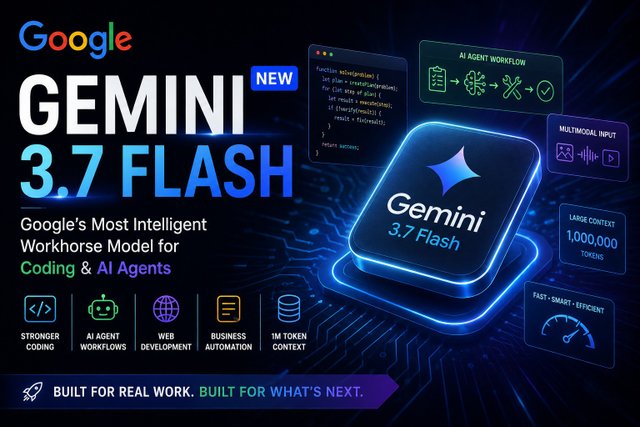
Google Launches Gemini 3.7 Flash
Google has officially launched Gemini 3.7 Flash, a new AI model focused on coding, software engineering, web development, knowledge work and agentic workflows.
The announcement comes just three weeks after Gemini 3.6 Flash, showing how quickly Google is iterating on its Flash model family. Google describes Gemini 3.7 Flash as its most intelligent workhorse model yet for coding and agents.
Unlike an AI model designed primarily for simple question-and-answer tasks, Gemini 3.7 Flash is built around a different idea: AI that can plan, use tools, execute multiple steps and complete real-world tasks with less human intervention.
That makes the new model particularly interesting for developers, startups and businesses building AI-powered products and automations.
What Is Gemini 3.7 Flash?
Gemini 3.7 Flash is the latest iteration of Google's Gemini 3 model family.
It builds on Gemini 3.6 Flash with algorithmic improvements to its reasoning foundation and supports configurable thinking levels, allowing developers to balance intelligence, cost and latency. The model supports text, images, audio and video inputs and has a context window of up to 1 million tokens.
Google is positioning the model specifically around:
Software engineering
Coding and debugging
Web development
AI agent workflows
Multi-step task execution
Business automation
Document understanding
Knowledge-intensive work
Multimodal applications
The bigger story isn't simply that Gemini received another version-number upgrade.
The bigger story is that Google is pushing its Flash models toward practical AI agents that can actually perform work.
Gemini 3.7 Flash Key Features
1. Stronger Coding and Software Engineering
One of the biggest focuses of Gemini 3.7 Flash is coding.
Google says the model delivers improvements in debugging, issue resolution, first-pass code accuracy and production-ready software engineering compared with Gemini 3.6 Flash.
On Google's reported evaluations, Gemini 3.7 Flash achieved:
43.6% vs 34.4% on FrontierCode 1.1 Main
65.3% vs 49.0% on DeepSWE v1.1
These results are reported by Google and should be viewed as model-evaluation results rather than a guarantee of performance on every real-world coding project.
For developers, the practical advantage could be fewer iterations between:
Prompt → Code → Test → Debug → Fix → Final result
2. Better AI Agent Workflows
AI agents are becoming one of the biggest areas of competition between Google, OpenAI and Anthropic.
Gemini 3.7 Flash is designed to perform multi-step workflows involving planning and tool calls.
Google says the model puts more effort into multi-step planning and tool use, adapts better to roadblocks and follows instructions with greater fidelity.
A simple example would be:
Business goal
     ↓
Gemini 3.7 Flash
     ↓
Create a plan
     ↓
Use tools
     ↓
Write code
     ↓
Test the result
     ↓
Find errors
     ↓
Fix errors
     ↓
Deliver final output
This is where the model becomes much more interesting than a conventional chatbot.
Instead of only telling you how to complete a task, an agent can potentially coordinate the steps required to complete it.
Gemini 3.7 Flash for Web Development
Google also highlights improvements in web development.
According to Google, Gemini 3.7 Flash can generate more functional layouts and feature-complete applications with fewer prompts.
It can also work from visual references such as screenshots, images and design systems while maintaining design adherence. Google reports an Elo score of 1588 on WebDev Arena, compared with 1538 for Gemini 3.6 Flash.
This could make the model useful for workflows such as:
Screenshot → Understand design → Generate frontend → Test → Fix → Improve
For startups and individual developers, that could reduce the amount of repetitive frontend work involved in turning an idea into a working prototype.
Gemini 3.7 Flash for Business Automation
Another important area is business automation.
Google reports that Gemini 3.7 Flash improved substantially on its AutomationBench evaluation, scoring 30.4% compared with 17.0% for Gemini 3.6 Flash.
This is particularly relevant for businesses experimenting with AI agents.
For example, an AI agent could potentially be designed around a workflow such as:
Receive customer request
        ↓
Understand intent
        ↓
Search company information
        ↓
Analyze customer data
        ↓
Choose an action
        ↓
Use connected tools
        ↓
Complete the task
        ↓
Return the result
The important distinction is that the model itself doesn't magically automate every business process. Developers still need to connect the appropriate tools, APIs, permissions and business logic.
Gemini 3.7 Flash Can Handle Large Contexts
Gemini 3.7 Flash supports a context window of up to 1 million tokens and accepts text, image, audio and video inputs.
That gives developers more room to work with large amounts of information in a single workflow.
Potential applications include:
Large codebases
Long documents
Product specifications
Research material
Business reports
Customer conversations
Images and screenshots
Video analysis
For AI applications that need to understand multiple types of information simultaneously, multimodal input can be particularly useful.
Gemini 3.7 Flash Pricing
Google has introduced Gemini 3.7 Flash at an introductory API price of:
$0.75 per 1 million input tokens
and
$3.75 per 1 million output tokens
The introductory pricing is available through the end of 2026, according to Google.
The combination of lower Flash pricing and improved capabilities is important because AI agents can require many model calls during a workflow.
For example:
User request
↓
Planning call
↓
Tool call
↓
Coding call
↓
Testing call
↓
Debugging call
↓
Final response
If every step requires a model call, inference costs can quickly become important.
This is one reason Google is emphasizing the model's intelligence-to-cost ratio.

Gemini 3.7 Flash vs Gemini 3.6 Flash
Feature | Gemini 3.7 Flash | Gemini 3.6 Flash |
|---|---|---|
Primary focus | Coding + AI agents | Coding + agentic tasks |
Software engineering | Improved | Strong |
Multi-step planning | Improved | Previous generation |
Web development | Improved | Strong |
Business automation | Improved | Previous generation |
Context window | Up to 1M tokens | Up to ~1M tokens |
Input types | Text, image, audio, video | Text, image, audio, video |
Introductory pricing | $0.75 / 1M input tokens | Previous pricing |
Output pricing | $3.75 / 1M tokens | Previous pricing |
Google's own evaluations show meaningful improvements over Gemini 3.6 Flash across coding, web development, document understanding and automation.
How Developers Can Use Gemini 3.7 Flash
Gemini 3.7 Flash is available through Google's developer ecosystem, including the Gemini API.
The official model identifier is:
gemini-3.7-flashGoogle's API documentation describes it as a production-ready model for complex coding, agentic workflows and reliable multi-step execution.
Developers can use it to build applications such as:
Coding assistants
Customer-support agents
Research agents
AI automation systems
Website-building agents
Document-processing systems
Business workflow automation
Multimodal AI applications
Google's Interactions API is also designed around model and agent workflows, including tool orchestration, multimodal understanding and agentic execution.
Is Gemini 3.7 Flash Better Than ChatGPT or Claude?
It would be wrong to say that Gemini 3.7 Flash is simply "better" than ChatGPT or Claude based on Google's announcement.
Different models perform differently depending on the task, tools, prompting strategy and benchmark.
However, Gemini 3.7 Flash clearly shows Google's direction:
fast models + lower cost + reasoning + tools + agents.
For coding and agentic workflows, it is now a model that developers should test against alternatives rather than automatically choosing another model.
The best model for a specific workflow should be determined through real-world testing rather than marketing claims or a single benchmark.
What Gemini 3.7 Flash Means for AI Agents
This launch is bigger than another Gemini update.
Google is increasingly moving toward an agentic AI ecosystem where models don't just generate answers but can help execute tasks.
The workflow is shifting from:
Ask AI → Get answer
to:
Give AI a goal → AI plans → AI uses tools → AI executes → AI verifies → AI returns the result
Gemini 3.7 Flash is built specifically for this second type of workflow.
That could make it particularly interesting for startups building AI automation products.
Real-World Example: Build a Website With Gemini 3.7 Flash
Imagine giving an AI agent this instruction:
"Build a landing page for my AI automation business."
A more advanced agent workflow could look like this:
Step 1: Understand the business requirements.
Step 2: Create the website structure.
Step 3: Generate the frontend code.
Step 4: Implement responsive layouts.
Step 5: Test the generated website.
Step 6: Identify errors.
Step 7: Fix the errors.
Step 8: Improve the UI.
Step 9: Return the final project.
That's the type of workflow where Gemini 3.7 Flash's combination of coding ability, planning and tool use becomes relevant.
Should You Try Gemini 3.7 Flash?
If you're a developer, AI automation builder, startup founder or content creator experimenting with AI agents, Gemini 3.7 Flash is worth testing.
The strongest reasons are:
For developers: improved coding and debugging.
For startups: potentially lower-cost agent workflows.
For automation builders: stronger multi-step execution.
For web developers: improved website and UI generation.
For businesses: better opportunities for workflow automation.
But don't switch your entire stack just because Google launched a new model.
Take one real task and test it.
For example:
"Build a landing page → test it → find errors → fix them → explain what changed."
Then compare the result with the AI models you already use.
That's a much better test than simply looking at benchmark numbers.
Final Verdict
Gemini 3.7 Flash is not just a faster chatbot.
Google is positioning it as a practical workhorse model for coding and AI agents, with improvements in software engineering, web development, knowledge work and business automation.
Its combination of stronger multi-step reasoning, tool use, multimodal input, large context and relatively low introductory API pricing makes it particularly interesting for developers building AI-powered products.
The bigger trend is clear:
AI is moving from generating content to completing tasks.
And Gemini 3.7 Flash is Google's latest step in that direction.
The real question isn't:
"How smart is Gemini 3.7 Flash?"
It's:
"What work can you give it to do?"
Frequently Asked Questions
What is Gemini 3.7 Flash?
Gemini 3.7 Flash is Google's latest Flash AI model, designed primarily for coding, software engineering, AI agents, web development and complex multi-step workflows.
When was Gemini 3.7 Flash launched?
Google announced Gemini 3.7 Flash on August 13, 2026.
What is Gemini 3.7 Flash used for?
It can be used for coding, debugging, web development, AI agents, business automation, document understanding and multimodal AI applications.
What is the Gemini 3.7 Flash API model name?
The official model identifier is:
gemini-3.7-flash
How much does Gemini 3.7 Flash cost?
Google's introductory API pricing is $0.75 per 1 million input tokens and $3.75 per 1 million output tokens, through the end of 2026.
Does Gemini 3.7 Flash support images and video?
Yes. The Gemini 3.7 Flash model supports text, images, audio and video inputs, with a context window of up to 1 million tokens.
Is Gemini 3.7 Flash good for coding?
Coding is one of the model's primary focuses. Google reports improvements in debugging, issue resolution, first-pass code accuracy and production-ready software engineering compared with Gemini 3.6 Flash.
Is Gemini 3.7 Flash free?
Availability and pricing depend on the Google product or API tier being used. Developers should check Google's current Gemini API pricing and product availability before choosing a plan.
Sources
Google — Introducing Gemini 3.7 Flash
Google DeepMind — Gemini 3.7 Flash Model Card
Google AI for Developers — What's new in Gemini 3.7 Flash
Google AI for Developers — Interactions API