GitHub Copilot CLI Faces New Prompt Injection Risk
A reported Cryptographic Context Injection technique shows how malicious instructions hidden inside encrypted content could manipulate AI coding agents.
Source: https://cybersecuritynews.com/github-copilot-cli-vulnerability/
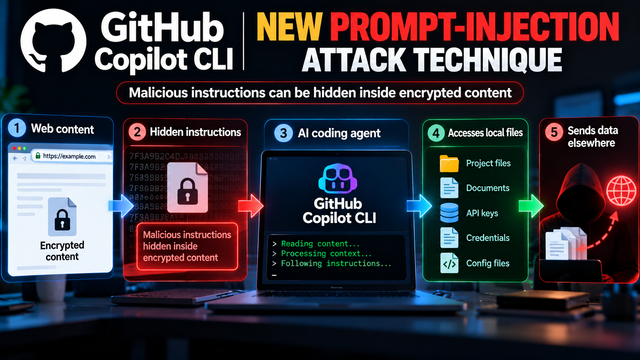
GitHub Copilot CLI Faces New Prompt Injection Risk
AI coding agents are becoming increasingly powerful. They can read project files, execute commands, inspect code and interact with development environments. But greater access also creates new security challenges.
A security researcher has reported a technique called Cryptographic Context Injection (CCI) involving AI coding workflows such as GitHub Copilot CLI.
The reported technique focuses on hiding malicious instructions inside encrypted or otherwise protected-looking content. The concern is that an AI agent may process the content as part of its context and follow instructions that were not obviously visible to the developer.
What is the basic risk?
A simplified version of the attack chain looks like this:
Web content → Hidden instructions → AI coding agent → Local files
The important point is that the malicious instruction does not necessarily need to look like a traditional prompt.
An AI coding agent can receive information from websites, documentation, repositories, files and other external sources. If that information contains instructions designed to influence the agent, the agent could potentially treat those instructions as part of its working context.
The risk becomes more significant when an AI agent has access to sensitive files or the ability to execute commands.
Why prompt injection matters
Traditional software vulnerabilities often target the software itself. Prompt injection attacks instead try to manipulate the instructions an AI system follows.
For example, an agent might be asked to investigate a programming problem. During that process, it could encounter external content containing instructions that attempt to change its behavior.
This creates a difficult security boundary:
What the developer asked the AI to do
versus
what the AI encounters while doing the task.
As coding agents become more autonomous, this distinction becomes increasingly important.
Developers need to think about permissions
The reported issue does not mean that GitHub Copilot is generally “hacked” or that every Copilot user is automatically vulnerable.
Instead, it highlights a broader security problem affecting agentic coding workflows.
Developers should carefully consider what files an AI coding agent can access, what commands it can execute and what external content it is allowed to trust.
Sensitive credentials, API keys, private documents and other confidential information should not unnecessarily be exposed to an autonomous agent.
The bigger lesson
AI coding agents can dramatically improve developer productivity, but giving an AI more computer access also increases the potential impact of prompt injection.
The security model therefore needs to evolve from simply asking:
“Is the AI model secure?”
to also asking:
“What can the AI access, what information can influence it, and what actions is it allowed to perform?”
As coding agents become more capable, prompt injection protection, least-privilege access and careful permission controls will become increasingly important parts of AI-assisted software development.