Gemma 3 Cinematic: 21% Boost Without Retraining
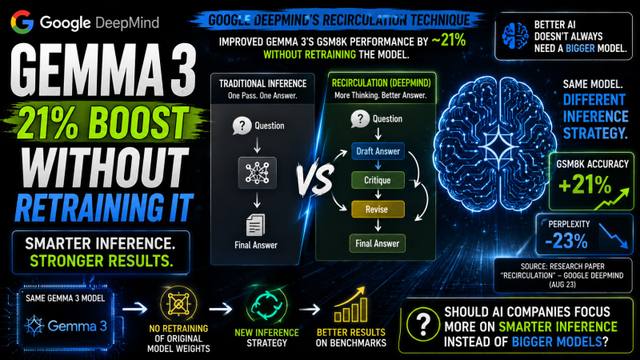
Google DeepMind's Recirculation method boosts Gemma 3 performance by changing how inference works, without changing the model's original weights.
By singamankitha
Source: https://arxiv.org/abs/2608.17981?utm_source=chatgpt.com
Gemma 3 Cinematic: 21% Boost Without Retraining
What if an AI model didn't need to be retrained to become better? Google DeepMind researchers have demonstrated a technique called Recirculation that improves the performance of Gemma 3 by changing how the model processes information at inference time.
For years, improving an AI model has usually meant one thing:
Train it again.
More data.
More computing power.
More parameters.
More training.
But a new Google DeepMind research paper is exploring a different direction.
Instead of changing the original model weights, researchers introduced a technique called Recirculation that changes how a pretrained transformer processes information.
On the Gemma 3 family, the researchers report substantial improvements, including a 21% increase in GSM8K accuracy and a 23% reduction in perplexity for their adaptive version of the technique.
And that creates a fascinating possibility:
Maybe better AI doesn't always require a bigger or newly trained model.
Sometimes, the improvement can come from changing how you use the model.
What Is Recirculation?
To understand the idea, imagine an AI model reading a sentence.
Traditional transformer models process information through a series of layers.
Information moves forward through the network.
The deeper layers can develop more sophisticated representations of the input.
But once that processing happens, the information normally follows the model's standard forward path.
Recirculation introduces a different idea.
The technique takes information from deeper layers and feeds part of it back toward earlier layers during processing.
In simple terms:
Input → Model processes information → Deeper understanding → Information recirculates → Model continues processing
Instead of treating the model as a one-way pipeline, Recirculation gives it a mechanism for repeatedly updating internal state.
The researchers describe this as helping the model behave more like a dynamical system that can track changing belief states.
That's the interesting part.
The researchers aren't simply making Gemma 3 larger.
They're changing the way information flows through it.
The 21% Number
This is where the headline comes from.
The research reports that Adaptive Recirculation increased accuracy on the GSM8K benchmark by 21% relative to the off-the-shelf baseline.
GSM8K is a benchmark consisting of grade-school-level mathematical reasoning problems.
It is commonly used to evaluate whether language models can solve multi-step arithmetic and reasoning questions.
A 21% improvement sounds enormous.
But there's an important detail.
It should not be interpreted as:
“Gemma 3 suddenly became 21 percentage points smarter.”
The paper's result is a relative performance improvement, and the exact interpretation depends on the evaluation setup.
That distinction matters when reporting AI benchmark results.
The more defensible headline is:
“Researchers report a 21% increase in GSM8K accuracy using Recirculation.”
That's still impressive without overstating what the benchmark proves.
Did They Really Avoid Retraining?
This is where the viral version of the story gets slightly messy.
The original Gemma 3 model weights remain frozen.
The researchers do not retrain the underlying Gemma 3 model itself.
However, there are two versions of the technique discussed in the paper.
Basic Recirculation
The basic method is training-free.
It modifies the inference process without training additional parameters.
This is the cleanest version of the “no retraining” story.
Adaptive Recirculation
The adaptive version goes further.
It uses a small token-conditioned component that is tuned while the original Gemma 3 weights remain frozen.
The researchers report that Adaptive Recirculation performs substantially better than basic Recirculation across their evaluations.
So the technically accurate statement is:
Gemma 3's original weights remain untouched, while the researchers improve performance by modifying the inference architecture; the strongest adaptive version involves light tuning of an added component.
That's much more accurate than saying the entire method requires absolutely no training.
Why This Is Different From Making a Bigger Model
The AI industry has spent enormous amounts of money making models larger and training them on more data.
That strategy works.
But it is expensive.
Training frontier AI models can require enormous amounts of computing resources.
And once the model is trained, you still have to pay for inference every time users interact with it.
Recirculation explores another part of the equation.
Instead of asking:
“How do we train a much bigger model?”
the researchers are asking:
“How much more can we get out of the model we already have?”
That's a very different research direction.
Think of It Like Getting More From the Same Brain
Imagine you have two students.
Student A is given more textbooks and spends another year studying.
Student B doesn't learn more material but changes the way they solve problems.
They pause.
Review their assumptions.
Reconsider previous steps.
Connect information from different stages.
Then produce their final answer.
Recirculation is somewhat analogous to changing the processing strategy rather than simply increasing the amount of knowledge stored in the model.
It's not literally giving the AI human-like thinking.
But it illustrates the underlying idea:
Better computation can sometimes produce better results without changing the underlying knowledge.
Recirculation Isn't Just Chain-of-Thought
You might be thinking:
“Isn't this just asking an AI to think longer?”
Not exactly.
The paper specifically distinguishes Recirculation from chain-of-thought reasoning.
Chain-of-thought generally involves generating intermediate reasoning tokens.
Recirculation changes the internal processing architecture.
Instead of simply asking the model to produce more visible reasoning, the method changes how internal representations are processed during inference.
That distinction is important.
One approach spends additional computation generating reasoning.
The other modifies the flow of information inside the model.
The Real Innovation: Inference-Time Compute
This research fits into a much bigger trend in AI.
For a long time, the primary path to better AI was:
More training compute.
Now researchers are increasingly exploring:
More inference compute.
That means using additional computation when the model is actually answering a question.
The idea is simple.
You don't necessarily need to make the model permanently smarter.
You can sometimes make it work harder when the problem requires it.
This has become particularly interesting for reasoning models.
Instead of giving every problem the same amount of computation, AI systems can potentially allocate more processing to difficult problems.
Easy question?
Fast answer.
Hard problem?
More computation.
Recirculation explores another way of making inference itself more powerful.
The Efficiency Question
At first glance, this sounds like an obvious win.
Better performance.
No changes to the original model.
Potentially no additional generation latency.
But there is a catch.
The paper says Recirculation introduces serial processing during the prefill phase.
That means the technique isn't simply “free intelligence.”
There is a computational tradeoff.
The generation stage can have essentially no additional latency according to the paper, but the initial processing of the prompt becomes more sequential.
For some applications, that could be acceptable.
For others, especially systems handling large prompts or high request volumes, it could become an important bottleneck.
So the real question isn't simply:
“Does it improve accuracy?”
It's:
“Is the accuracy improvement worth the additional computation and latency characteristics?”
That's the question developers will need to test.
Why Gemma 3?
Gemma 3 is Google's family of lightweight open models.
The family includes models ranging from 270 million parameters up to 27 billion parameters, designed to run across a wide range of hardware.
That makes Gemma an interesting target for this type of research.
If researchers can improve the performance of an existing model without modifying its original weights, developers could potentially benefit without having to download or deploy an entirely new model.
That could matter particularly for local AI.
Imagine having a model running on your own hardware.
Instead of downloading a dramatically larger model, you could potentially use a smarter inference strategy to squeeze more performance out of the model you already have.
That's still a research possibility rather than a guaranteed production benefit.
But it's an exciting direction.
What This Could Mean for Local AI
Local AI developers care about efficiency.
Every extra parameter consumes memory.
Every additional computation consumes energy and time.
Larger models generally require more powerful hardware.
That's why techniques that improve existing models are so interesting.
If inference-time techniques can consistently produce better results without dramatically increasing deployment requirements, smaller models could become more capable.
That could help AI run on:
Laptops
Workstations
Consumer GPUs
Edge devices
Mobile hardware
Google already positions Gemma 3 as a lightweight model family capable of running on relatively accessible hardware, including a single GPU or TPU for some variants.
Research like Recirculation could make the efficiency question even more important.
What Creators Can Learn From This
There is also a practical lesson here for people who use AI every day.
The research technique itself isn't something you can simply copy into ChatGPT and expect the exact same 21% improvement.
Don't claim that.
But the underlying principle is useful:
Don't always assume the first AI answer is the best possible answer.
You can deliberately create an inference workflow that gives the model opportunities to reconsider its work.
For example:
Question
↓
Draft answer
↓
Critique
↓
Identify mistakes
↓
Revise
↓
Final answer
That isn't the same as DeepMind's Recirculation architecture.
It's simply a creator-friendly workflow inspired by the broader idea that how you use an AI system can affect the quality of the result.
Bigger Models vs Smarter Inference
This could become one of the biggest debates in AI.
One side says:
Make the model bigger.
More parameters.
More training data.
More compute.
More capabilities.
The other direction asks:
Can we make existing models work smarter?
Better inference.
Better reasoning strategies.
Better memory.
Better tool use.
Better architecture.
Better test-time computation.
The future probably isn't one or the other.
We'll likely see both.
Large models will continue getting better.
But inference-time techniques could make smaller and cheaper models much more competitive.
And that could have major economic consequences.
The AI Race Could Become an Efficiency Race
The early AI race was largely about capability.
Who has the smartest model?
Now the competition is increasingly about efficiency.
Who can deliver the same capability with less compute?
Who can make a smaller model perform like a larger one?
Who can improve inference?
Who can reduce latency?
Who can run AI locally?
Who can produce better results for the same hardware budget?
Those questions matter because AI inference happens millions or billions of times.
Even a small efficiency improvement can become enormous at scale.
What Happens Next?
Recirculation is still research.
The paper doesn't mean that every AI model can suddenly become 21% better.
The reported results are specific to the researchers' experiments and evaluation setup.
The technique also introduces a prefill tradeoff that developers would need to evaluate before deploying it in production.
But the concept is important.
It challenges the assumption that improving AI always means changing the model itself.
Sometimes the interesting innovation happens around the model.
That could lead to a new generation of AI systems where the model weights stay relatively stable while inference strategies evolve rapidly.
Final Takeaway
The most interesting part of Google's Recirculation research isn't actually the number 21%.
It's the idea behind it.
AI progress doesn't always have to come from:
Bigger models.
More parameters.
More training.
Sometimes the breakthrough can come from using an existing model differently.
Google DeepMind's researchers demonstrated that their Recirculation approach can improve Gemma 3's performance while keeping the original model weights frozen, with Adaptive Recirculation reporting a 21% GSM8K accuracy increase and 23% lower perplexity across a broader dataset suite.
The strongest version of the technique does involve light tuning of an added component, so “zero training” is too simplistic.
But the bigger message remains:
The next AI breakthrough may not be a bigger model.
It might be a smarter way to use the model we already have.
And if that idea scales beyond Gemma 3, the economics of AI could change dramatically.
Better AI doesn't always mean bigger AI.
Sometimes, it means smarter inference.