Dolphin AI Turns Scripts Into Complete Videos
Indian startup Eloelo has launched Dolphin AI, an agentic video-production platform that can plan, generate, edit and enhance videos from scripts.
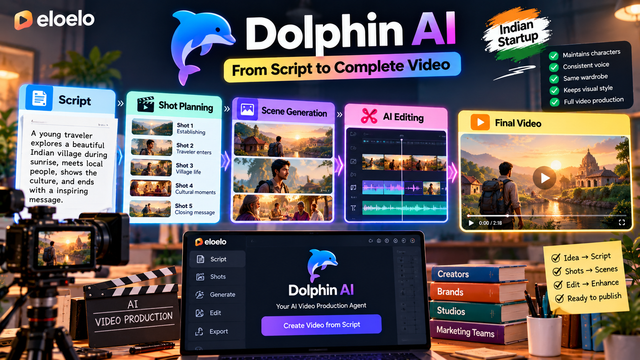
Dolphin AI Turns Scripts Into Complete Videos
An Indian startup is building a different kind of AI video tool.
Eloelo Group has launched Dolphin AI, an agentic video-production platform designed to handle much more than simply generating a video from a text prompt.
The platform is designed to take a creative idea or script and move through multiple stages of production, including scripting, shot planning, scene generation, editing and enhancement. The Indian Express reported that Dolphin AI was unveiled on September 29, 2026, at FICCI FRAMES 2026 in Mumbai.
The bigger idea is simple:
Script → Shot planning → Scene generation → Continuity → Editing → Final video
That makes Dolphin AI interesting because traditional text-to-video tools generally focus on generating individual clips. Creating a longer production can still require creators to manage many separate generations, shots, edits and continuity problems.
Dolphin AI is trying to put more of those steps into one production workflow.
From text-to-video to video production
Generating one impressive AI video clip is relatively easy to demonstrate.
Creating a complete multi-shot production is much harder.
A longer video may require the same character to appear across different scenes. The character may need to wear the same clothes, use the same voice and interact with the same objects and locations.
If every shot is generated independently, visual consistency can quickly break.
Eloelo says Dolphin AI addresses this through multi-shot planning and continuity technology designed to maintain consistency in characters, voices, wardrobes, props, locations and visual style across different shots.
That is one of the most important parts of the platform.
Instead of treating every generated clip as an isolated piece, the system is designed to understand the production as a connected sequence.
How the agentic workflow works
Dolphin AI's agentic production layer can interpret creative intent and break longer videos into individual shots.
A simplified workflow looks like this:
1. Script
The creator provides the story or video concept.
↓
2. Shot planning
The system determines how the story can be divided into individual shots.
↓
3. Scene generation
The required visual scenes are generated.
↓
4. Continuity
Characters, voices, wardrobe, props and visual style are kept consistent across shots.
↓
5. Editing
The generated material can be assembled and enhanced.
↓
6. Final video
The production is prepared as a complete video.
This is closer to an AI production assistant than a simple text-to-video generator.
Why continuity matters
Imagine creating a two-minute story about a character travelling through an Indian village.
The character appears in 20 different shots.
In one shot, the character wears a blue shirt.
In another, the shirt suddenly becomes white.
The character's face changes slightly.
The voice sounds different.
The camera style changes.
The background also changes unexpectedly.
These problems can make an AI-generated video feel artificial even when individual shots look impressive.
Maintaining continuity is therefore one of the biggest challenges in longer AI video production.
Dolphin AI's approach is designed specifically around this problem, with Eloelo saying its system can preserve important production elements across multiple shots.
Built from a real production workflow
Another interesting detail is where Dolphin AI came from.
Eloelo did not describe it simply as a research experiment.
According to the Indian Express report, the company developed Dolphin AI from its own large-scale video-production experience. Eloelo says it has produced more than 5,000 original dramas through its Story TV platform and tests more than 100,000 creative assets every month.
The company initially developed the technology to make its own production process faster and more iterative before opening the platform to creators, filmmakers, brands and studios.
That makes the product particularly relevant to professional content production.
The company has already experienced the repetitive parts of creating large volumes of content and is attempting to automate more of that workflow.
Why creators should care
For an individual creator, the most interesting part isn't necessarily generating another AI clip.
It is reducing the amount of manual work between an idea and a finished video.
A creator could potentially start with:
“Create a 60-second cinematic story about a young entrepreneur building a startup in Hyderabad.”
Instead of manually planning every shot, the production system could help turn the concept into a sequence of scenes.
That creates a much more interesting content workflow:
Idea → Script → Shots → Scenes → Edit → Publish
This could be particularly useful for social media creators who need to produce videos regularly.
Potential use cases
Dolphin AI's workflow could be useful for several types of production.
Social media
Creators could develop short-form stories and promotional videos from scripts.
Advertising
Brands could experiment with multiple video concepts without producing every version manually.
Entertainment
Studios could prototype scenes and stories before moving into larger production processes.
Marketing
Businesses could turn campaign ideas into video concepts more quickly.
Storytelling
Creators could experiment with longer AI-generated narratives where continuity matters more than a single impressive shot.
What makes this different from normal AI video generation?
The distinction is important.
A traditional workflow might look like:
Prompt → Generate clip → Prompt again → Generate another clip → Edit manually
An agentic production workflow aims to become:
Script → AI plans production → AI generates shots → AI maintains continuity → AI edits → Final video
That is a significant shift.
The AI isn't only generating pixels.
It is participating in the production process.
What this means for India
Dolphin AI is also an interesting example of India's growing role in the AI creator economy.
Instead of only using AI products developed elsewhere, Indian startups are increasingly building AI systems around specific production and business workflows.
For Indian creators, agencies and brands, tools like this could lower the amount of repetitive work required to produce video at scale.
A small creative team could potentially experiment with more concepts before committing significant time and money to traditional production.
At the same time, AI video tools still need human creative direction.
Storytelling, editing decisions, brand identity, cultural context and final quality control remain important.
The most useful way to think about Dolphin AI is therefore not “AI replaces the video team.”
It is:
“AI becomes another production layer inside the video team.”
The bigger trend
AI video is moving through an important transition.
The first wave focused on:
Text → Video
The next wave is increasingly focused on:
Idea → Production workflow → Finished video
Dolphin AI represents that second direction.
The interesting question is no longer only how realistic an AI-generated shot can look.
It is whether AI can manage an entire production while maintaining consistency from the first scene to the last.
If that approach continues improving, the future of AI video may look less like generating individual clips and more like having an AI production agent that helps create the entire project.