Claude & Agentic AI Security: New Risks for AI Agents
AI agents like Claude can use tools and take actions, creating new security risks around permissions, data access and autonomy.
Source: https://genai.owasp.org/resource/owasp-top-10-for-agentic-applications-for-2026/
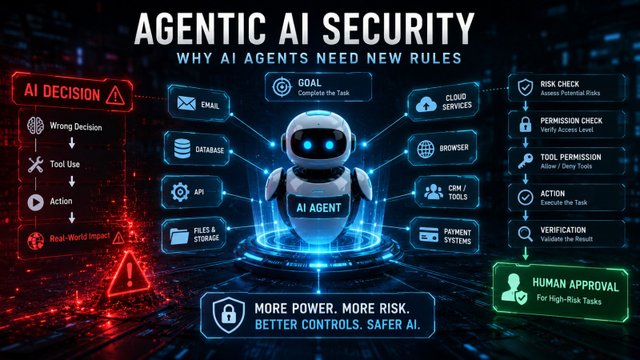
Agentic AI Is Creating a New Security Challenge
AI agents are changing how businesses use artificial intelligence.
Traditional chatbots mainly generate answers. Agentic AI systems can go much further: they can plan tasks, use tools, access external systems and take actions on behalf of users.
That creates a completely different security challenge.
If a chatbot produces a wrong answer, a person can usually review it before acting.
Chatbot:
Wrong answer → Human decides
But an AI agent may be connected directly to tools and business systems.
AI Agent:
Wrong decision → Tool → Action
A mistake can therefore become a real-world consequence.
Agents may interact with email, databases, APIs, cloud services, browsers, CRM platforms and other business tools. Giving an agent too much access can increase the potential impact of a mistake, compromise or malicious instruction.
One major concern is excessive agency—giving an AI agent unnecessary functionality, permissions or autonomy.
Another major risk is prompt injection, where malicious instructions contained in external content can influence an agent's behavior.
A safer agent architecture should introduce multiple control layers:
Goal → Agent → Risk Check → Permission Check → Tool → Action → Verification → Human Approval
Low-risk tasks can be automated, while high-risk actions should receive stronger controls.
For example, an agent that summarizes emails may only need read access. It shouldn't automatically receive permission to delete emails, change account settings or access unrelated systems.
For high-impact operations such as financial transactions, deleting critical data, changing production systems or granting permissions, additional verification or human approval can significantly reduce risk.
This is why agentic AI security is becoming its own area of AI security and governance. OWASP's Top 10 for Agentic Applications 2026 specifically addresses security risks associated with autonomous and tool-using AI applications.
The fundamental shift is simple:
AI security used to focus heavily on what models say.
Agentic AI security must also focus on what AI systems are allowed to do.
The bigger question for businesses is no longer just:
"How smart is the AI?"
It is:
"How much power should we give the AI—and what happens if it makes the wrong decision?"