Anthropic Invests $100M to Train 10,000 AI Engineers
Anthropic launches Claude Frontier Academy with a $100M commitment to train 10,000 engineers to deploy AI in enterprise workflows by 2027.
Source: https://www.anthropic.com/news/claude-frontier-academy
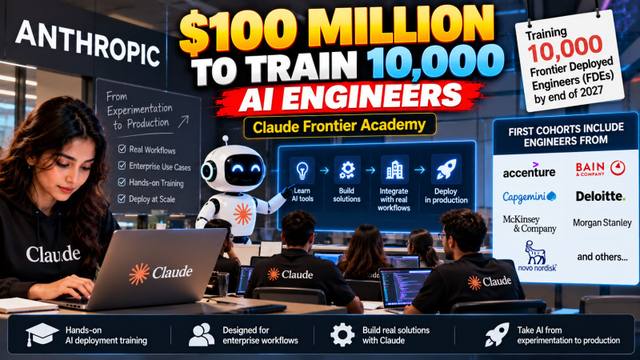
Anthropic Invests $100M to Train 10,000 AI Engineers
Anthropic is making a major investment in the people needed to bring artificial intelligence into real-world businesses. The company has announced the Claude Frontier Academy, backed by a $100 million commitment designed to train 10,000 Frontier Deployed Engineers (FDEs) by the end of 2027.
The announcement highlights a growing challenge in enterprise AI. Companies increasingly have access to powerful AI models, but having access to a model does not automatically mean an organization can successfully deploy AI across its business operations. Companies also need engineers who understand how to connect AI systems with existing software, data, tools and business processes.
Anthropic's Frontier Deployed Engineer concept focuses specifically on this implementation layer. Rather than concentrating only on theoretical AI knowledge or basic prompting, the program is designed around taking AI from experimentation into production.
The first cohorts of the program include engineers from major organizations such as Accenture, Bain, Capgemini, Deloitte, McKinsey, Morgan Stanley and Novo Nordisk, among others. These participants can learn how to build practical solutions using Claude and integrate AI into real enterprise workflows.
This approach reflects an important shift in the AI industry. Early enterprise AI adoption often focused on experimentation: employees testing chatbots, generating documents or using AI assistants for individual tasks. The next stage is much more complicated. Organizations want AI systems that can connect with internal applications, automate repetitive processes, work with company data and operate reliably at scale.
That requires specialized engineering skills.
A useful way to understand the emerging workflow is:
AI model → engineer → company systems → integrations → business workflow → production
The engineer becomes the bridge between the AI model and the organization's actual operations.
Anthropic's investment also suggests that the company sees a shortage of people capable of deploying advanced AI systems as a significant bottleneck. The future value of AI may therefore depend not only on improving models, but also on developing the workforce capable of turning those models into useful products and automated processes.
For developers and students, this trend could create new career opportunities around AI integration, agent development, workflow automation, enterprise deployment and AI systems engineering.
The announcement also challenges the idea that the next major AI role will simply be “prompt engineer.” As AI systems become more capable, organizations increasingly need people who can understand a business problem, design an AI-powered workflow, connect the necessary tools and evaluate whether the system works reliably.
Anthropic's Claude Frontier Academy ultimately represents a broader industry transition: AI adoption is moving from experimentation toward implementation.
The companies that successfully benefit from AI may not simply be those with access to the best models. They may be the organizations with the engineering talent capable of connecting those models to real business processes.