Anaconda Adds AI Agent Swarms for Autonomous Red-Team Testing
Anaconda has added agent swarms and autonomous red-team agents to its AI Dev Factory, allowing AI to be tested for security problems before deployment.
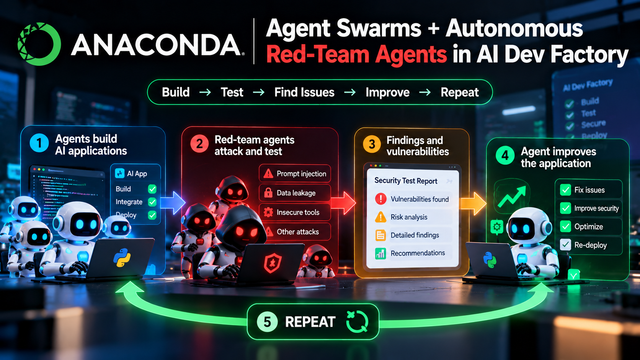
Anaconda brings agent swarms and autonomous red-team agents to AI development
AI development is becoming increasingly automated. AI agents can now help developers write code, build applications and manage parts of the development process. But as AI systems become more autonomous, testing those systems for security problems becomes equally important.
Anaconda has announced new capabilities for its AI Dev Factory, including agent swarms and autonomous red-team agents designed to test AI applications for security issues.
The idea is to create a development cycle where AI agents can build applications while other specialized agents test them for potential weaknesses.
What are agent swarms?
An agent swarm is a group of AI agents working together on a larger task.
Instead of asking one AI agent to handle everything, different agents can have different responsibilities. One agent might build an application, another could analyze its behavior and another could focus on security testing.
This creates a more automated development workflow.
The basic architecture can be represented as:
Agent builds → Red-team agents test → Findings → Agent improves → Repeat
AI agents testing AI agents
The interesting part of Anaconda's approach is the use of autonomous red-team agents.
Red teaming is a security practice where systems are deliberately tested to discover weaknesses before attackers can exploit them.
With autonomous AI red-team agents, some of this testing can potentially be performed continuously by AI.
A simplified workflow could look like this:
1. Build
AI agents create or modify an AI application.
2. Test
Red-team agents examine the application for security weaknesses.
3. Find issues
The testing agents generate findings and identify potential risks.
4. Improve
Development agents use the findings to make changes.
5. Repeat
The improved application goes through another testing cycle.
This creates a continuous build-test-improve loop.
Why this matters
AI applications can have security problems that traditional software testing may not fully capture. AI systems can be influenced by prompts, external information and unexpected inputs.
Automated red-team agents could therefore become an important part of the development process as companies deploy more AI-powered applications.
For Indian startups, developers and enterprises, this trend could reduce the amount of manual effort required for some security testing workflows while making continuous testing easier to integrate into AI development.
However, autonomous security testing should not completely replace human security expertise. Human review, access controls and proper security processes remain important.
The bigger picture
The development of AI systems may increasingly involve AI agents building and testing other AI agents.
That creates a new development loop:
Build → Attack → Find → Fix → Test again
If this approach becomes widely adopted, security testing could become a continuous part of AI development rather than something performed only before deployment.
The bigger idea is simple:
What if AI agents tested other AI agents before you deployed them?