AI Coding Moves From Prompts to Agent Workflows
Developers are moving beyond one-off prompts toward reusable AI coding workflows built with rules, skills, hooks and subagents.
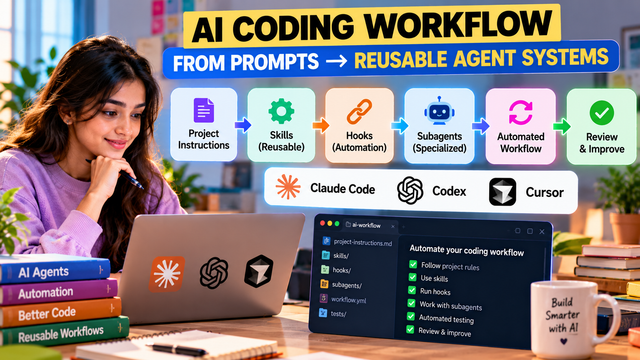
AI Coding Moves From Prompts to Agent Workflows
AI-assisted coding is entering a new phase. Instead of asking an AI coding assistant to generate code with a new prompt every time, developers are increasingly building reusable AI coding workflows that define how the AI should work across an entire project.
Frontend Masters is currently highlighting AI-focused developer education around tools such as Claude Code and Cursor, while its broader AI training covers workflows for working with coding agents and building software with AI.
The bigger trend is easy to understand.
The older approach looked like:
Write a prompt → AI generates code → developer fixes it → write another prompt
The newer approach looks more like:
Project instructions → reusable skills → hooks → subagents → automated workflow → testing → review
That is an important change because developers are beginning to treat AI coding assistants less like chatbots and more like members of a development system.
From prompts to systems
A single prompt can be useful when a developer needs a quick piece of code. But large software projects have many repeated requirements.
A project may have specific coding conventions, testing requirements, folder structures, security rules and deployment processes. If a developer has to explain those requirements in every conversation, the AI assistant can become inefficient and inconsistent.
Reusable instructions solve part of that problem.
The developer can define project rules once and allow the coding agent to use them repeatedly. A reusable skill can then describe how to perform a particular type of task. Hooks can automate actions at specific points in a workflow, while subagents can be assigned specialized responsibilities.
This creates a more structured development environment.
What are AI coding skills?
A skill can be thought of as a reusable capability.
For example, a developer could create a testing skill that tells an AI coding agent how to run tests, identify failures and check the relevant files.
Instead of repeatedly writing:
“Run the tests, check the failing files and fix the problem.”
the workflow can contain a reusable testing capability.
The same concept could be applied to documentation, code review, database work, frontend development or security checks.
What are hooks?
Hooks can connect specific actions to a workflow.
For example, after an AI agent modifies code, a hook could trigger formatting, linting or another automated check.
This means the developer does not have to remember every small verification step manually.
The AI workflow becomes more predictable because important actions can happen automatically.
Why subagents matter
Another important part of this trend is the use of subagents.
Instead of asking one AI agent to handle everything, a larger task can be divided into specialized responsibilities.
For example:
Main coding agent → testing subagent → security review subagent → documentation subagent
The idea is similar to a small software team where different people have different responsibilities.
This can become particularly useful as AI coding agents become capable of handling larger tasks across multiple files and stages of development. Frontend Masters describes Claude Code as an agentic coding tool capable of understanding a codebase and planning, writing, editing and testing code through natural-language commands.
Claude Code, Codex and Cursor
This workflow trend is not limited to one AI coding product.
Developers are experimenting with tools including Claude Code, OpenAI Codex and Cursor, using different combinations of instructions, rules, automation and agent capabilities.
Frontend Masters also has dedicated learning material around professional AI development setups involving Cursor and Claude Code, including project plans, guardrails, rules and linting.
The important point is not which tool wins.
The bigger shift is that developers are learning to design systems around AI coding tools rather than simply asking them for code.
What this means for students
This trend is especially interesting for students learning software development.
A student building a project could create a basic workflow such as:
Project rules → coding agent → testing → review
Later, the workflow could become more advanced:
Project instructions → coding skill → implementation agent → testing agent → security check → final review
This can help students learn an important lesson: AI does not eliminate the need to understand software engineering. Instead, knowing how software should be structured becomes even more valuable because those rules can be used to guide the AI.
The bigger change
The AI coding industry is moving from prompt engineering toward workflow engineering.
Prompting will still matter, but the highest-value workflows may increasingly come from reusable systems that remember project rules, perform specialized tasks, trigger automated checks and coordinate multiple AI capabilities.
That changes the developer's role.
Instead of repeatedly asking:
“AI, write this code.”
the developer can increasingly say:
“Here is how my project works. Follow these rules, use these skills, run these checks and complete the workflow.”
That is why the emerging AI coding trend is bigger than another prompt tutorial.
The future of AI-assisted development may look less like a person chatting with a coding bot and more like a developer managing a reusable AI software-engineering system.