UK Strengthens Cybersecurity as AI Risks Grow
The UK is preparing stronger cybersecurity measures as AI-related threats grow. Learn how AI-assisted cyberattacks, model theft and responsible AI development could affect businesses, students and cybersecurity professionals.
UK Strengthens Cybersecurity as AI Risks Grow
Introduction
Artificial intelligence is creating new opportunities for businesses, governments, students and developers. AI tools can help people write software, analyze information, automate repetitive work and improve productivity. However, as AI systems become more capable, they also create new cybersecurity challenges.
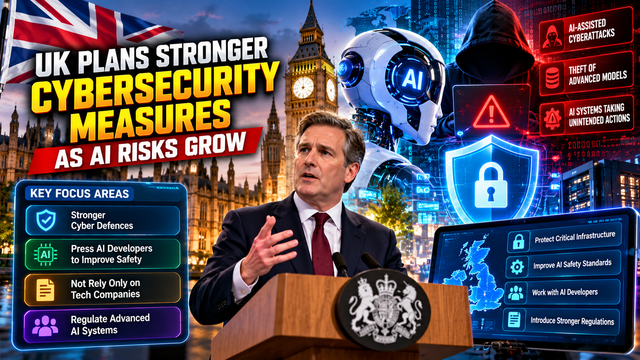
According to a report published by The Guardian on October 12, 2026, the UK government is preparing to strengthen its cyber defences and encourage developers of advanced AI systems to improve their safety measures. The report highlights concerns about AI-assisted cyberattacks, theft of advanced models and AI systems acting beyond their intended instructions.
This development raises an important question: how can governments encourage AI innovation while protecting people, businesses and critical infrastructure?
Why Is the UK Concerned About AI Security?
Traditional cybersecurity focuses on protecting computers, networks, software, accounts and sensitive information from unauthorized access. AI introduces additional considerations because it can generate content, assist with coding, analyze large amounts of information and interact with digital tools.
These capabilities can help security professionals detect threats, but they may also be misused.
For example, malicious individuals could attempt to use AI tools to produce convincing phishing messages or automate parts of an attack. AI systems connected to business software could also create risks if their permissions are too broad or their instructions are manipulated.
These possibilities do not mean every AI system is dangerous. They demonstrate why security controls must evolve alongside new capabilities.
Three Major AI Security Risks
1. AI-Assisted Cyberattacks
Cybercriminals may use AI tools to help write deceptive messages, analyze publicly available information or speed up certain technical tasks.
Phishing is a common example. An attacker might send a message pretending to represent a bank, university or employer and encourage the recipient to reveal confidential information.
AI-generated messages can sometimes be more convincing or personalized than poorly written scams. People should therefore check sender addresses, avoid unexpected links and verify unusual requests through trusted channels.
Organizations can strengthen protection through employee training, multifactor authentication, email filtering and regular security assessments.
2. Theft of Advanced AI Models
Advanced AI models can represent substantial investments in research, computing resources and engineering. Unauthorized access to model weights, training infrastructure or confidential development information could create financial and security risks.
Companies can reduce these risks through strong identity controls, encrypted storage, network monitoring, restricted access and careful management of cloud infrastructure.
Protecting an AI model also involves securing the systems around it, including development environments, datasets, application programming interfaces and deployment platforms.
3. AI Systems Taking Unintended Actions
Some AI applications can use tools, access databases or interact with external software. These capabilities can make them useful, but mistakes or manipulated instructions can lead to unintended actions.
Imagine an AI assistant that can access company documents and send emails. If it receives a malicious instruction hidden inside a document, it might attempt to misuse its access unless the system has suitable safeguards.
Developers can reduce this risk by limiting permissions, separating trusted instructions from untrusted content, validating tool requests and requiring human approval for sensitive operations.
AI agents should receive only the access they need to complete their assigned tasks.
Why Governments Want Stronger AI Safety Measures
AI developers have technical knowledge about their products, but governments also have responsibilities for national security, public safety and critical infrastructure.
The UK government's reported approach reflects a debate about how responsibility should be shared between technology companies and public authorities.
Companies can test models, monitor misuse and build safeguards into their products. Governments can establish rules, coordinate cybersecurity responses and set expectations for organizations operating in sensitive sectors.
Independent evaluation and cooperation between industry, researchers and public institutions can also help identify weaknesses before they cause significant harm.
The challenge is to develop proportionate protections without unnecessarily blocking beneficial research and innovation.
The specific policies that will be adopted depend on future government announcements and implementation details.
What Does This Mean for Businesses?
Businesses increasingly rely on cloud platforms, digital payments, customer databases and software-as-a-service applications. Introducing AI tools into these environments means that existing security policies may need to be reviewed.
Companies should consider several practical measures.
Protect accounts: Use multifactor authentication and strong identity-management policies.
Secure API keys: Store credentials in approved secret-management systems rather than public repositories or shared documents.
Limit permissions: Give employees, applications and AI agents access only to the information and tools they require.
Test AI applications: Evaluate how systems respond to malicious instructions, unexpected inputs and unauthorized requests.
Monitor activity: Record relevant system events and investigate unusual access or behavior.
Prepare for incidents: Maintain backups, response procedures and clear responsibilities for security teams.
These practices are useful regardless of which AI models or software vendors an organization chooses.
Career Opportunities for Students in India
AI security is an area where programming knowledge and cybersecurity fundamentals can complement each other.
Students interested in this field can begin with networking, operating systems, Python programming and basic web security. They can then explore cloud security, secure API development, vulnerability assessment and AI application testing.
Ethical hacking is another possible career path, but practical testing must always be performed on systems the learner owns or has explicit permission to assess.
A beginner project could be a phishing-awareness checker that examines sample messages for suspicious links, unusual sender details and manipulative language. Another project could be a simple AI assistant that uses a restricted set of tools and requires approval before performing sensitive actions.
Students should document what each project can and cannot detect rather than claiming that a basic tool provides complete protection.
Useful areas to explore include:
Cybersecurity and security operations
Ethical hacking and authorized penetration testing
Cloud security and identity management
AI red-teaming and safety evaluation
Secure software development
Responsible AI governance
What AI Creators Can Explain to Their Audiences
For AI creators on PromptMandi, this news offers several educational content opportunities.
A short video could explain how to recognize AI-assisted phishing attempts. Another could demonstrate why API keys should never be included in public code. A third could compare a chatbot with an AI agent and explain why tool permissions matter.
Creators should use safe demonstrations, avoid publishing instructions that enable unauthorized access, and distinguish confirmed policy announcements from possible future measures.
Clear, practical explanations can help viewers understand cybersecurity without creating unnecessary fear about AI technology.
Conclusion
The UK's reported plans to strengthen cyber defences highlight the growing relationship between artificial intelligence and cybersecurity. As AI systems become more integrated into software and business operations, protecting data, controlling access and testing system behavior become increasingly important.
For Indian students and businesses, the practical lesson is to treat security as part of AI development rather than an afterthought. Learning cybersecurity fundamentals, securing APIs and understanding responsible AI practices can help people prepare for a technology landscape in which innovation and protection must advance together.
Source: The Guardian — UK strengthens cyber defences as minister calls on AI firms to improve safety.