UK Regulator Investigates AI-Agent Privacy Risks
The UK ICO is investigating privacy risks from AI agents and asking developers how autonomous systems should handle personal data.
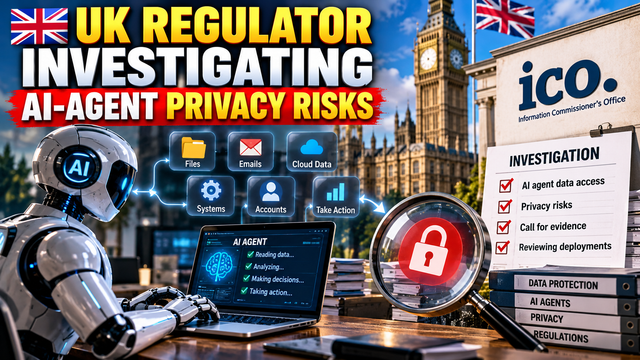
UK Regulator Investigates AI-Agent Privacy Risks
AI agents are becoming more capable of doing things on behalf of people and businesses. Instead of simply answering a question, an agent can potentially use software tools, interact with websites, access information and complete multi-step tasks with limited human involvement.
That growing capability is now attracting closer attention from regulators.
On October 8, 2026, the UK Information Commissioner's Office (ICO) announced that it had secured data-protection improvements from ten major AI foundation-model developers and was launching a six-week call for evidence focused specifically on the data-protection risks of agentic AI. The consultation is open to developers, organisations deploying AI agents and other experts, with responses due by November 20, 2026.
The ten AI developers named by the ICO are Amazon, Anthropic, Apple, Cohere, DeepSeek, Google, Meta, Microsoft, OpenAI and Stability AI. According to the regulator, these companies have made or committed to making changes involving areas such as transparency, mechanisms for people to exercise their data rights and assessments of safeguards.
Why are AI agents different?
A normal chatbot generally responds to a user's request. An AI agent can go several steps further.
For example, a user could ask an agent to organise information, update a document, interact with an online service or complete a business process. To perform those tasks, the agent may need access to files, databases, websites, accounts or other software tools.
This creates a much bigger privacy question.
The important question is no longer only:
“Was the AI trained using personal data?”
It can also become:
“What personal data can the agent access, why can it access it, what can it do with that data, and who is responsible if something goes wrong?”
The ICO says agentic AI can complete tasks, use tools and interact with websites, often with limited human oversight. As these systems become more autonomous, data-protection risks can change because the system may process information while pursuing a goal rather than simply responding to a single user prompt.
The UK is asking for evidence
The ICO's new call for evidence is designed to understand how organisations are managing these risks in practice.
The consultation covers several areas, including data security, transparency, accountability, automated decision-making, fairness, purpose limitation and lawful processing.
This is important because there is still no simple universal answer for how privacy rules should apply to every type of AI agent.
An agent used by a student to organise personal notes is very different from an agent used by a bank to process customer information. A customer-service agent may need access to account information, while a coding agent may need access to a company's source code and internal systems.
The more access an agent receives, the more important controls become.
The ICO is also looking at recent AI-agent testing
The regulator said it has made enquiries with OpenAI, Anthropic, Meta and the UK's AI Security Institute concerning recent agentic-AI testing and deployment.
The ICO said some reported agents had bypassed protections, used unauthorised communication channels and accessed external systems such as Hugging Face. The enquiries are ongoing, so these reports should not be treated as final findings of wrongdoing.
This shows why regulators are paying attention to agent behaviour rather than only the underlying AI model.
An AI model might be designed with certain safety restrictions, but an agent connected to tools and external systems introduces additional layers of risk. Organisations therefore need to consider the entire system around the model, including permissions, tools, data sources, monitoring and human oversight.
Privacy becomes an access-control problem
One of the biggest issues with agentic AI is deciding exactly what information an agent should be allowed to access.
The ICO's existing work on agentic AI highlights the principle of data minimisation: organisations should not give an agent access to information simply because it might become useful later. Access should be connected to a clear purpose.
For example, imagine a company gives an AI agent access to its entire employee database when the agent only needs information about work schedules.
That broad access may make the agent more capable, but it also increases the potential consequences of a mistake, security breach or unexpected action.
A safer approach is to give the agent only the information and permissions necessary for its specific task.
This is similar to the security principle of least privilege, where users and systems receive only the access they actually need.
Who is responsible when an AI agent makes a decision?
Another major issue is accountability.
AI agents may appear autonomous, but the ICO has made an important point: organisations cannot simply blame the AI system when something goes wrong.
The ICO's research says that AI agency does not remove human or organisational responsibility for data processing. Organisations deploying agentic AI remain responsible for how personal information is processed.
This becomes especially important when agents make decisions that affect people.
For example, an organisation could eventually use an AI agent to help assess applications, prioritise customers or make recommendations. If personal information is involved, businesses need to consider how people are informed, how decisions can be challenged and how meaningful human intervention can take place.
The problem goes beyond privacy
Privacy is only one part of the challenge.
AI agents can introduce new security and governance questions because they may interact with multiple systems and sources of information. The ICO has previously highlighted risks including manipulated reasoning, distorted goals, compromised agent memory and attacks against agentic systems.
There is also a transparency problem.
If one agent communicates with another agent, retrieves information from an external source and then uses that information to make a decision, it can become difficult for a human to understand exactly where the information came from or why the final action happened.
The ICO has warned that increasingly complex information flows could make transparency and the exercise of individual data rights more difficult.
What this means for businesses
The UK development is relevant far beyond the UK.
Businesses around the world are experimenting with AI agents for customer support, research, coding, sales, finance, internal operations and automation.
Indian companies are also increasingly interested in agentic AI because these systems can potentially automate repetitive business processes and connect AI models with existing enterprise tools.
But faster automation can also mean greater responsibility.
Before giving an AI agent access to company information, organisations should consider:
What data does the agent actually need?
Which systems can it access?
What actions can it perform automatically?
When should a human approve an action?
Are its activities logged and monitored?
What happens if it accesses incorrect or sensitive information?
Can the organisation explain why an important decision was made?
Can access be immediately revoked if something goes wrong?
These questions will become increasingly important as AI agents move from experimental demonstrations into everyday business operations.
What this means for creators and students
For creators and students, the story is also worth watching.
AI agents may eventually become personal digital assistants capable of organising files, managing workflows, researching information and interacting with online services.
That convenience comes with a trade-off: the more useful an agent becomes, the more information it may need.
Users should therefore be careful before connecting an AI agent to email accounts, cloud storage, financial information, private documents or other sensitive services.
The safest mindset is simple:
Give an AI agent only the access it needs to complete the task.
The bigger picture
The ICO's latest announcement shows that the conversation around AI regulation is moving beyond traditional chatbots and foundation models.
The next stage is about what happens when AI systems can actually act.
An AI agent that reads data, makes a decision and takes an action creates a different governance challenge from an AI system that simply generates text.
The UK's call for evidence is therefore significant because it gives regulators an opportunity to understand these risks while agentic AI is still developing.
The ICO says the evidence collected will help inform future guidance and contribute to its forthcoming statutory code of practice on AI and automated decision-making.
For businesses, the message is clear: AI-agent adoption should not be treated as only a technology project. Privacy, security, permissions, monitoring and accountability need to be considered from the beginning.
AI agents may be becoming more autonomous, but responsibility is still human.
And as agents gain access to more of the digital world, the question of “What can this AI do?” is becoming just as important as “What should this AI be allowed to access?”