TocklAI: India's New AI Model for Tea Growers
India launches TocklAI, a specialised AI project using verified tea research to help growers explore pest control, soil health and climate adaptation.
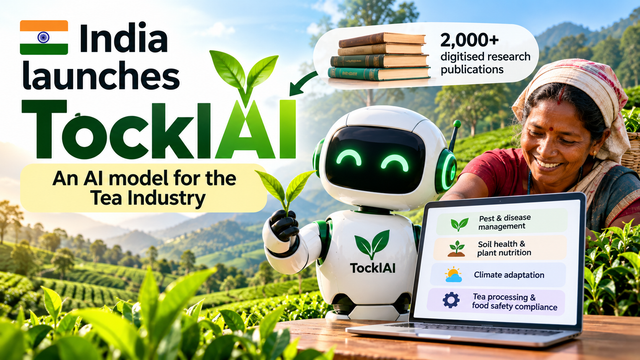
TocklAI: How India Is Using AI to Transform the Tea Industry
India's artificial intelligence story is moving beyond general-purpose chatbots. A new development from the country's tea research community shows how AI can be designed around the needs of a specific industry.
On October 8, 2026, the Tea Research Association (TRA) launched TocklAI, an AI model project built specifically for the tea industry. The project draws on the scientific research of Assam's Tocklai Tea Research Institute, an institution with more than a century of experience studying tea cultivation, plant health, soil management and processing.
Unlike a general-purpose AI assistant that answers questions across many subjects, TocklAI is designed to help users access specialised tea research. The system uses retrieval-augmented generation, commonly known as RAG, to retrieve relevant information from a verified research archive before generating an answer.
The archive includes more than 2,000 digitised scientific publications. The aim is to make decades of agricultural knowledge easier for tea planters, estate managers and smaller growers to access.
This launch highlights an important direction for AI: sometimes the most useful model is not the one that knows a little about everything, but the one that can help people find reliable information about a specific problem.
1. What is TocklAI?
TocklAI is a specialised artificial intelligence project developed by the Tea Research Association for the tea industry. It is intended to connect agricultural questions with the research and practical knowledge accumulated by Tocklai Tea Research Institute in Jorhat, Assam.
Tea cultivation involves many interconnected factors. Growers need to consider the health of tea plants, local soil conditions, rainfall, temperature, pests, diseases, plant varieties and harvesting practices. Processing and food-safety requirements add further complexity after the leaves have been harvested.
Finding relevant guidance can require access to scientific papers, technical manuals, research reports and experienced agricultural advisers. These resources are valuable, but the information may be difficult to search or understand without specialist knowledge.
TocklAI aims to make that information more accessible through an AI-powered question-and-answer experience. Instead of relying only on general knowledge learned during model training, the system retrieves relevant material from TRA's research archive to help formulate responses.
For example, a tea grower might want to understand a particular soil-health problem or learn what research says about managing a crop disease. A specialised assistant could help locate relevant guidance and explain it in a more accessible format.
The intention is to connect established tea research with the people who need it in their day-to-day work.
2. Why does India's tea industry need specialised AI?
Agriculture is not a one-size-fits-all activity. Advice that works for one crop, region or growing condition may not work equally well elsewhere.
Tea production is influenced by weather patterns, soil characteristics, plant varieties, disease pressure, farm management and processing practices. Tea-growing areas also differ in their local environmental conditions and production challenges.
India's tea industry includes large estates as well as many smaller growers. Access to specialist advice, research publications and technical support can vary considerably between them.
A general-purpose chatbot may be able to explain basic agricultural concepts, but it may not consistently provide the specialised, locally relevant information needed for a particular tea-growing problem. It can also produce confident-sounding answers that require verification.
A specialised system has a different goal: make relevant industry knowledge easier to retrieve and understand.
For tea growers, this could mean spending less time searching through technical documents and more time understanding the research relevant to a question. For researchers, it could provide another way to make existing publications accessible to a wider audience.
The technology does not replace agronomists or agricultural scientists. Its potential value lies in helping people find and interpret information more efficiently.
3. How does TocklAI use RAG?
One of the key technical ideas behind TocklAI is retrieval-augmented generation, or RAG.
RAG combines two processes: retrieving relevant information from a collection of documents and using an AI model to generate a response informed by that information.
A simplified workflow looks like this:
Step 1: A user asks a question.
A grower enters a question about tea cultivation, plant health, soil nutrition or another supported topic.
Step 2: The system searches its knowledge archive.
The retrieval component looks for relevant passages or documents in the available research collection. In TocklAI's case, the reported knowledge base includes digitised scientific publications from the Tea Research Association's research archive.
Step 3: Relevant information is provided to the AI model.
The system uses the retrieved material as context for answering the user's question.
Step 4: The AI generates an explanation.
The model produces a response based on the available context and its language-generation capabilities.
Step 5: The user evaluates the guidance.
For important agricultural decisions, users should check the recommendations against the original research, local field conditions and qualified expert advice.
The key idea is that the model does not need to memorise every detail of every publication. It can retrieve relevant information when a question is asked.
However, RAG is not a guarantee of correctness. A retrieval system might find incomplete or irrelevant material, and a language model may still misinterpret evidence or generate unsupported details. The quality of the source archive, retrieval process and evaluation methods matters.
4. What is the role of Tocklai Tea Research Institute?
Tocklai Tea Research Institute, located in Jorhat, Assam, is a long-established centre for tea research. Its work includes the study of tea cultivation, plant improvement, soil health, pests and diseases, climate-related challenges and tea processing.
The institute's history matters because a specialised AI assistant is only as useful as the knowledge it can draw upon. A research archive built around a specific crop and industry can contain details that a general-purpose system may not readily retrieve or apply correctly.
TRA's broader research work also includes practical guidance for tea estates and growers. Its official website describes research activities and resources covering areas such as cultivation, tea soils, climate research, processing and pest management.
By making a large body of research searchable through an AI-based interface, TocklAI aims to connect that institutional knowledge with modern digital tools.
The long-term opportunity is not simply to turn research papers into chatbot answers. It is to improve how research findings are discovered, understood and used in real agricultural settings.
5. What can TocklAI help tea growers explore?
The reported applications span several important areas of tea production.
Pest and disease management
Pests and plant diseases can damage tea crops and affect productivity. Growers need to understand possible causes, recognise warning signs and learn about appropriate management practices.
A research-grounded AI assistant could help users find relevant publications and guidance related to tea pests and diseases. Any suggested treatment still needs to be checked against local conditions and current expert recommendations.
Soil health and plant nutrition
Healthy soil supports plant growth and contributes to long-term plantation productivity. Questions about nutrients, soil conditions and plant development often require technical information.
A specialised assistant could help growers locate research about soil management and plant nutrition. The correct action may vary according to soil testing, weather, plantation conditions and professional advice.
Climate adaptation
Changing weather patterns and extreme events can affect tea production. Research into climate adaptation can help growers understand possible risks and explore practices intended to improve resilience.
TocklAI's research-based approach could make relevant climate and cultivation publications easier to find. It should not be treated as a substitute for local weather forecasts or a guarantee of future crop outcomes.
Tea processing and food safety
Tea quality depends not only on cultivation but also on how leaves are processed and handled. Food-safety and compliance requirements are also important for businesses supplying domestic and international markets.
Access to specialised research may help users find information about processing practices and relevant technical guidance. Businesses must still follow applicable standards and verify current regulatory requirements.
Plant varieties and replanting
Selecting suitable planting material and deciding when to replant can have long-term implications for a tea estate. Research on plant varieties, cultivation and field management can inform these decisions.
A specialised AI assistant could help users discover relevant material, while final decisions should take local growing conditions and professional recommendations into account.
6. Why small tea growers could benefit
One of the most important goals described in reporting about TocklAI is making specialist research more accessible to smaller growers.
Large estates may have established management teams, technical advisers and access to agricultural specialists. Smaller producers may have fewer resources for finding and interpreting scientific information.
When research is difficult to locate or written in highly technical language, useful findings may not reach everyone who could benefit from them.
An accessible AI interface could help narrow that gap. A grower could ask a practical question and use the response to discover relevant research, understand technical concepts or prepare questions for an agricultural adviser.
This does not mean every farmer will automatically receive a perfect recommendation. Digital access, language support, ease of use, connectivity and the quality of responses will all influence whether the tool is useful in practice.
The real measure of success will be whether growers can use it reliably, understand its limitations and apply verified information to their local conditions.
7. What does TocklAI mean for Indian agritech startups?
TocklAI offers a useful example for entrepreneurs interested in building AI products for agriculture.
Instead of trying to build another chatbot that answers every possible question, a startup could focus on a well-defined problem and a trustworthy knowledge base.
For example, specialised AI applications could help users explore crop-specific research, understand agricultural documents, organise soil-test information or locate guidance relevant to a particular farming region. These are possible directions for the wider industry, not claims that TocklAI already provides every such feature.
The first challenge is acquiring reliable, legally usable information. A system built on poor-quality or outdated documents may give misleading answers regardless of how capable its language model is.
The second challenge is validation. Agricultural specialists need to assess whether responses are accurate, relevant and suitable for the intended audience.
The third challenge is usability. Farmers may prefer short, practical explanations, regional-language support or interfaces that work well on mobile phones. Product teams must test these needs rather than assume a technical demonstration will translate into everyday adoption.
Finally, developers need to measure outcomes. Does the tool help users find information more quickly? Are its answers supported by relevant sources? Does it handle uncertain questions responsibly? Can users recognise when expert help is necessary?
These questions matter more than simply advertising the number of parameters in a model.
8. Can the same approach work in other industries?
The core idea behind TocklAI can be applied to many fields where specialised, trusted information is important.
Healthcare: An assistant could help authorised professionals search clinical guidelines and research literature, while keeping medical decisions under appropriate professional oversight.
Education: A school or university could build a learning assistant grounded in approved textbooks, course materials and institutional documents.
Law and compliance: A system could retrieve relevant passages from current regulations and policy documents, while clearly indicating the source and date of the material.
Manufacturing: An assistant could help authorised staff search maintenance manuals, equipment documentation and approved operating procedures.
Government services: A knowledge assistant could make official schemes, eligibility rules and service instructions easier to understand, provided the information is maintained and kept current.
Each example would require its own safeguards, data permissions and quality checks. The same RAG architecture does not automatically make an application reliable or appropriate for a high-stakes domain.
The lesson from TocklAI is the value of combining AI with a carefully selected body of domain-specific knowledge.
9. What are the limitations and risks?
Specialised AI systems can be useful, but users should understand their limitations.
First, the knowledge base may not contain every relevant study. If the archive is incomplete, the system may miss important information.
Second, research can become outdated. New findings, revised practices and changing regulations may require the knowledge base to be updated.
Third, retrieval can fail. The system might locate a document that mentions the right topic but does not actually support the answer being generated.
Fourth, the language model may misinterpret a scientific result or produce details that are not supported by the source. This is why traceable citations, expert evaluation and clear uncertainty handling are important design goals for research assistants.
Fifth, agricultural recommendations depend on local circumstances. A general explanation of a pest or nutrient problem cannot replace field inspection, soil analysis or a qualified professional's assessment where those are needed.
For these reasons, TocklAI should be understood as a tool intended to improve access to tea research, not as an infallible agricultural expert.
10. What happens next?
The launch is an important first step, but real-world impact will depend on how the project develops and how people use it.
The Economic Times reported that more than 2,000 scientific publications had been digitised and that the work was expected to continue over an 18-month period. The research archive is therefore an important part of the project's ongoing development.
Future evaluation should consider the accuracy of responses, the relevance of retrieved documents, the needs of small growers and how easily users can verify the information provided. Accessibility, updates and practical feedback will also influence its usefulness.
It will be important to distinguish the project's intended benefits from outcomes demonstrated through independent evaluation or real-world use. A launch announcement describes what a system aims to achieve; long-term evidence shows how well it achieves those goals.
Final takeaway: AI built around real problems
TocklAI represents an interesting direction for India's AI ecosystem. Instead of focusing only on general-purpose models, it applies AI to a specific agricultural industry and connects users with a specialised research archive.
For tea growers, the aim is to make scientific knowledge easier to find. For students and developers, it offers a practical example of retrieval-augmented generation. For agritech startups, it demonstrates why trusted data, expert involvement and a clearly defined user need are central to building useful AI products.
The wider lesson is simple: a useful AI assistant does not need to know everything. It needs to retrieve relevant knowledge, explain it clearly and recognise when human expertise is necessary.
If TocklAI can make verified tea research easier to access and use, it could become a valuable example of how AI can support India's agricultural knowledge systems.
Sources
The Economic Times: https://economictimes.indiatimes.com/news/india/tea-research-association-launches-tocklai-the-worlds-first-ai-model-for-tea/articleshow/134794610.cms
Tea Research Association: https://tocklai.org/
Tea Research Association — About TRA: https://tocklai.org/about-tra/
This article describes reported capabilities and intended applications. Actual performance and agricultural outcomes should be assessed through practical use and expert evaluation.