Sarvam AI: India's 105B Model and the Future of Indian AI
Indian AI startup Sarvam is building powerful language models designed for India's linguistic diversity and business needs. Its 105-billion-parameter model, voice AI services, and plans for a much larger model India's growing ambition .
By Gangothri
Source: https://www.sarvam.ai/blogs/sarvam-30b-105b?utm_source=chatgpt.com
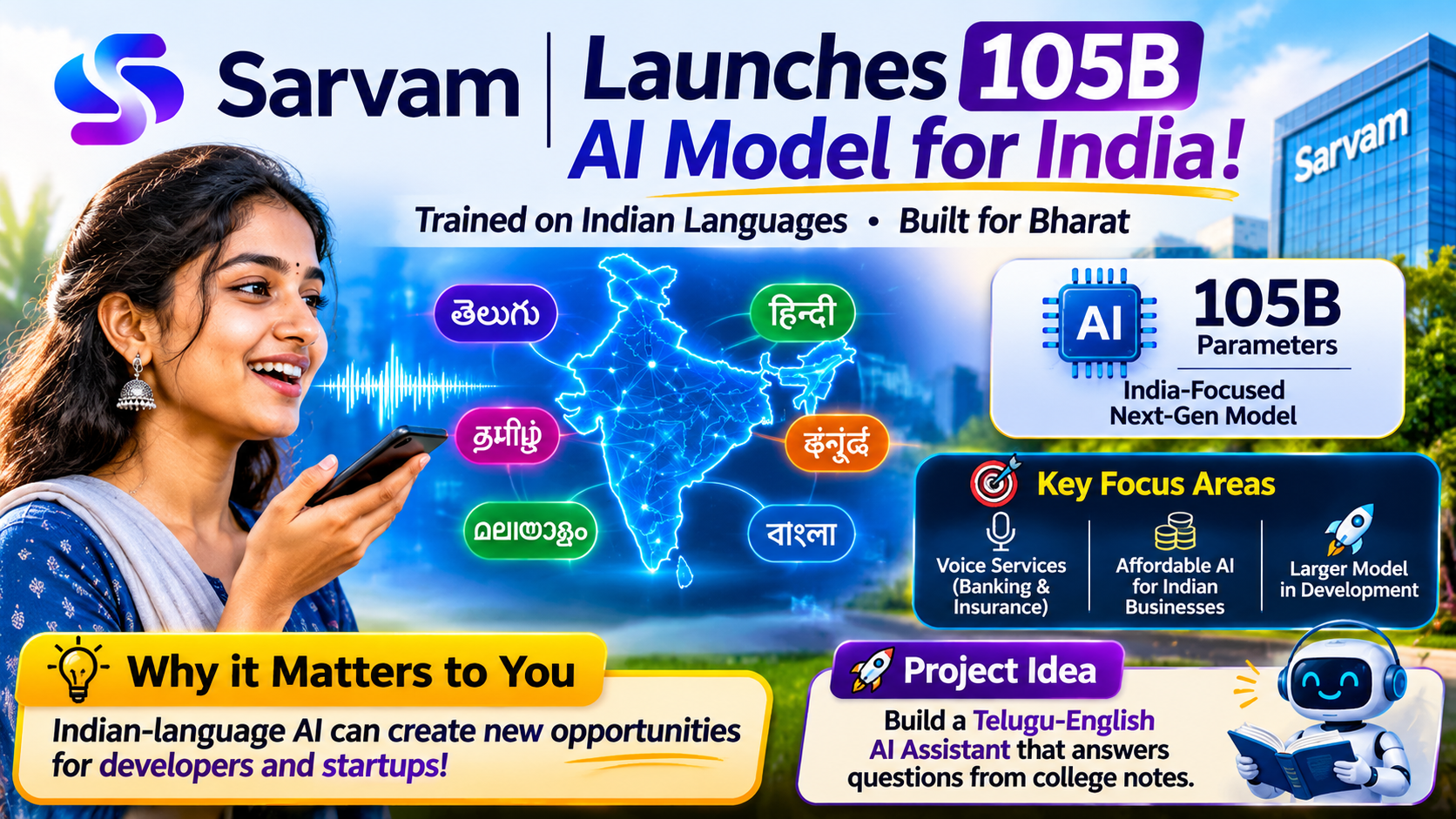
Sarvam AI: India's 105-Billion-Parameter Model and the Future of Indian-Language Artificial Intelligence
Artificial intelligence is becoming an important part of everyday life. People use AI to write emails, learn new subjects, translate languages, create images, generate code, and solve business problems. However, much of the global AI industry has developed around English-speaking users and markets with strong digital infrastructure.
India presents a different challenge.
The country has hundreds of languages and dialects, millions of people who prefer speaking rather than typing, and businesses that need technology capable of understanding local accents, mixed-language conversations, and regional requirements.
This creates an important opportunity for Indian AI companies.
One company working in this area is Sarvam AI, an Indian artificial intelligence startup developing large language models, speech technology, and AI products designed for Indian users.
Its 105-billion-parameter language model and growing focus on affordable business applications have attracted attention. The company is also working towards a much larger model as it expands its AI capabilities.
The development raises an important question: Can India build AI systems that are powerful, affordable, and genuinely useful for its own people and businesses?
1. What Is Sarvam AI?
Sarvam AI is an Indian artificial intelligence company focused on building foundational AI models and applications for India's linguistic and business environment.
The company aims to develop technology that understands Indian languages, speech patterns, documents, and real-world use cases.
Instead of concentrating only on general-purpose chatbots, Sarvam is also working on applications such as:
Indian-language conversational assistants.
Speech-to-text systems.
Text-to-speech technology.
Document understanding.
Voice-based customer service.
Enterprise AI applications.
Tools for government and public services.
This approach is important because India's technology requirements are different from those of many other countries.
For example, a customer may ask a banking question in Telugu, switch to English for a technical term, and then return to Telugu. A useful AI assistant should understand the meaning of the complete conversation instead of treating every language change as a separate problem.
Similarly, a person may speak with a regional accent, use informal expressions, or pronounce English words differently. AI systems designed for Indian users need to handle these situations reliably.
Sarvam's work is aimed at addressing such requirements.
2. Understanding Sarvam's 105-Billion-Parameter Model
One of the company's major developments is its 105-billion-parameter large language model, known as Sarvam 105B.
To understand why this matters, it is useful to understand what parameters mean.
Parameters are numerical values that an AI model learns during training. They help the model recognize patterns in language, understand relationships between words, and generate responses.
A model with billions of parameters has a large number of learned values. However, a larger parameter count does not automatically mean that a model is better at every task.
Its quality also depends on training data, architecture, evaluation, computing efficiency, and how well it performs in real applications.
Sarvam introduced its 30B and 105B models at the India AI Impact Summit in February 2026. The 30B model was designed with conversational applications in mind, while the 105B model supports more complex reasoning and longer tasks.
The 105B model has a reported context window of up to 128,000 tokens. A context window determines how much information a model can consider within a conversation or request.
For example, a long document, a collection of notes, or a detailed business report can be supplied as context for a question. The model can then use that information to prepare an answer.
Sarvam subsequently announced that both models would be released as open-source models in March 2026. The company said they were trained from scratch using computing resources made available through the IndiaAI Mission.
This is significant because it gives developers and researchers access to models they can explore and potentially build applications around, subject to the applicable licence and deployment requirements.
3. Why Indian Languages Are a Major Focus
India's linguistic diversity is one of the biggest opportunities and challenges for artificial intelligence.
Many people are comfortable using their mother tongue for everyday communication. They may understand English but still prefer to ask questions, receive instructions, or conduct transactions in a regional language.
A conventional English-first chatbot may not provide a natural experience for these users.
Consider a simple example.
A student asks:
"Machine learning ante enti? Simple ga example tho explain cheyyi."
This sentence combines Telugu and English. It asks for a simple explanation of machine learning with an example.
An AI system that understands code-mixed language can respond naturally without requiring the student to translate the question into formal English first.
The same capability can be useful in banking, healthcare administration, education, agriculture, and government services.
Sarvam's wider speech and language technology aims to make these interactions more accessible.
Its product ecosystem includes speech recognition, speech generation, translation, and document intelligence. These technologies can work together to support applications where users speak in one language, receive information in another, or interact with documents containing regional scripts.
However, language support should not be confused with perfect understanding. Real-world performance still needs to be tested across accents, dialects, background noise, spelling variations, and specialist terminology.
4. Why Sarvam Is Focusing on Affordable AI
Building and operating advanced AI systems can be expensive.
Companies need computing infrastructure, specialised processors, electricity, data storage, software engineering teams, and ongoing model maintenance.
For a large global technology company, these expenses may be manageable. For a small Indian business, the cost of using advanced AI for thousands or millions of customer interactions can become a major concern.
This is especially important for voice services.
Imagine a bank receiving thousands of customer calls every day. If every call requires an expensive AI model, operating costs can increase quickly.
A more efficient system could help the bank automate routine enquiries while transferring complicated or sensitive cases to human employees.
This is one reason Sarvam is focusing on cost-efficient AI deployment.
The company has argued that India needs AI systems designed around the tasks that businesses actually perform, rather than simply trying to compete through model size.
For example, a specialised model that performs well at understanding a banking conversation may be more commercially useful than a much larger general-purpose model that costs significantly more to operate.
The important measure is not just how many parameters a model contains. It is how reliably and economically it completes the required task.
5. Voice AI Could Change Banking and Insurance
One of the most interesting business opportunities for Indian-language AI is voice-based customer service.
Banks and insurance companies communicate with customers about many routine matters, including:
Account and service enquiries.
Policy information.
Premium reminders.
Payment instructions.
Application status.
Basic product information.
Customer support requests.
Many customers prefer speaking in their own language instead of navigating complicated menus or typing long messages.
A voice AI assistant could listen to a customer's question, convert speech into text, understand the request, retrieve relevant information, and generate a spoken response.
For example, a customer might ask:
"Na insurance policy premium eppudu pay cheyyali?"
The system needs to understand that the customer is asking when the insurance premium is due.
A suitable AI workflow could identify the customer's request, retrieve the correct policy information through an authorised system, and explain the due date in the customer's preferred language.
For a bank, a similar assistant could answer basic questions about branch timings, application progress, or account services.
However, these applications require strong security controls. Banks and insurers handle sensitive personal and financial information. Voice identity checks, customer consent, access permissions, audit logs, and human escalation are essential.
An AI assistant should not make high-impact financial decisions or disclose private information without the appropriate verification.
The biggest opportunity is therefore not simply replacing call-centre employees. It is reducing repetitive work and helping human support teams handle more complicated cases.
6. Sarvam's Larger Model Ambition
Sarvam's ambitions extend beyond its 105B model.
Recent reporting describes the company's plan to develop a model with approximately one trillion parameters, a substantial increase in scale. The Financial Times reported that the company expected the larger model within six to nine months of its November 2026 reporting.
Developing a model of this size is a major engineering challenge.
It requires large computing resources, carefully prepared training data, distributed training systems, efficient model architecture, and extensive testing.
But building a larger model is only one part of the challenge.
The company must also determine whether the model delivers meaningful improvements in reasoning, language understanding, speech applications, and enterprise tasks.
For Indian users, a particularly important measure will be whether the technology performs well in regional languages and real-world conversations.
A larger model could potentially support more complex tasks, but it may also require more computing resources. Sarvam will need to balance performance, affordability, and deployment efficiency.
The company's long-term direction reflects a wider ambition: building AI infrastructure that can serve India's requirements rather than depending entirely on systems developed elsewhere.
7. What Is Sovereign AI, and Why Does India Need It?
The term "sovereign AI" refers to a country's ability to develop, control, and use important AI capabilities in ways that support its own strategic, economic, and social needs.
This does not necessarily mean that every part of the technology must be developed domestically. It means having meaningful control over important parts of the AI ecosystem, including models, data, computing infrastructure, deployment, and governance.
For India, sovereign AI could offer several advantages.
Local-language support: AI systems can be designed around Indian languages, accents, and communication styles.
Data governance: Organisations can choose deployment arrangements that meet their privacy, security, and regulatory requirements.
Domestic innovation: Indian developers and startups can build products using models and infrastructure suited to local needs.
Economic opportunities: Local AI development can create opportunities in research, engineering, infrastructure, and enterprise software.
Public services: AI could help make information and services more accessible to citizens who are not comfortable using English.
The Government of India's IndiaAI Mission is one initiative supporting the development of domestic AI capabilities. Sarvam has been among the organisations selected to develop indigenous foundational AI technology.
This support is important because training advanced models requires significant computing resources that may be difficult for early-stage startups to obtain independently.
At the same time, sovereign AI does not automatically guarantee better performance, lower prices, or complete data independence. These outcomes depend on the quality of the technology, infrastructure, governance, and long-term investment.
8. What This Means for Indian Startups
Sarvam's progress could create opportunities for startups building products for Indian businesses and consumers.
A startup does not need to train a 105-billion-parameter model to participate in the AI ecosystem.
It can use existing models and APIs to solve specific problems.
For example, a small company could build a Telugu-language customer support assistant for local businesses. Another could create a voice-based appointment booking system for clinics. A third could develop an AI tool that explains financial documents in simple regional language.
Some promising application areas include:
Education: Regional-language tutors, AI note assistants, spoken-language learning applications, and question-answering systems for college materials.
Agriculture: Voice assistants that explain farming information, help users understand documents, or provide access to relevant public information.
Healthcare administration: Appointment assistants, patient instruction tools, and document-processing applications, with appropriate clinical and privacy safeguards.
Banking: Customer support, service explanations, and guided application workflows with strict identity verification.
Insurance: Policy document search, premium reminders, and assistance with understanding coverage terms.
Retail: Voice-based product enquiries, order updates, and customer support in local languages.
The most promising products will solve a clear problem for a specific group of users rather than simply adding a chatbot to an existing website.
9. Career Opportunities for AI and Computer Science Students
For students studying Computer Science, Artificial Intelligence, or Machine Learning, India's growing AI ecosystem creates opportunities to build practical skills.
A strong foundation in programming and software development remains important.
Students interested in this area can focus on the following technologies:
Python: A widely used programming language for AI development, data processing, and machine learning.
Large Language Models: Learn how LLMs work, how prompts are structured, and how models use context to generate responses.
APIs: Learn how to connect an AI model to websites, mobile applications, databases, and other services.
Speech Recognition: Understand how spoken audio can be converted into text.
Text-to-Speech: Learn how an application can generate natural-sounding speech from written responses.
Retrieval-Augmented Generation: Learn how to connect an AI model to external documents so that it can answer questions using relevant information.
Model Deployment: Learn how to make an AI application available through a web service or mobile application.
Databases and Security: Understand how to store user information, control access, protect sensitive data, and maintain application reliability.
Students can demonstrate these skills through small projects instead of relying only on certificates.
10. Project Idea: Build a Telugu-English AI Assistant for College Notes
One practical project inspired by this development is a Telugu-English AI assistant that answers questions from college notes.
The goal is simple: students upload their subject notes or PDF files and ask questions in either Telugu or English.
For example:
"Explain operating system in simple English."
"Deadlock ante enti? Example tho cheppu."
"Give me a 10-mark answer from Unit 3."
"Summarise this chapter."
"Create five multiple-choice questions from these notes."
The application could use a retrieval-based architecture.
Step 1 – Upload study material
Allow students to upload PDF files, lecture notes, and text documents.
Step 2 – Extract the content
Use a document-processing library to extract text from the uploaded material. For scanned documents, an OCR system may be required.
Step 3 – Split the content
Divide long notes into smaller sections so the application can retrieve relevant passages efficiently.
Step 4 – Create searchable embeddings
Convert the document sections into numerical representations called embeddings and store them in a vector database.
Step 5 – Retrieve relevant information
When a student asks a question, search for the most relevant sections from the uploaded notes.
Step 6 – Generate the answer
Send the question and retrieved information to an LLM through an API. Ask it to answer using the supplied study material.
Step 7 – Support Telugu-English interaction
Allow users to type questions in English, Telugu script, or Romanised Telugu. Add speech-to-text and text-to-speech features as optional improvements.
Suggested technology stack:
Python for backend development.
Streamlit or React for the user interface.
A suitable LLM API for answer generation.
A vector database for document retrieval.
Sarvam speech APIs for supported Indian-language voice features.
The project should display the source page or section used to generate an answer. This helps students verify information and reduces the risk of receiving unsupported answers.
A simple first version could focus on one subject and a small collection of notes. Additional features such as voice questions, quizzes, and exam-answer formatting can be added later.
11. Challenges Sarvam and the Indian AI Industry Must Address
Despite the opportunities, developing AI for India is not easy.
Language accuracy: Indian languages contain dialects, regional expressions, and code-mixed speech. Models must be tested beyond standard written language.
Speech recognition: Background noise, different accents, and low-quality phone connections can affect voice systems.
Computing costs: Large models require substantial resources. Keeping services affordable while maintaining reliable performance is a continuing challenge.
Data privacy: Banking, insurance, healthcare, and government applications require careful handling of personal information.
Hallucinations: AI systems can generate incorrect information confidently. Businesses need testing, monitoring, and human review.
Competition: Sarvam competes in a rapidly developing AI market with international technology companies and other Indian startups.
Real-world adoption: A successful demonstration does not guarantee that a system will work reliably at large scale. Companies must prove that their products deliver measurable value in actual business environments.
These challenges will influence how quickly Indian-language AI becomes part of everyday services.
12. What Should We Watch Next?
Several developments will help determine Sarvam's long-term impact.
First, the performance of its models in real-world Indian-language tasks will be important. Benchmark results are useful, but customers also need reliable conversations, accurate document processing, and consistent responses.
Second, the cost of running AI applications will matter. Indian businesses need solutions that are affordable at high volumes, particularly for voice services.
Third, the company's larger-model development will be worth watching. The important question will be whether additional scale produces meaningful improvements rather than simply increasing the parameter count.
Finally, adoption by businesses, developers, educational institutions, and public services will show whether locally focused AI can become a widely used technology platform.
Conclusion: India's AI Opportunity Is About More Than Model Size
Sarvam AI's 105-billion-parameter model represents an important development in India's effort to build its own AI capabilities.
Its focus on Indian languages, voice technology, and affordable enterprise applications addresses problems that matter to a large and diverse population.
For businesses, the opportunity lies in using AI to make customer service and routine operations more efficient. For developers, it creates possibilities for building products around regional languages and specialised workflows. For students, it provides practical project areas involving LLMs, speech technology, APIs, and application development.
The company's plans for a much larger model show that its ambitions are continuing to grow. However, the real test will be how well these systems work for ordinary users and businesses.
India's AI future will not be decided by model size alone. It will also depend on affordability, language accessibility, trust, data security, and useful applications.
If these elements come together, Indian-language AI could become an important part of the country's digital future—and create opportunities for the next generation of Indian developers and entrepreneurs.
Sources: Financial Times reporting on Sarvam's AI strategy and planned larger model; Sarvam AI's official model release and product information; Government of India and IndiaAI Mission materials.