Replit AI: Future of Enterprise Coding
Replit adds admin APIs, audit logs, and workspace controls to help companies manage AI coding at scale.
Source: https://replit.com/enterprise?utm_source=chatgpt.com
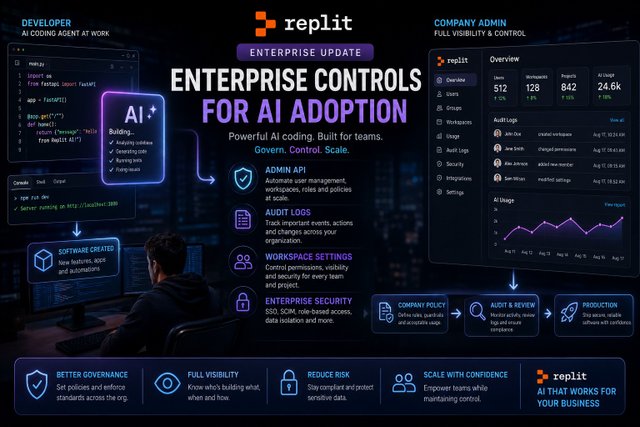
Replit AI: Enterprise Controls for Coding Agents
AI coding has changed the way software can be built.
A developer can describe an idea in natural language, ask an AI agent to write the code, test it, fix errors, connect services, and even prepare an application for deployment.
For individual developers, that can feel like a superpower.
For companies, however, it creates a very different problem:
Who is controlling what the AI is doing?
That question is becoming increasingly important as businesses move from experimenting with AI to using AI coding agents inside real engineering workflows.
Replit is now adding more enterprise controls around its AI-powered development environment, including an Admin API, audit logs, and workspace settings designed to give organizations greater visibility and control over how Replit is used across their teams.
The announcement represents a much bigger trend in enterprise AI:
Companies don't just need AI that can build software. They need AI that IT and security teams can govern.
The AI coding revolution created a new problem
Traditional software development already has layers of organizational control.
Companies can decide who has access to repositories.
They can control production environments.
They can manage developer permissions.
They can monitor infrastructure.
They can review code before it reaches production.
But AI coding agents introduce a new layer.
Instead of a developer manually writing every line of code, an AI agent can potentially generate large sections of an application, modify existing files, run commands, troubleshoot problems, and perform multiple development tasks.
That dramatically increases productivity.
It also increases the number of things an organization needs to understand.
What is the AI building?
Which employee asked it to build it?
What tools did it use?
What changes did it make?
Which workspace did the activity happen in?
Did the developer follow company policies?
Was sensitive information involved?
And if something goes wrong, can the company determine what happened?
These are enterprise questions, not just developer questions.
The admin panel becomes part of AI development
This is why Replit's enterprise controls are significant.
The future of AI coding isn't simply going to be about giving every employee access to the most capable coding agent possible.
Companies need a management layer around that capability.
Think about a normal enterprise application.
IT administrators don't simply install software on thousands of computers and walk away.
They manage users.
They manage permissions.
They monitor activity.
They establish policies.
They investigate unusual behavior.
They maintain records.
AI coding environments are increasingly moving toward the same model.
The AI becomes another powerful system inside the company's technology environment.
And powerful systems need governance.
What does an Admin API change?
An Admin API can give organizations a programmatic way to manage administrative functions instead of relying entirely on manual dashboard operations.
That matters when a company has dozens, hundreds, or thousands of users.
Imagine a company onboarding 200 developers.
An administrator may need to configure access, organize users, manage workspaces, apply policies, and integrate the platform with existing internal systems.
Doing all of that manually doesn't scale particularly well.
An API allows administrative operations to become part of an organization's broader IT workflows.
For example, companies can potentially connect AI development platforms to identity systems, internal tooling, security processes, and automated onboarding or offboarding workflows.
That is the difference between:
"We have an AI tool."
and
"We have an AI development platform that fits into our enterprise infrastructure."
Audit logs are becoming essential
The second major piece is auditability.
If employees are using powerful AI agents to build software, companies need a record of important activity.
This doesn't necessarily mean companies need to monitor every word an employee types into an AI assistant.
The important point is that organizations need visibility into meaningful administrative and workspace events.
Audit logs can help answer questions such as:
Who did something?
When did it happen?
Where did it happen?
What changed?
That information becomes particularly important when a company is investigating a security incident, troubleshooting an unexpected change, or preparing for compliance requirements.
Auditability is already a normal concept across enterprise software.
As AI becomes more deeply integrated into development, AI platforms are increasingly expected to provide similar capabilities.
Replit has already positioned its Enterprise offering around controls such as role-based access control and audit logs, alongside enterprise security and compliance features.
Why workspace controls matter
Workspace settings may sound less exciting than an AI model upgrade.
But for businesses, they can be more important.
A company may have different rules from an individual developer.
For example, a business might want to establish standards around:
Who can access certain workspaces
Which users can perform specific actions
How AI development is organized
What security settings are enabled
How teams collaborate
How development environments are managed
This is where enterprise AI starts looking less like a chatbot and more like infrastructure.
And infrastructure needs rules.
AI agents make governance more important
The rise of AI agents is a major reason this matters.
A traditional AI assistant usually waits for a prompt and returns an answer.
An AI coding agent can potentially do much more.
It can reason about a project.
Read files.
Create files.
Modify code.
Run tests.
Use development tools.
Iterate on errors.
And potentially work through multiple steps before producing a result.
That makes agents incredibly useful.
But it also creates a larger governance surface.
If an employee gives an AI agent permission to work inside a company project, the organization needs to understand what boundaries exist around that agent.
Otherwise, companies could end up with a strange situation:
Humans have strict permissions, while the AI they control has enormous practical capabilities.
That is exactly the kind of gap enterprise governance needs to address.
The new enterprise AI workflow
The future workflow could look something like this:
Developer
↓
AI coding agent
↓
Company policies
↓
Workspace permissions
↓
Development activity
↓
Audit logs
↓
Security and engineering review
↓
Production
The important thing is that the AI isn't operating in isolation.
It sits inside a controlled environment.
That gives companies a way to combine AI productivity with organizational oversight.
Companies can't simply give everyone unrestricted AI access
This is where the business case becomes especially strong.
Imagine a company with 1,000 employees.
Now imagine giving every employee access to powerful AI agents capable of creating software.
Some employees will use them responsibly.
Some will experiment.
Some may misunderstand security policies.
Some may accidentally expose sensitive information.
Some may create applications that bypass internal processes.
And some may simply build things faster than the company's existing review systems can handle.
The problem isn't necessarily that employees are doing something malicious.
The problem is that AI increases the speed at which things can happen.
If an employee can create an internal tool in an afternoon instead of several weeks, traditional approval processes may struggle to keep up.
Companies therefore need governance that can operate at AI speed.
AI governance isn't about stopping employees
There is a common misconception that enterprise governance means adding restrictions everywhere.
That's not necessarily the goal.
Good governance should make responsible AI adoption easier.
A developer shouldn't have to wait days for permission to perform a normal task.
At the same time, an organization should be able to prevent dangerous actions and investigate serious incidents.
The ideal system creates clear boundaries:
Develop freely within approved boundaries.
Escalate when something crosses those boundaries.
Record important activity.
Review high-risk changes.
That allows companies to move quickly without completely sacrificing control.
This is bigger than Replit
Replit's announcement is part of a much broader enterprise AI pattern.
We're seeing the same fundamental question appear across AI products:
How do companies control powerful AI once employees start using it at scale?
It isn't enough to ask whether an AI model is capable.
Businesses also need to ask:
Can we control access?
Can we manage users?
Can we establish policies?
Can we monitor important activity?
Can we investigate incidents?
Can we integrate the system with our existing infrastructure?
Can we meet security and compliance requirements?
Those questions may become just as important as model benchmarks.
The rise of the AI administrator
This could eventually create an entirely new category of work.
Think about the traditional roles inside a company.
There are system administrators.
Cloud administrators.
Security administrators.
Database administrators.
Identity and access teams.
Now imagine organizations needing people who manage AI systems and AI agents across the company.
Their responsibilities could include:
Managing AI access
Creating organizational policies
Monitoring AI usage
Reviewing risky activity
Managing permissions
Integrating AI systems with enterprise identity platforms
Establishing security standards
Evaluating new AI capabilities
The AI administrator may become a real enterprise role.
Not because companies don't trust AI.
Because companies increasingly do trust AI enough to give it important responsibilities.
And important responsibilities require management.
Security becomes even more important
AI coding also creates a security challenge because generated software can contain vulnerabilities.
Replit has been investing in security controls around AI-assisted development, including its Security Center, Auto-Protect, and Package Firewall initiatives. Replit says its Package Firewall blocks malicious or compromised packages during development, while its Auto-Protect workflow can prepare and test patches for newly identified critical vulnerabilities.
That shows how AI development and security are becoming interconnected.
You can't simply make AI coding faster.
You also need to make the resulting software secure.
Otherwise, companies could end up trading development speed for security risk.
The productivity versus control debate
There is a genuine tension here.
The more freedom you give AI agents, the more useful they can become.
But the more freedom you give them, the more carefully you need to control their environment.
Restrict an agent too much, and developers may stop using it because it becomes frustrating.
Give it unlimited access, and you could create serious security and governance problems.
Enterprise AI therefore has to find the middle ground.
Enough freedom to create.
Enough control to stay safe.
That balance will likely become one of the defining challenges of AI adoption.
Why this matters for businesses
For startups and small teams, AI coding can already feel transformative.
A small group can build software that previously required a much larger engineering organization.
But as those teams grow, governance becomes unavoidable.
A five-person startup can communicate directly.
A 5,000-person company cannot.
That's where centralized controls become valuable.
The company needs consistent policies.
It needs visibility.
It needs accountability.
And it needs ways to integrate AI into existing IT and security systems.
Replit's enterprise direction reflects that reality.
The question is no longer simply:
"Can AI build our software?"
It is:
"Can our organization safely manage AI while it builds our software?"
The next stage of AI coding
The first phase of AI coding was about proving that AI could write software.
The next phase is about making AI coding reliable.
The next phase after that is increasingly about making it enterprise-ready.
That means:
AI agents + security + permissions + auditability + governance.
Companies want the productivity benefits of AI without losing control over their development environment.
And that's exactly why features like Admin APIs, audit logs, and workspace controls matter.
They aren't flashy AI capabilities.
They won't generate a viral demo like an agent building an entire application in minutes.
But they could be the infrastructure that determines whether large organizations are actually willing to deploy AI coding at scale.
The bigger lesson
AI adoption inside companies is moving from experimentation to infrastructure.
Businesses are no longer asking only:
"Which AI tool should our employees use?"
They're beginning to ask:
"How do we manage AI as part of the company?"
That's a much bigger question.
Replit's latest enterprise controls are one example of where the industry is heading.
AI coding agents will probably become more capable.
They will take on larger tasks.
They will interact with more systems.
They will potentially operate with greater autonomy.
And as that happens, governance will become more important—not less.
The future of enterprise AI isn't going to be completely unrestricted AI.
It also isn't going to be AI locked behind endless approval processes.
The winning model is likely somewhere in between:
Powerful AI, operating inside clear boundaries, with visibility and accountability built in.
Because the future question isn't just:
"Can AI build the software?"
It's:
"Can your company control what AI builds, understand what it did, and trust it enough to put that software into production?"
That is the real enterprise AI challenge.