Qwen: The Open-Model Ecosystem Advantage
Alibaba's Qwen is building more than a model family—its growing developer ecosystem could become a powerful competitive advantage in open AI.
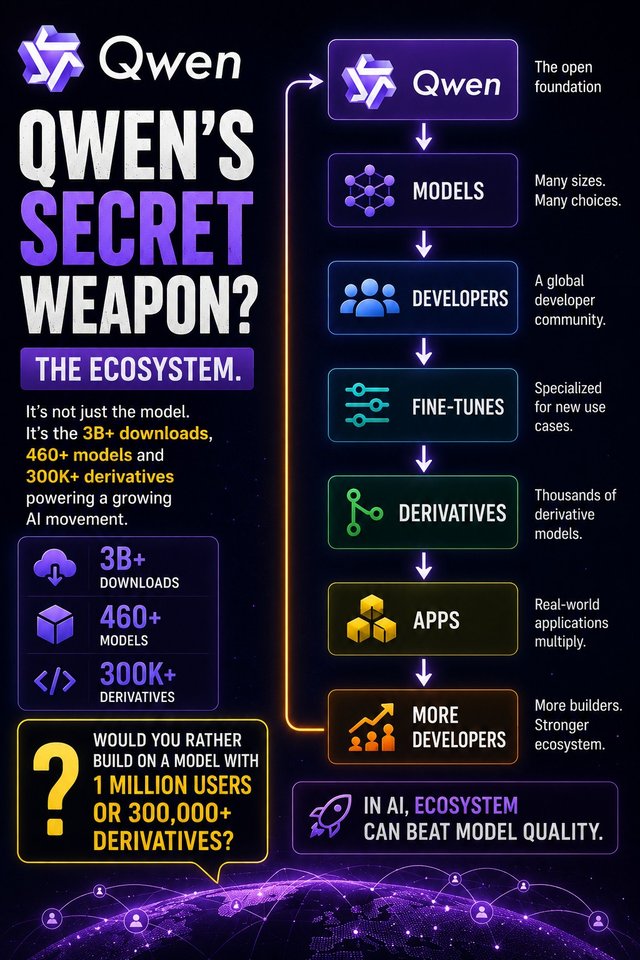
Qwen's Biggest Advantage Might Not Be the Model
The AI industry often focuses on one question:
"Which model is the best?"
But Alibaba's Qwen ecosystem highlights another important strategy:
The real competitive advantage may be the ecosystem built around the model.
Qwen isn't simply a collection of AI models.
Developers can download models, fine-tune them, create derivatives, build applications and share improvements with the wider community.
That creates a potentially powerful cycle:
Qwen
↓
Models
↓
Developers
↓
Fine-tunes
↓
Derivatives
↓
Applications
↓
More developers
↓
More models & improvements
And the cycle repeats.
Why This Matters
Imagine two AI models with similar capabilities.
Model A
100,000 developers
↓
Limited integrations
↓
Few derivatives
Model B
Large developer community
↓
Thousands of fine-tunes
↓
Specialized models
↓
More applications
↓
More developers
Even if the underlying models are comparable, Model B can become more valuable because of the ecosystem surrounding it.
That's a network effect.
The Open-Model Advantage
Open models give developers more flexibility than simply consuming an AI through a hosted API.
Depending on the model's license and capabilities, developers may be able to:
Run models themselves
Fine-tune them
Build specialized versions
Integrate them into products
Optimize them for specific hardware
Create domain-specific applications
Share derivative models
That creates an ecosystem where improvements don't only come from the company that originally created the model.
Developers become part of the development cycle.
Qwen's Ecosystem Effect
The reported scale around Qwen illustrates this strategy.
Reports cite billions of model downloads, hundreds of models and hundreds of thousands of derivatives across the ecosystem.
Those numbers matter because every developer experimenting with Qwen potentially creates another piece of infrastructure, knowledge, tooling or application around the ecosystem.
The result can become:
More developers
↓
More experiments
↓
More specialized models
↓
More applications
↓
More adoption
↓
More developers
That is much harder for competitors to reproduce than simply releasing another model.
The Real Business Moat
Traditional AI competition often looks like:
Company → Better Model → More Users
But an ecosystem-driven strategy can look like:
Company → Model → Developers → Applications → Ecosystem → More Developers
The second system can become self-reinforcing.
That's why the most important question may not be:
"Is Qwen the smartest model?"
It could be:
"How large and active is the ecosystem being built around Qwen?"
This Applies Beyond Qwen
The same principle can be seen throughout technology.
Android became powerful partly because of its developer ecosystem.
AWS became powerful partly because companies built infrastructure around it.
GitHub became valuable because developers built projects and workflows on top of it.
Open-source AI can follow a similar pattern.
The model becomes the foundation.
The community becomes the multiplier.
The Creator Lesson
This also applies to creators and AI businesses.
You don't always win by creating the single best product.
You can win by creating something people build on top of.
For example:
AI model
↓
Developer tools
↓
Templates
↓
Prompts
↓
Plugins
↓
Apps
↓
Community
↓
More creators
That ecosystem can become more defensible than the original product alone.
The Bigger AI Business Battle
The AI competition may therefore evolve from:
"Who has the best model?"
to:
"Who has the strongest ecosystem?"
Because models can improve quickly.
But a large community of developers, applications, integrations and derivative projects can create a much deeper competitive moat.
Reel Hook
"Qwen's biggest advantage might not be its AI model."
Pause.
"It's the developers building on top of it."
Visual Flow
Qwen
↓
Models
↓
Developers
↓
Fine-tunes
↓
Derivatives
↓
Apps
↓
More Developers
CTA
"Would you rather build on a model with 1 million users—or one with hundreds of thousands of derivatives?