One Human. 3.1 cinematic AI Workdays. The Future Has Arrived.
OpenAI says its researchers are now using the equivalent of 3.1 agent-workdays for every human workday, enabling more code, experiments and parallel research.
By singamankitha
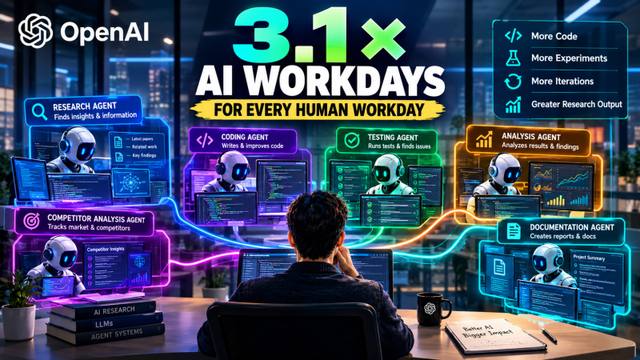
OpenAI Researchers Now Get 3.1 AI Workdays for Every Human Day
What if one researcher could effectively get several extra workdays every day?
According to OpenAI, that is increasingly becoming a reality inside its research organization.
OpenAI reports that its researchers are now using the equivalent of 3.1 agent-workdays for every human workday.
The number is striking.
But it is also easy to misunderstand.
This does not mean that one human researcher has been replaced by 3.1 AI employees.
Instead, the metric represents the amount of work being performed by AI agents alongside human researchers.
The bigger story is about a fundamental change in how knowledge work can be organized.
Instead of one person completing one task at a time, a researcher can increasingly have multiple AI agents working on different tasks simultaneously.
From One Researcher to a Team of Agents
Imagine a researcher starting the day with five different tasks.
Traditionally, they might need to work through them sequentially:
Research → Coding → Testing → Analysis → Documentation
Only one or two tasks can receive serious attention at any given moment.
With AI agents, the workflow can become parallel:
Human researcher
↓
Research Agent
Coding Agent
Testing Agent
Analysis Agent
Documentation Agent
↓
Results return simultaneously
The researcher can then review the outputs and decide what deserves attention.
This is the important shift.
AI isn't simply making one person type faster.
It is allowing one person to delegate multiple streams of work simultaneously.
What Does “3.1 Agent-Workdays” Actually Mean?
The phrase “3.1 agent-workdays” can sound like three extra employees working alongside every researcher.
That's not what the metric means.
OpenAI converts agent activity into an equivalent amount of work measured against an eight-hour human workday.
So when the company says researchers are using 3.1 agent-workdays per human workday, it is describing the amount of agent effort being generated relative to a conventional human workday.
Think of it as a measurement of AI work capacity, not a headcount.
One researcher might spend a few hours directing agents while those agents collectively perform many hours of coding, analysis, experimentation or other technical work.
The human remains responsible for deciding what matters.
Why Parallelism Is More Important Than “Saving Time”
Most AI productivity stories focus on saving time.
For example:
Task takes 60 minutes → AI completes it in 20 minutes.
That's useful.
But agentic AI introduces another dimension:
One person → multiple tasks happening at the same time.
That is a fundamentally different productivity model.
Consider a researcher who needs to:
investigate a new research idea,
modify an experiment,
analyze previous results,
debug a piece of code,
and prepare documentation.
Instead of doing these tasks one after another, they can potentially delegate them to different agents.
The researcher then becomes the person coordinating the work rather than personally executing every step.
The productivity gain therefore comes from two directions:
Faster execution
Parallel execution
=
Greater research throughput
More Agents Can Mean More Experiments
OpenAI says its researchers are writing more code and running more experiments as they increasingly use coding agents.
This matters because experimentation is one of the fundamental engines of research.
Suppose a researcher has ten possible ideas.
Without automation, limited time may mean that only a few can be explored deeply.
With multiple agents, the researcher can potentially investigate several directions concurrently.
For example:
Agent 1
Test research hypothesis A
Agent 2
Implement optimization B
Agent 3
Analyze experiment C
Agent 4
Investigate a performance regression
Agent 5
Review previous research
The human researcher can then compare the outputs.
This doesn't guarantee better research.
But it can increase the number of ideas that can be investigated.
The Human Still Controls the Research
This is where the OpenAI example needs an important qualification.
More agent work does not mean that AI has taken over research decisions.
OpenAI says humans continue to control research priorities and deployment decisions.
That means the workflow is closer to:
Human decides what matters
↓
Agents execute
↓
Agents report results
↓
Human evaluates
↓
Human decides what happens next
The distinction is extremely important.
AI can potentially conduct hundreds of experiments.
But someone still needs to determine which experiments are worth running.
Someone needs to decide whether the results are reliable.
Someone needs to recognize when an unexpected result is important.
And someone needs to decide whether the system should actually be deployed.
The New Productivity Unit May Be the “Human + Agent”
For decades, productivity was often measured around human workers.
How much can one engineer produce?
How many projects can one analyst complete?
How many hours does one employee need?
Agentic AI introduces another possibility.
The fundamental productivity unit could increasingly become:
Human + AI agents
rather than simply:
Human
A highly capable worker could potentially coordinate several specialized agents.
One agent handles research.
Another handles coding.
Another runs tests.
Another analyzes results.
Another prepares documentation.
The human becomes the coordinator and decision-maker.
This resembles having a digital team that can operate continuously while remaining under human direction.
This Changes What “Being Productive” Means
There is another consequence.
If AI can perform more of the execution layer, simply working longer hours may become less important than learning how to delegate effectively.
The valuable skill becomes knowing:
What should I give the AI?
What should I keep for myself?
How should I divide a complex problem between multiple agents?
How do I verify the results?
Which output deserves my attention?
This is closer to management than traditional software assistance.
The person isn't simply using an AI tool.
They are increasingly managing a collection of AI workers.
A Possible Agentic Workday
Imagine an AI researcher starting work at 9:00 AM.
At 9:05, they assign a research question to one agent.
At 9:10, another agent begins modifying an experiment.
At 9:15, a third agent analyzes previous results.
At 9:20, a fourth agent starts testing an alternative approach.
While those agents work, the researcher reviews yesterday's results and decides which direction deserves more resources.
By lunchtime, multiple streams of work have produced new information.
The researcher can then redirect the agents.
A failed experiment can be abandoned.
A promising result can receive additional compute.
A new hypothesis can be assigned to another agent.
The researcher is no longer waiting for one task to finish before beginning the next.
The entire workflow becomes more continuous and parallel.
The “3.1” Number Is Really a Signal
The most interesting part of OpenAI's figure isn't necessarily the exact number.
Whether the ratio is 3.1, 4 or something else in the future, the underlying trend is what matters.
AI agents are becoming capable of performing enough work that companies can begin measuring their output in units that resemble human labor.
That's a major conceptual shift.
We have moved from:
AI as software
to:
AI as an assistant
to:
AI as an agent
and potentially toward:
AI as digital labor.
But More AI Work Doesn't Automatically Mean Better Results
There is an important limitation.
More work does not automatically equal better work.
If five agents investigate the wrong question, you may simply get five answers to the wrong question.
If agents produce unreliable code, parallel execution can multiply errors just as quickly as it multiplies useful work.
If researchers cannot verify the outputs, additional agent activity may actually create more information to sort through.
That's why the human remains important.
The goal isn't simply:
More AI output.
The goal is:
More useful output.
That requires strong prompts, task decomposition, evaluation systems, verification and human judgment.
The Verifier Becomes More Important
A particularly useful workflow is therefore not just multiple agents working in parallel.
It is:
Multiple agents
↓
Independent outputs
↓
Verifier agent
↓
Human review
This creates a second layer of quality control.
For example:
Research Agent
Find relevant information.
↓
Coding Agent
Build the experiment.
↓
Testing Agent
Check the implementation.
↓
Analysis Agent
Interpret the results.
↓
Verifier Agent
Look for inconsistencies and errors.
↓
Human
Make the final decision.
This architecture could become increasingly common as companies deploy agentic AI systems.
What This Means for Business
The implications extend far beyond AI research.
Imagine a small business with one founder and a collection of AI agents.
One agent performs competitor research.
Another analyzes customer feedback.
Another creates marketing drafts.
Another writes software.
Another tests the software.
Another prepares reports.
The founder still makes the important decisions.
But the amount of work that can happen between those decisions increases dramatically.
That could change the economics of small teams.
A company may not need dozens of people performing every individual task if a smaller number of highly skilled employees can coordinate large numbers of AI agents.
That doesn't mean human workers become unnecessary.
Instead, the composition of work can change.
Humans may spend more time on strategy, relationships, judgment and creativity while agents handle increasing amounts of execution.
The Future May Not Be “AI vs Humans”
The OpenAI example points toward a different model.
Not:
Humans OR AI
But:
Humans + AI agents
The human determines the destination.
The agents perform parts of the journey.
The human evaluates the results.
The agents perform the next round.
And the cycle continues.
This could create a powerful feedback loop where a single skilled person can coordinate significantly more work than before.
The Real Question
The headline is:
“OpenAI researchers now get 3.1 agent-workdays per human workday.”
But the deeper question is:
What happens when every knowledge worker can command a team of AI agents?
A software developer could have coding and testing agents.
A researcher could have experiment and analysis agents.
A marketer could have research and content agents.
A founder could have agents handling research, operations and analysis.
The competitive advantage may increasingly belong to people who know how to design and manage these workflows effectively.
One Human. Multiple AI Workdays.
The most important takeaway isn't that AI is working 3.1 times harder than humans.
It is that the relationship between human time and machine work is changing.
One human hour can increasingly initiate many hours of parallel AI activity.
That creates a new productivity equation:
Human direction
↓
Multiple AI agents
↓
Parallel execution
↓
More experiments
↓
More results
↓
Human judgment
The human remains in control.
But the amount of work that can happen around that human is expanding.
And that may be one of the most important changes brought by agentic AI.
The future of productivity may not be about making humans work faster.
It may be about giving every skilled person the ability to delegate work to a growing digital workforce.