OpenAI Researchers Are Running Multiple cinematicalAI Agents at Once
OpenAI reveals how its researchers are using multiple coding agents simultaneously to write more code, run more experiments and accelerate AI research.
By @admin
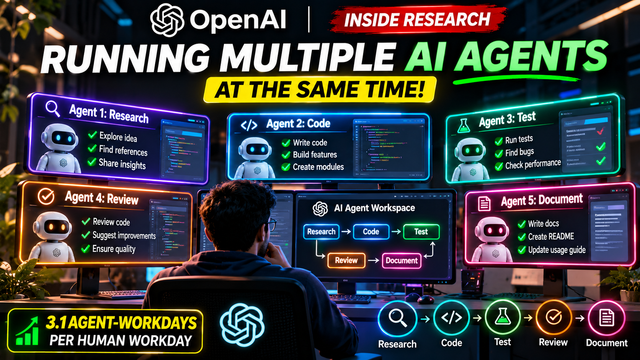
OpenAI Researchers Are Running Multiple AI Agents at Once: The Future of Software Development Is Changing
Imagine opening your laptop and starting five AI agents.
One researches a problem. Another writes code. A third runs experiments. A fourth checks for bugs. The fifth reviews the results and prepares documentation.
While all five agents are working, you act as the project manager, deciding what needs to happen next and checking their results.
This might sound like a futuristic software development workflow, but it is increasingly becoming a reality inside OpenAI.
On September 6, 2026, OpenAI published an inside look at how its researchers are using coding agents throughout their daily work.
The findings reveal a significant change in how AI research is conducted.
Researchers are no longer simply asking an AI chatbot a question, receiving an answer and moving on.
They are increasingly running multiple coding-agent sessions simultaneously, delegating different tasks and coordinating their outputs.
OpenAI also reported increases in code production, research experiments and the complexity of tasks handled by agents.
This development raises an important question:
Are we moving from AI assistants to entire teams of AI workers?
Let's explore what OpenAI revealed, how these workflows operate and how developers can apply the same approach to their own projects.
1. What exactly did OpenAI reveal?
OpenAI's September 6 report, titled "Research acceleration: The view inside OpenAI", provides an overview of how coding agents are changing the daily work of its research organization.
The company observed that researchers were increasingly using coding agents throughout the day, often running multiple sessions concurrently.
The total usage of these agents was growing rapidly and outpacing growth among other teams within OpenAI.
But the most interesting part was not simply the increase in usage.
Researchers were also delegating increasingly complex tasks to these agents.
Instead of using AI only for small coding suggestions, they were assigning longer tasks involving research infrastructure, troubleshooting, experimentation and technical analysis.
OpenAI reported that researchers were writing more code and running more experiments.
The company also observed that agents were succeeding more often at increasingly difficult tasks, although they still required human guidance and intervention.
This is an important development because AI is beginning to participate in more stages of the actual research process.
2. The surprising numbers behind OpenAI's multi-agent workflow
OpenAI shared several statistics that demonstrate how deeply coding agents have entered its research workflow.
Let's look at the most interesting findings.
3.1 agent-workdays for every human workday
Before June 2026, the total agent runtime across OpenAI's research organization was lower than the total human working time.
By mid-August, that relationship had changed.
OpenAI reported approximately 3.1 agent-workdays of effort for every human workday.
To understand this, imagine a researcher working for eight hours.
Across the research organization, agents collectively generated an equivalent of approximately 24.8 hours of agent runtime for every eight-hour human workday.
This does not mean that one researcher personally receives 24.8 hours of productive work every day.
It is an organization-wide comparison of accumulated agent runtime against human working time.
Nevertheless, it demonstrates how much parallel computing and delegated work can expand a research team's capacity.
More than $600 in daily AI usage
By mid-August, the median researcher in OpenAI's measured group was using more than $600 worth of daily inference at API prices.
That is a substantial amount of AI usage.
It demonstrates how researchers are using agents for much more than occasional questions or short code suggestions.
More than $7,000 for the 90th-percentile user
OpenAI also reported that researchers at the 90th percentile were using more than $7,000 worth of tokens per day at API prices.
This shows how intensive AI usage can become when multiple agents are working on demanding technical tasks.
These are estimates using API pricing, not necessarily the actual internal amount OpenAI paid.
Four or more concurrent agents
OpenAI also reported that the number of researchers using highly concurrent workflows, such as running four or more agents simultaneously, was increasing.
The figures included both agents directly started by researchers and subagents created by those agents.
This is an important distinction.
Researchers are not necessarily managing every individual agent manually. Some agents can delegate parts of their work to additional agents.
3. What does running multiple AI agents actually mean?
To understand this development, we need to distinguish between a traditional AI chatbot and an AI agent.
A traditional chatbot generally responds to individual prompts.
For example:
You ask ChatGPT to write a Python program.
It generates code.
You ask it to fix an error.
It suggests a correction.
You ask another question.
It responds again.
An AI agent can work through a larger task using tools and multiple steps.
Depending on its permissions and configuration, it can:
- Read and modify files.
- Execute code.
- Run tests.
- Search through documentation.
- Analyze errors.
- Use external tools.
- Complete multiple connected tasks.
- Delegate subtasks to other agents.
Now imagine running several agents simultaneously.
Instead of asking one agent to handle an entire software project, you divide the work.
Agent A investigates the problem.
Agent B develops the solution.
Agent C writes tests.
Agent D reviews the code.
Agent E prepares documentation.
Each agent works on a defined responsibility, and a coordinating agent or human brings everything together.
This is the basic idea behind multi-agent orchestration.
The goal is to reduce the time spent waiting for one task to finish before starting another.
However, not every task should be parallelized. Tasks that depend heavily on one another may need to run sequentially.
4. Why are OpenAI researchers using multiple agents?
AI research is a complicated process.
Developing a better AI model requires much more than writing a few lines of Python.
Researchers need to:
1. Develop research ideas.
2. Design experiments.
3. Write code and infrastructure.
4. Prepare datasets and evaluations.
5. Run training and testing.
6. Analyze results.
7. Identify bugs and unexpected behaviour.
8. Integrate successful improvements.
Each stage can become a bottleneck.
For example, a researcher might have a promising idea but spend hours troubleshooting infrastructure before testing it.
A coding agent can help investigate the error, examine the codebase and suggest or implement a solution.
Meanwhile, another agent could prepare evaluation scripts or analyze previous experiment results.
This allows researchers to spend more time making important decisions instead of performing every repetitive technical task themselves.
OpenAI specifically highlighted improvements in troubleshooting internal research infrastructure.
It also reported that some teams previously holding human-led technical support sessions saw declining attendance because researchers increasingly used coding agents to solve technical problems.
This suggests that agents are beginning to change not only how researchers write code but also how research teams organize their work.
5. OpenAI's research intern milestone
There is another significant detail in the September 6 announcement.
OpenAI said it had reached its previously announced goal of creating an automated research intern by September 2026.
What does that mean?
OpenAI describes a research intern as a system capable of carrying out well-defined research tasks under human direction.
These are tasks that could take a skilled human researcher several days to complete.
The important words are "well-defined" and "under human direction".
This does not mean OpenAI has created a completely independent scientist capable of deciding every research priority and running an entire research laboratory without supervision.
It means the company believes its systems have reached a level where they can assist with substantial research tasks.
OpenAI also stated that it was making progress toward its next goal: an automated AI researcher by March 2028.
That is an ambitious target.
The broader direction is clear: AI agents are gradually moving from assisting with individual coding tasks toward participating in larger research workflows.
6. The five-agent workflow developers can try today
You don't need to work at OpenAI to experiment with multi-agent workflows.
Developers can begin with a simple three-agent setup and expand when it proves useful.
Here is a practical example.
Agent 1: Researcher
Responsibility:
- Understand the project requirements.
- Research available technologies.
- Compare libraries and frameworks.
- Identify possible technical problems.
- Prepare an implementation plan.
Output: A research report and technical specification.
Agent 2: Builder
Responsibility:
- Read the technical specification.
- Create the project structure.
- Write the required code.
- Implement features.
- Connect the required services.
Output: A working implementation.
Agent 3: Reviewer
Responsibility:
- Inspect the generated code.
- Identify bugs and security problems.
- Run available tests.
- Check whether requirements are satisfied.
- Recommend corrections.
Output: A review report and verified fixes.
Once this workflow becomes reliable, you can expand it.
For example:
Agent 4: Tester
Runs unit tests, integration tests and edge-case checks.
Agent 5: Documentation specialist
Creates README files, API documentation and setup instructions.
A human remains responsible for reviewing important decisions and approving sensitive actions.
This is a much more practical starting point than immediately creating dozens of autonomous agents.
7. Which tools can help you build multi-agent workflows?
Several tools can help developers experiment with this approach.
OpenAI Codex
Codex can work on coding tasks, inspect repositories, modify files and execute development workflows.
It supports agentic coding workflows, including parallel tasks and subagent capabilities in supported environments.
LangGraph
LangGraph is a framework for building stateful agent workflows.
Developers can define agents, connect them through graphs, manage shared state and control how tasks move between different stages.
It is useful when you need more control over the workflow.
n8n
n8n is a workflow automation platform that can connect AI models, APIs, databases and other services.
You can use it to create workflows where different AI steps perform research, process information, trigger actions and send results to other services.
Claude Code
Claude Code is another coding-agent tool that can work with project files, execute commands and help developers complete complex programming tasks.
Different tools have different strengths, permissions and orchestration capabilities. You should select them based on your project rather than assuming every agent framework behaves identically.
8. Does running more agents always mean better results?
No.
This is where developers need to be careful.
Running ten agents does not automatically make a project ten times faster.
Multiple agents can introduce new problems.
Conflicting code changes
Two agents may edit the same files and create conflicts.
Duplicated work
Agents might independently solve the same problem because they do not share sufficient information.
Higher costs
Every additional agent can consume tokens and computing resources.
Context management
Agents need access to the correct information. Poorly designed workflows can cause them to misunderstand project requirements.
Quality control
One agent can produce incorrect code, and another agent might incorrectly approve it.
OpenAI also acknowledged that human steering remains important.
In its analysis of tasks estimated to require four to eight hours of human work, more than half of successful tasks involved at least one human intervention.
That is an important reminder.
Agents are becoming more capable, but human supervision has not disappeared.
The best multi-agent systems are not simply collections of autonomous workers.
They are carefully coordinated workflows with clear responsibilities, shared context, testing and human oversight.
9. What does this mean for the future of software development?
The traditional software development workflow often looks like this:
Human plans → Human codes → Human tests → Human reviews → Human documents.
AI-assisted development introduced a new workflow:
Human plans → AI generates code → Human reviews.
Multi-agent development introduces another possibility:
Human defines the objective → Multiple agents work in parallel → Agents exchange results → Human reviews and approves.
This could change how developers approach large projects.
Instead of spending most of their time writing every individual component, developers may increasingly focus on architecture, task assignment, system design and quality control.
The role of a software developer could gradually expand from writing code to managing complex systems of AI-assisted work.
However, programming knowledge will remain important.
Without understanding architecture, databases, APIs, security and testing, developers may struggle to identify when an agent has produced incorrect results.
The future developer may not need to write every line of code manually, but they will still need to understand what the code is supposed to do.
Final thoughts: One developer, multiple AI workers?
OpenAI's September 6 report provides a useful look at how AI agents are changing real research environments.
Researchers are using multiple agents concurrently, writing more code and running more experiments.
Agents are also taking on increasingly complex tasks.
But the most important lesson isn't simply to run as many agents as possible.
It is to learn how to divide work intelligently, coordinate independent tasks and verify the results.
Start with three agents:
Researcher → Builder → Reviewer.
Make that workflow reliable before adding more.
Because the next major productivity shift may not come from having a smarter chatbot.
It may come from learning how to manage an entire team of AI agents.
The question is no longer just how good your AI assistant is. It's how effectively you can coordinate multiple AI workers.
How many AI agents could you manage simultaneously without losing control?
Three? Five? Ten?
Share your thoughts in the comments.