OpenAI Launches ChatGPT for cinematical Financial Services
OpenAI introduces an AI platform for finance professionals, combining GPT-6 Astra with financial data and enterprise controls.
By @admin
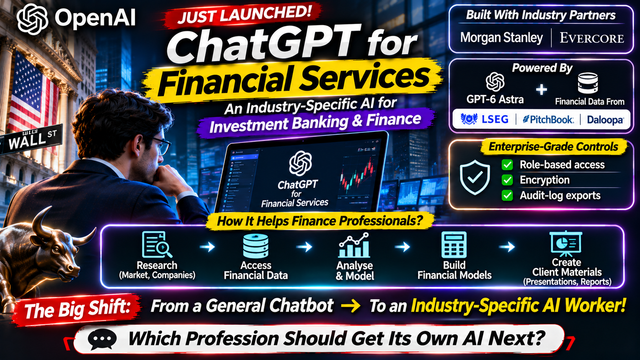
OpenAI Launches ChatGPT for Financial Services: Is AI Becoming an Investment Banking Assistant?
Artificial intelligence is moving into another high-value industry. OpenAI has launched ChatGPT for Financial Services, a specialized AI offering designed to help financial institutions with research, financial analysis, modelling workflows and client-facing materials.
Announced on September 10, 2026, the product combines OpenAI's GPT-6 Astra model with financial information from providers including LSEG News, PitchBook, Daloopa and Crunchbase. It was shaped through design partnerships with two major financial firms: Morgan Stanley and Evercore.
The launch highlights a larger change in the AI industry. Companies are increasingly moving beyond general-purpose chatbots and building AI systems around the specific data, workflows and requirements of professional industries.
1. What exactly has OpenAI launched?
ChatGPT for Financial Services is a tailored ChatGPT Work experience built on ChatGPT Enterprise. Its initial focus is investment banking and equity research.
These are areas where professionals regularly handle large volumes of financial information. Analysts research companies, examine earnings reports, compare competitors, evaluate financial performance and prepare documents for clients.
Traditionally, much of this work involves moving between spreadsheets, financial databases, research reports, company filings and presentation software.
OpenAI's goal is to bring more of these activities into a connected AI-powered workspace.
The product is designed to help teams research companies, analyse financial information, develop financial models and prepare customized client materials, including pitchbooks using company templates.
This does not mean the AI independently replaces an investment banker. It is a tool intended to support professionals in their work.
2. Why Morgan Stanley and Evercore matter
OpenAI says the product was shaped through design partnerships with Morgan Stanley and Evercore.
That is important because financial institutions have demanding requirements. They need reliable data, traceable research, consistent documents and strong controls over who can access sensitive information.
Working with financial firms gives OpenAI insight into the practical problems that professionals face every day.
For example, an investment banking team may need to prepare an analysis of a company before advising a client. The work can involve reviewing financial statements, understanding market conditions, comparing competitors and presenting the findings in a particular format.
A general chatbot might help explain a financial concept. A specialized platform aims to connect the research, data and document-production steps into a more useful workflow.
The design partnerships are therefore significant, but they should not be mistaken for proof that every bank has adopted the product or that all financial workflows are now automated.
3. Financial data is the key difference
One of the most important parts of this launch is its built-in financial data.
OpenAI identifies providers including:
- LSEG News: financial and market news content.
- PitchBook: information on private companies, investors and transactions.
- Daloopa: structured financial information and company data.
- Crunchbase: company and business information.
The product also supports connections to other financial data services, depending on a firm's existing subscriptions and access rights.
Why does this matter?
Imagine an analyst researching a publicly traded company. The analyst may need to examine earnings information, compare financial performance across several years, review industry developments and identify changes in the company's business.
Without integrated data, the analyst may have to search several platforms, download reports and manually transfer information into spreadsheets.
With connected financial sources, the AI can help retrieve relevant information and organize it for analysis.
OpenAI says the product can provide granular citations, allowing users to trace figures and claims back to source material. This is particularly important in finance, where an incorrect number can affect a valuation, report or client decision.
However, citations do not automatically guarantee that an answer is correct. Professionals still need to check the underlying source, date, assumptions and calculations.
4. What can GPT-6 Astra do in financial workflows?
The product uses GPT-6 Astra, which OpenAI describes as being designed to improve information retrieval, financial reasoning and the generation of useful work products.
The intended workflow goes beyond answering a simple question.
A finance professional could use the platform to:
Research companies: Gather relevant information from connected financial sources and documents.
Analyse earnings: Review company performance, financial statements and supporting information.
Compare competitors: Organize information about companies operating in the same industry.
Develop financial models: Assist with analysis and modelling workflows using relevant inputs and assumptions.
Prepare client materials: Turn research and analysis into documents, spreadsheets and presentations that follow a firm's templates.
The real value is the connection between these tasks. Instead of treating research, analysis and presentation creation as completely separate activities, the product aims to help professionals move between them in one workspace.
Still, financial modelling requires more than generating a spreadsheet. Analysts must understand assumptions, accounting treatment, valuation methods and the limitations of the data. AI-generated work needs review before it is used in a professional or client-facing decision.
5. Enterprise security and governance
Financial institutions handle confidential business information, client records and sensitive transactions. They cannot simply connect every data source to an ordinary chatbot without considering security and compliance.
OpenAI says ChatGPT for Financial Services builds on ChatGPT Enterprise's security and governance controls.
The announced controls include:
- Role-based access.
- Encryption.
- Central management of access and data connections.
- Workspace-log exports for compliance and audit workflows.
These controls are important because different employees may have different permissions. A research analyst, investment banker and compliance officer may not be authorized to access the same information.
Audit logs can also help organizations review how a system was used.
But enterprise security features should not be interpreted as automatic regulatory approval. Each institution still needs to assess its own legal obligations, data permissions, internal policies and risk controls before deploying the product.
6. Is this the future of industry-specific AI?
This launch represents a broader direction in artificial intelligence.
The first major wave of generative AI introduced general-purpose assistants. People could ask questions, write content, summarize documents and generate code.
The next wave is increasingly focused on specialized workflows.
Consider the difference:
A general chatbot answers a question about financial markets.
An industry-specific financial AI can connect to approved financial data, retrieve relevant information, help organize an analysis and prepare materials in a firm's preferred format.
The same approach could expand into other industries.
In healthcare, specialized AI systems may help professionals work with medical records and clinical documentation.
In law, AI platforms may help teams review contracts, search legal documents and prepare research.
In manufacturing, AI could connect operational data, maintenance records and production workflows.
In marketing, specialized systems can connect customer data, campaign performance and content production.
The key difference is not simply a more powerful model. It is the combination of a model, specialized information, software integrations, permissions and a workflow designed for a particular job.
7. What does this mean for India?
India has a large financial services ecosystem, including banks, fintech companies, investment firms, insurance providers and financial research businesses.
For these organizations, industry-specific AI could create opportunities to improve research, document processing, reporting and internal productivity.
Smaller businesses may also benefit as similar capabilities become available through more accessible products.
But adoption will depend on several factors: data quality, cost, integration with existing systems, security requirements, regulatory expectations and the ability of employees to verify AI-generated work.
For students and aspiring professionals, this shift also changes the skills that may be valuable.
Knowing how to write prompts is useful, but it is not enough. People working in finance will still need to understand accounting, financial statements, valuation, spreadsheets and business fundamentals.
AI skills become more powerful when combined with real domain knowledge.
8. What are the limitations?
It is important not to confuse a specialized AI platform with a fully autonomous financial expert.
OpenAI's own financial-services terms say that its outputs are for informational purposes, not financial or investment advice. They also warn that information and outputs may be inaccurate, incomplete, delayed or out of date.
That means users should verify important figures, examine the source material and review assumptions before relying on an AI-generated result.
There are also practical questions around cost, access, data licensing, integration and how well the system performs on complex real-world tasks.
The product's initial focus is investment banking and equity research. OpenAI has indicated plans to broaden its financial data and expand into other financial-services categories, but future expansion should not be confused with capabilities already available today.
9. The bigger picture: AI is becoming a worker for specific industries
The most important part of this announcement is not simply that OpenAI has launched another version of ChatGPT.
It is the direction of the product.
The AI industry is moving towards systems that combine advanced models with industry-specific information and professional workflows.
For investment bankers, that means AI assistance with research, financial analysis and client materials. For other industries, similar specialized platforms may eventually support their own day-to-day work.
The winning products may not be the ones that can answer the most general questions. They may be the ones that understand a particular profession, connect to the right information and help people complete real tasks reliably.
One question remains: if finance gets its own specialized AI, which profession should get one next — healthcare, law, education, marketing or software development?