OpenAI DevDay 2026 | Cinematical AI Agents, GPT-6.1 Sol & Codex Revolution
OpenAI unveiled 20+ updates at DevDay 2026, signalling a major shift towards always-on agents, computer use and collaborative AI tools.
By @admin
Source: https://openai.com/index/devday-2026/?utm_source=chatgpt.com
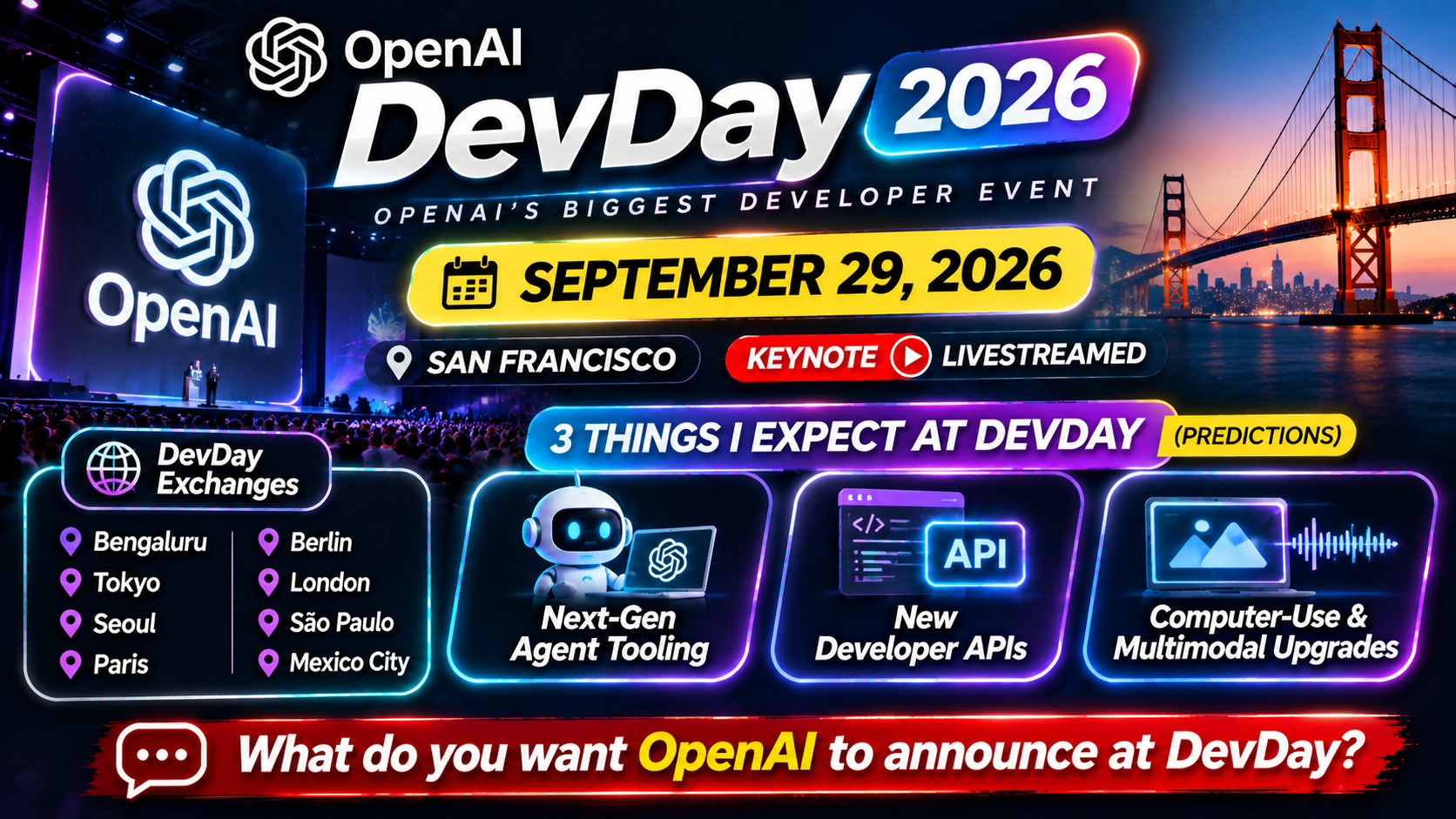
OpenAI DevDay 2026: The Shift From Chatbots to AI Workers
For years, the main way people interacted with artificial intelligence was simple: type a question, receive an answer and move on.
That model is changing.
At OpenAI DevDay 2026, held on September 29 in San Francisco, OpenAI announced more than 20 updates spanning its models, ChatGPT, Codex, developer APIs and collaborative tools. The announcements point towards a different direction for AI: systems that can do more than respond to individual prompts. They can take on tasks, interact with software, collaborate with people and continue working across longer workflows.
The event's biggest message was not one new model or one flashy feature. It was a broader shift from conversational assistants towards AI agents and integrated work environments.
1. Dots: Always-on AI agents
One of the headline announcements was Dots, OpenAI's new always-on agents.
Unlike a conventional chatbot that waits for a user to ask a question, Dots are designed to handle ongoing responsibilities. OpenAI describes them as agents that can get to know what matters to a user, work on their behalf and take some tasks off their plate.
The idea is to move from asking AI for help one task at a time to delegating a continuing responsibility.
For example, an agent might help organise project information, follow a recurring workflow or prepare work based on connected context and instructions.
But there is an important distinction: an always-on agent is not automatically an independent employee. Its actual abilities depend on the tools, permissions, integrations and plan availability provided to it. Users still need to understand what an agent can access and what actions it is authorised to take.
OpenAI initially listed Dots for Pro and Business Premium in eligible markets, with beta access for certain Enterprise, Education and Healthcare workspaces when enabled by administrators.
2. GPT-6.1 Sol: A new model for professional work
OpenAI also introduced GPT-6.1 Sol, an upgrade to GPT-6 Sol.
The company highlighted improvements in agentic coding, computer use and professional work. It positioned Sol as offering performance approaching Astra while costing one-fifth of Astra's standard input and output token prices.
For developers, model capability is only one part of the decision. Cost matters too.
A model that can handle complex tasks at a lower price may make it more practical to run longer workflows, build AI-powered products and serve more users within a fixed budget.
OpenAI also announced Ultrafast, a premium speed tier designed for workloads where response speed is particularly important. The company reported up to eight times faster token generation in Codex and up to six times faster generation in the API for supported configurations.
These are OpenAI's stated performance comparisons, not a guarantee that every application will experience the same speed improvement.
3. Agents API gets computer-use capabilities
For developers, one of the most consequential announcements was the expansion of the Agents API with computer-use support.
This allows developers to build agents that can interact with software through its user interface, rather than relying only on conventional API integrations.
That matters because many real-world business processes involve software that does not expose every action through a convenient API.
An agent with computer-use capabilities could potentially navigate interfaces, interact with applications and complete multi-step workflows.
OpenAI also brought capabilities such as tool search, tool calling, context compaction and multi-agent functionality into the developer offering.
This gives developers a foundation for building applications where multiple agents can work together and use tools to complete more complex tasks.
However, computer use also introduces risk. An agent interacting with business software needs carefully controlled permissions, safeguards against unintended actions and ways for people to review important decisions.
4. Codex moves beyond the laptop
OpenAI expanded Codex with cloud-based development workflows.
Developers can run Codex on a computer, remotely from a phone or in the cloud. Reusable development environments are intended to help tasks start quickly and provide teams with shared configurations and permissions.
The company also refreshed Codex CLI with voice-based task steering and an agents view to make it easier to delegate and monitor multiple tasks.
Another announcement was Code Review in the ChatGPT desktop app. It helps developers inspect code changes, review differences and ask Codex about potential issues before sharing feedback on GitHub or GitLab.
OpenAI also introduced Codex Security Cloud, which can scan GitHub repositories, investigate findings, remove duplicates and prepare fixes in the cloud.
Together, these updates show how AI coding tools are expanding from code completion into broader software development workflows.
5. ChatGPT becomes a platform for developer-built experiences
OpenAI also announced plugin extensions that allow developers to create experiences within ChatGPT.
The idea is to give third-party tools a place inside ChatGPT, including sidebar access and interactive panels where users can work alongside conversations.
OpenAI also described improvements to plugin creation, submission and discovery.
This is important because it moves ChatGPT closer to a platform where developers can build and distribute specialised experiences, rather than treating it only as a standalone chatbot.
The company also announced support for MCP events in plugin automations. This can allow connected workflows to start when something happens in another application, such as a new task appearing on a project board.
The broader direction is towards AI applications that respond to events and work across connected services.
6. ChatGPT Space and Pages: AI collaboration for teams
DevDay also included announcements aimed at teams.
ChatGPT Space is designed as a shared environment where colleagues, ChatGPT and agents can work with common knowledge and projects.
Pages are collaborative documents that can be used to write, research, generate charts, create images and develop ideas with teammates and agents.
OpenAI also introduced collaborative slides, shared team tasks and ways to use ChatGPT in Slack and Microsoft Teams for eligible business plans.
These features point towards a future where AI is part of the team's working environment, not just an individual productivity tool.
Instead of copying information between multiple applications, teams could increasingly use AI to connect discussions, documents, tasks and deliverables.
Availability differs by feature and subscription plan, so these announcements should not be interpreted as meaning every tool is available to every user.
7. A new business opportunity for AI developers
For developers and startups, DevDay's announcements create several possible product directions.
Developers can explore specialised agents, computer-use applications, automated code review, workflow integrations and tools built around ChatGPT's platform.
For example, a small software company could build an agent that helps manage a customer-support workflow. A marketing team could use connected tools to organise campaign tasks. A development team could use AI to review changes and investigate software issues.
These are potential applications, not proof that every workflow can already run safely without human involvement.
The commercial opportunity will depend on whether products solve real problems, protect customer data and deliver measurable value.
A product that saves time but creates costly errors may not be useful. A product that completes tasks reliably, respects permissions and makes its work auditable has a stronger chance of earning business trust.
8. What this means for India
India has a large developer community, a growing startup ecosystem and businesses looking to automate digital operations.
OpenAI's DevDay announcements are relevant to Indian developers because they create more building blocks for AI-powered software.
Developers can experiment with agent-based applications, computer-use workflows, API integrations and collaborative tools. Startups can explore specialised products for customer support, operations, sales, software development and internal business processes.
But the opportunity is not simply to add an AI chatbot to an existing product.
The stronger opportunity is to identify a repetitive workflow, understand its risks and build an AI system that completes a meaningful part of that work reliably.
Students should also pay attention to the skills behind these products: programming, API design, databases, cloud infrastructure, security, testing and workflow engineering.
9. The bigger shift: From answers to completed work
The most important takeaway from DevDay 2026 is the direction of travel.
AI is moving beyond systems that mainly generate text or answer questions. OpenAI is building towards agents that can work across tools, interact with software, collaborate with teams and handle continuing responsibilities.
That does not mean human workers will immediately be replaced, or that agents can safely handle every task without supervision.
Reliability, security, privacy, cost and accountability will determine how quickly these systems become useful in real businesses.
But the direction is clear: the next stage of AI competition is not only about who has the smartest model. It is also about who can turn that intelligence into useful, dependable work.
DevDay 2026 gave developers and businesses a clearer look at how OpenAI wants to build that future.