OpenAI Defender’s Window — AI Cybersecurity
OpenAI’s Defender’s Window explores how AI can help security teams find vulnerabilities, analyze threats, and protect software before attackers exploit them.
Source: https://openai.com/index/the-defenders-window/?utm_source=chatgpt.com
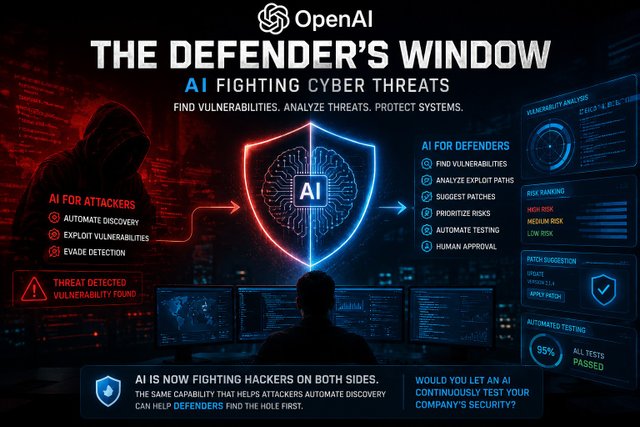
OpenAI’s Defender’s Window: How AI Is Changing Cybersecurity
Cybersecurity has always been a race between attackers and defenders.
Hackers look for weaknesses. Security teams try to find those weaknesses first.
Attackers automate reconnaissance. Defenders build automated detection systems.
Attackers search for vulnerabilities. Defenders patch them.
Now, artificial intelligence is entering both sides of that race.
OpenAI’s new “The Defender’s Window” initiative highlights an important shift in cybersecurity: AI is not only being discussed as a tool that can help attackers. It can also become a powerful system for helping defenders identify vulnerabilities, understand threats, and strengthen software before those weaknesses are exploited.
That could change how security teams operate.
Instead of waiting for an attack and responding to it, organizations could increasingly use AI to continuously search for weaknesses and help security teams fix them before attackers discover them.
The old cybersecurity model
Traditional cybersecurity often works around a simple cycle.
A company builds software.
Security teams test it.
A vulnerability is discovered.
The vulnerability is analyzed.
A patch is developed.
The patch is deployed.
Then the process starts again.
The problem is that modern software is extremely complicated.
Large organizations can have thousands of applications, cloud services, APIs, databases, devices, dependencies, and lines of code.
Security teams have to monitor all of them.
Attackers, meanwhile, only need to find one useful weakness.
That creates an uncomfortable imbalance.
A company might have hundreds of security controls working correctly, but a single overlooked vulnerability can still become an entry point.
AI could potentially help change that equation.
AI can search for vulnerabilities faster
One of the most interesting applications of AI in cybersecurity is vulnerability discovery.
Security researchers traditionally spend significant amounts of time reviewing code, understanding application behavior, testing inputs, and investigating suspicious activity.
AI can potentially accelerate parts of this process.
An AI system could analyze large amounts of code and infrastructure information, identify suspicious patterns, compare components against known vulnerability classes, and highlight areas that deserve human attention.
The important word here is assist.
AI doesn't magically make cybersecurity perfect.
Its output still needs to be evaluated.
But if an AI system can reduce the amount of time required to identify potential weaknesses, security researchers can spend more time investigating the vulnerabilities that actually matter.
That could be a major productivity improvement.
The same technology can help attackers
There is a darker side to this development.
The capabilities that make AI useful for defenders can also potentially make attackers more efficient.
AI can help automate tasks that previously required significant technical knowledge and manual effort.
That creates a cybersecurity arms race.
Imagine two teams looking at the same software.
One team is trying to protect it.
The other is trying to break into it.
Both have access to increasingly capable AI tools.
The advantage may go to whichever side can use those tools more effectively.
This is why AI cybersecurity isn't simply a story about "AI stopping hackers."
It's about AI changing the speed and scale of the entire security process.
From finding the hole to understanding the exploit path
Finding a vulnerability is only the beginning.
Security teams also need to understand its significance.
Is the vulnerability actually exploitable?
What systems could be affected?
What would an attacker need to do?
How serious is the potential impact?
How quickly should it be fixed?
AI could help security teams organize and prioritize this information.
Instead of presenting security teams with hundreds or thousands of alerts, AI systems could potentially help identify which problems deserve immediate attention.
That's important because cybersecurity teams don't have unlimited time.
If every alert is treated as equally important, genuinely dangerous vulnerabilities can get buried inside the noise.
AI-assisted risk prioritization could help change that.
AI could also suggest fixes
The next step is remediation.
Once a vulnerability has been identified, developers and security teams need to determine how to fix it.
That can sometimes involve changing code, updating dependencies, modifying configurations, improving authentication, changing access controls, or redesigning part of a system.
AI coding systems could potentially analyze a vulnerability and suggest a patch.
But this is where human oversight becomes especially important.
A patch that fixes one vulnerability could accidentally introduce another problem.
It could break an application.
It could affect performance.
It could change business logic.
It could create unexpected behavior.
So the future isn't necessarily:
AI finds bug → AI automatically changes everything.
A safer workflow looks more like:
AI identifies vulnerability → AI analyzes risk → AI proposes a fix → automated testing → human security team reviews → deployment.
That distinction matters.
The cybersecurity workflow is becoming more automated
The emerging workflow can be thought of as a pipeline.
Step 1: Analyze the environment
AI examines code, infrastructure, applications, configurations, and other security-relevant information.
Step 2: Find potential vulnerabilities
The system identifies weaknesses or suspicious patterns that may require investigation.
Step 3: Rank the risks
Potential problems are prioritized based on factors such as severity, exposure, and potential impact.
Step 4: Analyze possible attack paths
The system can help security researchers understand how a vulnerability could potentially be abused.
Step 5: Suggest remediation
AI can propose code changes, configuration changes, patches, or other defensive measures.
Step 6: Test the solution
Automated testing can help determine whether the proposed fix actually works without breaking existing functionality.
Step 7: Human approval
Security professionals review the findings and decide what should actually be deployed.
This combination of AI automation and human judgment could become an important model for future cybersecurity operations.
Why continuous security testing matters
One of the biggest advantages of AI could be persistence.
Humans don't have unlimited attention.
A security team cannot manually inspect every part of a massive software environment every minute of every day.
AI systems can potentially run continuously.
That means organizations could move closer to a model where security testing isn't something that happens only during scheduled audits.
Instead, security could become a continuous process.
New code gets deployed.
AI analyzes it.
A new dependency is added.
AI checks it.
A configuration changes.
AI evaluates it.
A vulnerability appears in a newly discovered component.
The system flags it.
A suspicious change occurs.
The security team gets an alert.
This could fundamentally change the relationship between software development and cybersecurity.
Security could move closer to the development process
Historically, development and security have sometimes operated as separate functions.
Developers build software.
Security teams test it.
Problems are discovered later.
AI could help bring those activities closer together.
Imagine a developer writing a new feature.
Before the code reaches production, an AI security system analyzes it and identifies a potentially dangerous pattern.
Instead of discovering the problem weeks later during a security review, the developer can address it immediately.
That creates something much closer to security by design.
Security becomes part of the development process rather than a final inspection at the end.
But AI is not a cybersecurity magic button
There is a temptation to look at AI and assume that automation solves everything.
It doesn't.
AI systems can make mistakes.
They can misunderstand code.
They can produce incorrect recommendations.
They can generate false positives.
They can miss vulnerabilities.
And in security, a wrong answer can have serious consequences.
That's why human expertise remains critical.
A security professional needs to understand the business environment, the architecture, the threat model, and the potential consequences of a proposed change.
AI can process information extremely quickly.
But speed isn't the same thing as judgment.
The strongest systems will likely combine both.
The new cybersecurity equation
The traditional security equation looked something like this:
Human attackers vs human defenders
Then automation entered:
Automated attackers vs automated defenders
Now we're moving toward:
AI-assisted attackers vs AI-assisted defenders
That changes the scale of the game.
A task that once required hours of manual analysis could potentially be completed much faster.
A security team that previously had to investigate hundreds of issues manually could potentially use AI to prioritize them.
A vulnerability that might have remained unnoticed could potentially be identified earlier.
But the same acceleration can benefit attackers.
That's why defensive AI needs to be developed carefully.
Why the Defender’s Window matters
The most interesting idea behind OpenAI's Defender’s Window isn't simply that AI can be used for cybersecurity.
People already know that.
The bigger idea is that the security industry may be entering a period where defenders can use increasingly capable AI to actively search for weaknesses instead of simply reacting after an attack.
That changes the mindset.
Instead of:
"We hope our systems are secure."
The goal becomes:
"Continuously look for ways our systems could fail, then fix them before someone else finds them."
That's a much more proactive approach.
What happens when AI becomes faster than attackers?
This is the billion-dollar question.
If defensive AI becomes capable enough to identify and fix vulnerabilities faster than attackers can exploit them, cybersecurity could become significantly stronger.
But if offensive AI develops faster, the opposite could happen.
Attackers could discover vulnerabilities faster.
They could automate more of their operations.
They could scale attacks across more organizations.
They could reduce the amount of human expertise required for certain activities.
The outcome isn't predetermined.
It will depend on how quickly defensive systems develop, how organizations deploy them, how security researchers adapt, and how governments and companies manage increasingly capable AI systems.
Human approval still matters
For high-impact security decisions, human oversight remains extremely important.
An AI system should not automatically be trusted simply because it produces a confident answer.
Security teams need to verify findings.
Developers need to review proposed code changes.
Organizations need to test patches.
And sensitive actions should have appropriate controls and authorization.
The ideal future isn't necessarily humans disappearing from cybersecurity.
It is humans being able to supervise much more powerful defensive systems.
Instead of manually checking every small issue, security professionals could focus on the hardest problems while AI handles large-scale analysis and repetitive work.
The future of cybersecurity may look very different
Imagine a company where every piece of code is continuously analyzed.
Every new deployment is automatically tested.
Every infrastructure change is evaluated.
Potential vulnerabilities are ranked by risk.
AI investigates suspicious behavior.
Potential fixes are generated.
Automated systems test those fixes.
And security professionals receive a prioritized list of the issues that actually require their attention.
That's not science fiction anymore.
Pieces of this workflow already exist across modern security and software-development systems.
The interesting question is how far AI can push that automation.
The bigger picture
AI is transforming cybersecurity because it changes the economics of finding and fixing vulnerabilities.
Attackers can potentially automate more.
Defenders can potentially automate more.
The speed of discovery can increase.
The amount of software that can be analyzed can increase.
And the time between discovering a vulnerability and responding to it could potentially decrease.
That could be a major advantage for defenders.
But it also means organizations cannot assume that traditional security practices will remain sufficient forever.
The threat environment is changing.
The tools are changing.
The speed is changing.
And the defenders have to change with it.
The question everyone should be asking
The most interesting question isn't:
"Can AI hack systems?"
We already know AI has cybersecurity implications on both sides.
The better question is:
"Can defenders use AI to find and fix vulnerabilities faster than attackers can exploit them?"
If the answer eventually becomes yes, AI could become one of the most powerful defensive technologies cybersecurity has ever seen.
But getting there requires more than powerful models.
It requires strong security practices, careful testing, human oversight, responsible deployment, and constant adaptation.
OpenAI's Defender’s Window highlights that shift toward a more proactive vision of cybersecurity.
The future may not be about waiting for hackers to find the hole.
It may be about using AI to find the hole first.
And in cybersecurity, being first can make all the difference.