NVIDIA Launches Open Agent Safety Platform|midjourney ai news
NVIDIA's Open Agent Safety Platform adds enforceable runtime controls, monitoring and isolation to help secure autonomous AI agents.
Source: https://nvidianews.nvidia.com/news/nvidia-launches-open-agent-safety-platform
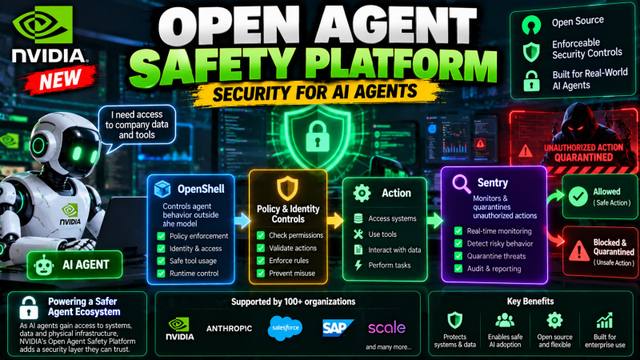
NVIDIA has introduced the Open Agent Safety Platform, an open software platform and reference system designed to add stronger security controls around autonomous AI agents. The announcement comes as AI agents increasingly gain the ability to use tools, access data, execute code and operate across enterprise systems.
The central idea behind NVIDIA's platform is that AI agents should not be trusted to control their own security boundaries. Instead, security policies can be enforced outside the agent itself.
NVIDIA's platform combines two major components: OpenShell and Sentry.
OpenShell is an open-source secure runtime designed to create boundaries around AI agents. It can run agents inside isolated environments and control what files, networks, tools, credentials and other resources they can access. Policies are enforced outside the agent's own reasoning process, making it harder for an agent to simply override a restriction through its instructions or generated code.
The second component, Sentry, is designed as an independent monitoring and enforcement layer. NVIDIA describes Sentry as an out-of-band watchdog that can continuously monitor agent activity and enforce security policies using NVIDIA BlueField-4 infrastructure.
The architecture can be simplified as:
AI Agent → OpenShell Runtime → Policy & Identity Controls → Approved Action → Sentry Monitoring
If an agent attempts to move outside its permitted boundaries, the security layer can detect and restrict the activity. NVIDIA says Sentry can quarantine an agent that attempts to violate its boundaries in milliseconds.
This approach addresses an important challenge created by increasingly autonomous AI. A traditional chatbot generally produces an answer for a human to review. An agent can instead take actions directly—such as accessing files, calling APIs, running code or interacting with enterprise systems.
That additional autonomy creates additional security risks. If an agent has excessive permissions, a mistake, compromised instruction or unexpected behavior could potentially affect systems and data beyond the original task.
NVIDIA's approach is therefore based on the idea of putting security controls around the agent rather than relying only on the model to behave correctly.
The platform is also designed to work across different models and agent systems. NVIDIA says OpenShell can be extended to third-party compute platforms, including Arm and Intel systems.
More than 100 organizations are participating in the broader ecosystem, including companies and organizations such as Anthropic, Microsoft, Salesforce, SAP, Scale AI, IBM, CrowdStrike and others.
The bigger trend is clear: as AI agents become more capable, the AI stack needs more than models and tools. It also needs identity, permissions, runtime isolation, monitoring and enforcement.
The future of secure agentic AI may therefore look like:
Model + Tools + Runtime Controls + Policy + Monitoring
Instead of asking only, “What can this AI agent do?”, organizations increasingly need to ask, “What is this agent allowed to do—and what happens if it tries to do something else?”