Mistral Large 4: A New 1 Trillion Parameter AI Model
Discover Mistral Large 4,the 1.05-trillion-parameter multimodal AI model designed for coding,agents,and business workflows,with a one-million-token context window.
Mistral Large 4: Inside the New 1-Trillion-Parameter AI Model
Introduction: A New Milestone in Open-Weight AI
Artificial intelligence is advancing beyond simple chatbots. Modern AI models are increasingly designed to write software, analyse documents, interpret images, use tools, and complete complex tasks across multiple steps.
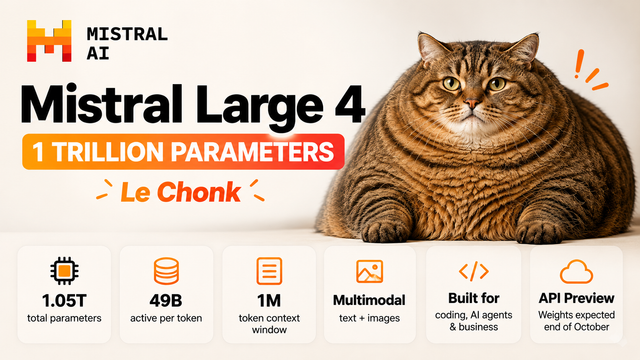
On October 6, 2026, French AI company Mistral AI announced Mistral Large 4, a new multimodal model with approximately 1.05 trillion total parameters. The company introduced it under the playful nickname “Le Chonk.”
The announcement attracted attention because of the model's scale, its reported coding and agent capabilities, and Mistral's plan to release its model weights.
According to Mistral, the model is available through a public preview API, while the weights are planned for release by the end of October 2026. This distinction matters: developers can experiment with the hosted preview, but should not assume that downloadable weights are already available for local deployment.
Mistral Large 4 is intended for several kinds of work, including software engineering, multimodal understanding, scientific tasks, and business automation. The company describes it as an open-weight model built around a Mixture-of-Experts architecture.
For developers, students, and technology businesses, the announcement raises an important question: could a model that combines a very large total parameter count with a smaller active parameter count make advanced AI more flexible to deploy?
To understand the significance of this release, it helps to examine its architecture, context window, capabilities, limitations, and potential applications.
1. What Is Mistral Large 4?
Mistral Large 4 is a general-purpose multimodal AI model developed by Mistral AI, a French artificial intelligence company.
A general-purpose model can support multiple tasks rather than being limited to one narrow application. Depending on the available features and integrations, those tasks may include answering questions, analysing text and images, generating code, reasoning over documents, and supporting AI agents.
The model uses a Mixture-of-Experts, or MoE, architecture. This is a design in which different parts of a model can be activated for different inputs.
Instead of using every parameter for every token, an MoE model routes information through selected expert components. This can help manage the computational requirements of a model whose total parameter count is very large.
Mistral reports that Large 4 contains 1.05 trillion total parameters and approximately 49 billion active parameters per token in its launch announcement.
These numbers describe different things. Total parameters represent the model's overall learned components, while active parameters indicate the subset used for a particular token's processing.
The distinction helps explain why a trillion-parameter model does not necessarily perform every operation as if all one trillion parameters were active at once.
However, active parameter count alone does not determine real-world speed or cost. Hardware, memory requirements, routing, software optimisation, and the details of the workload also matter.
2. Understanding the Mixture-of-Experts Architecture
Traditional dense language models generally use their main parameter set throughout each model-processing step. Mixture-of-Experts models take a different approach.
An MoE architecture contains multiple expert components and a routing mechanism that selects which experts process particular inputs.
Think of it like a large team of specialists.
A software question might be routed through expert components that contribute to code-related processing, while another input may activate a different combination. The analogy is simplified, but it captures the basic idea of conditional computation.
This approach can increase the total capacity of a model without requiring every expert to be used for every token.
For developers, that is an important architectural strategy because large models can be expensive to serve. Using selected experts can help balance model capacity with computational requirements.
Nevertheless, MoE systems introduce their own engineering challenges. They may require careful routing, memory management, distributed computation, and hardware coordination.
A model with more total parameters is not automatically better than a smaller model. The useful comparison depends on task performance, reliability, response time, cost, and deployment requirements.
Mistral Large 4's significance therefore lies not just in its headline parameter count, but in how its architecture supports its intended workloads.
3. Why Does the One-Trillion-Parameter Figure Matter?
The phrase “one-trillion-parameter AI model” is attention-grabbing, but the number needs context.
Parameters are learned numerical values inside a model. During training, the model adjusts these values to improve its ability to perform tasks.
A larger parameter count can provide additional capacity, but it does not guarantee better answers, stronger reasoning, or fewer mistakes.
The way a model is trained, the quality of its data, its architecture, and the methods used to evaluate it all influence its capabilities.
Mistral Large 4's reported 1.05 trillion total parameters indicate a very large model architecture. Its approximately 49 billion active parameters per token provide a separate measure of the computation selected for each token.
For developers, the important questions are practical:
Does the model solve the task accurately?
Can it handle long and complicated instructions?
Does it generate reliable code?
Can it use tools appropriately?
What is the cost of completing a real task?
Can the model be deployed in the required environment?
These questions provide more useful information than parameter count alone.
4. A One-Million-Token Context Window
Another headline feature of Mistral Large 4 is its one-million-token context window.
A context window is the amount of input and conversation information a model can consider within a request or supported interaction.
A larger context window can be useful when a task requires information from many documents, lengthy instructions, or a substantial amount of source code.
Imagine a software developer who needs help understanding a large project. Instead of examining only a small function, the developer may want the model to consider information from multiple files, technical documentation, and earlier instructions.
A large context window can make these workflows more practical, provided the application and API support the required input.
Potential uses include:
Large codebases: Developers may provide substantial amounts of code and supporting documentation for analysis.
Document research: A model can help summarise and compare lengthy reports, subject to the quality of its retrieval and reasoning.
Business analysis: Teams may examine multiple documents and extract information relevant to a particular question.
Long-running tasks: AI applications may need to preserve a substantial amount of context as work progresses across multiple steps.
However, a one-million-token window does not mean the model will remember everything permanently. Context is not the same as long-term memory.
Nor does a large context window guarantee perfect understanding of every detail. Important facts can still be overlooked, and conflicting information can lead to incorrect conclusions.
Developers should use document retrieval, structured summaries, and verification when a task depends on precise information.
5. Multimodal Capabilities: Working With Text and Images
Mistral Large 4 is described as a natively multimodal model with support for text and image understanding.
A multimodal model can work with more than one type of input. In this case, image understanding expands the kinds of information an application can process beyond plain text.
For example, a user might provide an image of a chart and ask for an explanation of its main trends. Another application could analyse a diagram or extract relevant information from a visual document.
Potential applications include:
Understanding charts and diagrams.
Reviewing technical drawings.
Analysing images in documents.
Extracting information from visual reports.
Supporting visual inspection workflows.
Combining image understanding with tool-based tasks.
Mistral describes applications involving engineering drawings, large satellite imagery, document evidence, and visual grounding.
Visual grounding is the ability to connect an answer to relevant elements in an image rather than providing only a general description.
For instance, a useful system should identify the relevant part of a diagram or image and explain why it matters to the task.
These capabilities could be valuable in engineering, manufacturing, research, and other fields where visual information is important.
However, image understanding is not infallible. A model can misread labels, overlook small details, or draw conclusions that are not supported by the image.
For high-stakes applications, outputs should be checked against the original source and, where appropriate, reviewed by a qualified person.
6. Coding and Software Engineering
Software engineering is one of the major areas highlighted in Mistral's announcement.
Modern coding assistants do more than autocomplete individual lines. They may help developers understand unfamiliar repositories, write tests, review proposed changes, investigate errors, and coordinate multiple steps in a development workflow.
Mistral reports that Large 4 performs strongly on several coding evaluations, including DeepSWE, SWE-Atlas-QnA, and Terminal-Bench.
These evaluations examine different aspects of software-related capability. Their scores should be interpreted according to each benchmark's design rather than treated as interchangeable measurements.
For developers, the attraction of a capable coding model is its potential to help with more complicated work.
A developer might ask an AI assistant to explain how several modules interact, suggest a code change, generate tests, and summarise the proposed modification.
An agentic coding workflow can go further by using supported tools to inspect files, execute tests, or iterate on a solution.
But a model's benchmark performance does not guarantee that every generated program will work correctly.
Software engineers must still review changes, run tests, inspect security implications, and understand what the system modifies.
AI can accelerate parts of development, but good engineering practices remain essential.
7. AI Agents and Multi-Step Workflows
Mistral Large 4 is also designed to support agentic workflows.
An AI agent uses a model together with tools and a workflow to pursue a goal across multiple steps.
A basic chatbot might explain how to prepare a report. An agent-enabled application might gather approved information, organise the results, create a spreadsheet, and produce a summary, provided it has the required tools and permissions.
This creates opportunities for business automation.
For example, a company might build an assistant that gathers information from authorised sources, extracts important details, and prepares a draft report for an employee to review.
A software team might use an agent to inspect a repository, propose a fix, and run available tests in a controlled environment.
These workflows depend on more than model intelligence. The application needs reliable tool integrations, suitable permissions, error handling, and clear limits on what the agent can do.
An agent can also make mistakes across multiple steps. A wrong assumption early in a workflow may affect the final result.
For this reason, sensitive operations should include validation and human approval where appropriate.
Mistral Large 4's agentic capabilities could help developers build more sophisticated applications, but the quality of the complete system will depend on its design and implementation.
8. Potential Uses in Finance, Law, Science, and Manufacturing
Mistral's announcement highlights professional workloads across several industries.
Finance
AI can assist with organising financial documents, extracting figures, comparing reports, and preparing draft analyses.
Financial outputs must be checked carefully because small numerical errors can affect important decisions. AI-generated calculations should be verified against reliable data and appropriate methods.
Legal work
A model can help organise documents, identify relevant passages, and prepare summaries for legal professionals.
It should not be treated as a substitute for qualified legal judgment. Legal conclusions depend on jurisdiction, context, evidence, and current law.
Science and research
AI can support literature review, data analysis, coding, and scientific simulations.
Researchers still need to validate calculations, inspect assumptions, and reproduce results. A fluent explanation is not proof that a scientific claim is correct.
Manufacturing and engineering
Multimodal systems can potentially help interpret technical drawings, inspect documents, and organise information from engineering workflows.
Real-world deployments require careful validation because incorrect interpretations can lead to costly or unsafe outcomes.
Across all these industries, the model is best viewed as a tool that can support professionals rather than automatically replace their expertise.
9. What Does Open-Weight AI Mean?
One of the most important aspects of Mistral Large 4 is Mistral's stated plan to release its model weights.
Model weights are learned numerical values that determine much of a model's behaviour. When weights are made available under appropriate terms, developers can gain more control over how the model is deployed and integrated.
This is different from using only a hosted API.
With a hosted API, the provider operates the model infrastructure and customers send requests through the supported service.
With downloadable weights, eligible users may be able to deploy the model in their own infrastructure, depending on the hardware requirements, software support, and licence.
Open-weight access can be valuable to organisations that want more control over their deployment environment, data flows, customisation, or operational dependencies.
However, open weights do not automatically mean that every part of a model is open source.
Training datasets, complete training code, infrastructure, and other components may not be released. The model licence also determines which uses and redistribution arrangements are permitted.
For Mistral Large 4, the distinction is especially important because the October 6 announcement introduced a public preview while stating that the weights were expected later in the month.
Until the weights are actually released, developers should not claim that the model can already be downloaded and run locally.
10. Why This Matters for Indian Developers and Startups
India has a large community of software developers, engineering students, technology startups, and businesses exploring AI adoption.
Mistral Large 4 could be worth evaluating for applications involving coding, document analysis, image understanding, and business workflows.
For example, an Indian software startup might investigate whether a capable coding model can help developers understand a large codebase or generate tests.
An educational technology company might explore document-based tutoring or image-assisted explanations.
A business could evaluate AI-assisted extraction of information from lengthy reports, provided the system handles confidential information appropriately.
For organisations that eventually want to self-deploy an open-weight model, control over infrastructure and data processing may be an important consideration.
But self-hosting a trillion-parameter model is a significant engineering undertaking. It can require substantial memory, suitable accelerators, specialised inference software, and careful performance optimisation.
A model's total parameter count does not directly translate into a single fixed hardware requirement, especially for a Mixture-of-Experts architecture. Actual needs depend on weight precision, quantisation, memory placement, inference implementation, and the number of concurrent users.
Indian developers should therefore begin by testing the hosted preview, comparing task quality and API costs, and estimating their actual workload.
They should not assume that downloading weights will automatically make a large model inexpensive to operate.
11. Availability, Pricing, and Deployment
Mistral announced a public preview of Large 4 through Mistral Studio and its API.
The official model documentation lists a one-million-token context window and API pricing. Pricing and promotional terms can change, so developers should check the current model page before estimating costs.
The announcement states that the weights are planned for release by the end of October 2026. That is a future release target as of October 9, not confirmation that downloadable weights are already available.
Developers considering the model should evaluate several factors:
Whether the preview meets their application's requirements.
API pricing for input and output tokens.
Response time and reliability.
Performance on representative tasks.
Data handling and regional deployment requirements.
The eventual weight-release terms and licence.
Hardware and operating costs for self-deployment.
For some applications, a hosted API may be the simplest option. For others, self-deployment could offer useful control once the weights and supporting tools are available.
The right choice depends on technical requirements, costs, compliance obligations, and the team's operational capabilities.
12. Limitations and Questions to Consider
Mistral Large 4 is a significant announcement, but it is important to distinguish company claims from independently verified conclusions.
Benchmark scores can help compare models, but results depend on evaluation methods, test sets, and the systems being compared.
A large context window does not guarantee perfect recall. Multimodal capabilities do not eliminate image-recognition errors. Strong coding scores do not mean that every program generated by the model will be secure or correct.
Similarly, an open-weight release does not automatically guarantee low deployment costs or complete independence from external software and infrastructure.
Developers should test the model with their own workloads and compare it with alternatives using consistent evaluation methods.
Security, privacy, licensing, and reliability should be considered alongside raw performance.
These precautions are especially important when an AI system will handle confidential information, influence financial decisions, or interact with production systems.
Conclusion: A Large Model With a Practical Deployment Question
Mistral Large 4 combines a reported 1.05 trillion total parameters, approximately 49 billion active parameters per token, a one-million-token context window, and multimodal capabilities in a Mixture-of-Experts model.
Mistral is positioning it for coding, AI agents, visual understanding, scientific work, and professional business tasks.
The public API preview gives developers an opportunity to evaluate the model before the planned release of its weights. That release could expand deployment choices for organisations seeking greater control over their AI infrastructure.
For Indian students, developers, and startups, the most useful next step is to test real applications rather than focusing only on the headline parameter count.
The important questions are whether the model solves a real problem, produces reliable results, meets the required latency and cost targets, and can be deployed under suitable terms.
Mistral Large 4 is an interesting development in open-weight AI, but its long-term impact will depend on measured performance, practical deployment, and the value developers can build on top of it.
Official source: Mistral AI, “Introducing Mistral Large 4,” October 6, 2026.