Microsoft Voice AI & GitHub Agentic Coding Updates|midjourney ai news
Microsoft brings real-time voice agents closer to production, while GitHub pushes developers toward multi-agent coding workflows.
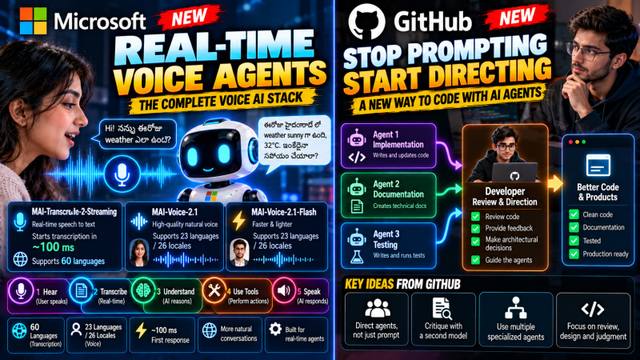
Microsoft Voice AI and GitHub Agentic Coding Updates
The way people interact with AI is moving beyond simple text prompts. Two recent updates from Microsoft and GitHub highlight an important shift: AI systems are becoming faster at handling real-time conversations, while software developers are increasingly expected to manage and review AI agents instead of writing every line of code themselves.
Microsoft introduced three new MAI models on October 1, 2026: MAI-Transcribe-2-Streaming, MAI-Voice-2.1, and MAI-Voice-2.1-Flash. Together, these models provide important building blocks for creating more responsive voice agents. MAI-Transcribe-2-Streaming continuously converts incoming speech into text, allowing applications to receive partial transcription results while a person is still talking. Microsoft says the model supports 60 languages and is designed for low-latency, real-time applications such as voice assistants, customer-service systems, meetings, captions and voice-driven interfaces.
The other two models focus on speech generation. MAI-Voice-2.1 is designed for expressive, high-quality multilingual speech across 23 languages, while MAI-Voice-2.1-Flash is optimized for responsive voice applications and real-time interactions. This creates a more complete voice-agent pipeline: an AI can hear speech, process the request, use tools or perform an action, and then respond naturally using generated speech.
The second major update comes from GitHub. In an October 2 article, GitHub argues that developers need to learn how to direct AI agents, critically review their output, and make strong technical decisions. Instead of asking one AI model to build an entire application and accepting the result, developers can divide work between specialized agents. One agent can handle implementation, another can prepare documentation, and another can create or run tests. The developer remains responsible for reviewing the results and deciding what is ready to ship.
GitHub also recommends using a second AI model to critique the first model's work. This approach can expose problems that the original model missed, such as inefficient code, incomplete requirements or missing edge cases. The developer then acts as the final reviewer rather than blindly accepting AI-generated output.
Together, these updates point toward a broader change in AI workflows. Voice agents are becoming more conversational and responsive, while coding agents are becoming more autonomous and collaborative. The valuable skill is increasingly shifting from simply prompting AI to orchestrating, reviewing and directing AI systems.
For creators and developers, this creates an interesting practical workflow: build a real-time multilingual voice assistant using Microsoft's MAI models, then use multiple coding agents to build, document and test the application. The human remains in control while AI handles more of the execution.
The future AI workflow may therefore look less like “ask AI a question” and more like speak to an agent, give it a goal, let specialized agents execute the work, and review the final result.