Microsoft Copilot Studio Becomes an AI App Factory
Microsoft Copilot Studio now brings apps, workflows and AI agents together in one platform for building business solutions.
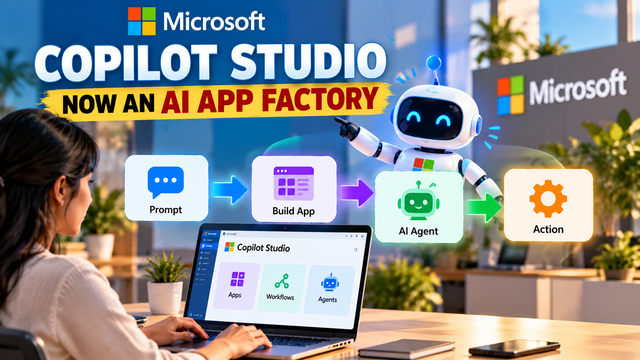
Microsoft Copilot Studio Becomes an AI App Factory
Microsoft is changing how businesses can build AI-powered applications.
Instead of treating an AI chatbot, an automation workflow and a business application as separate projects, Microsoft Copilot Studio is bringing these pieces together in one environment.
In its latest Copilot Studio update, Microsoft says makers can now build apps, workflows and AI agents together. The goal is to help organisations transform business processes from an initial idea into a production-ready solution without stitching together as many separate development tools.
This represents an important shift in enterprise AI.
The first generation of business AI was largely focused on chatbots and assistants. Employees could ask questions, generate content, summarize information or get help with specific tasks.
The newer approach is more ambitious.
AI agents can reason about a task, adapt to changing situations and take actions using connected tools. Workflows can handle processes that need predictable and repeatable execution. Apps can provide the interface that employees use to interact with the overall system.
Microsoft is now combining all three.
From chatbot to complete business solution
A traditional business automation project might require several different tools.
A company could build a front-end application in one environment, create automation in another, connect an AI model separately and then add monitoring and security controls around the system.
Copilot Studio is designed to bring these pieces closer together.
Microsoft describes the approach as one studio where apps, workflows and agents can work together.
For example, imagine an employee onboarding process.
An app could provide managers and employees with a structured interface.
A workflow could automatically perform predictable onboarding tasks.
An AI agent could answer questions, handle exceptions and adapt when something unexpected happens.
Instead of building each component independently, the three can become parts of one solution.
Apps can be created using natural language
One of the notable additions is app building inside Copilot Studio.
Microsoft says apps are available in public preview and makers can describe what they want to build using natural language. The description can include the desired business outcome, intended users, data and actions.
Copilot Studio can then generate a draft application that the maker can preview and refine. Microsoft also says developers retain access to the underlying code when deeper customization is required.
This could lower the barrier for people who understand a business problem but do not have extensive traditional software-development skills.
Instead of starting with a blank development environment, a user can begin by describing the solution.
The AI helps turn that description into an application.
AI agents get more control with hooks
Another important addition is called hooks.
AI agents are useful because they can reason and adapt. However, some actions in a business process need to happen consistently every time.
Microsoft's hooks provide deterministic control at important points in an agent's lifecycle.
For example, hooks can be used to load required context when a session begins, inspect a tool call before it runs, modify or block a tool call, transform results after a tool executes, and respond when an error occurs. Hooks can also capture logging and telemetry.
This is important for production AI.
A company may want an agent to make decisions dynamically, but it may not want the agent to have unlimited freedom when performing sensitive actions.
For example:
AI agent → decides what to do → hook checks action → approved → tool executes
This creates a middle layer between the agent's reasoning and the actual action.
It can help businesses keep important rules deterministic while allowing the AI to remain flexible in other parts of the workflow.
Reusable enterprise knowledge
Microsoft is also expanding Copilot Studio's connection to enterprise knowledge through its Foundry IQ integration.
Microsoft says the integration is generally available and allows organisations to reuse a knowledge base across multiple Copilot Studio agents. Each agent can be configured with appropriate knowledge sources and retrieval scope.
Agents can retrieve information and provide grounded answers with citations, helping users verify where generated information came from.
This is especially useful for businesses with large amounts of internal information.
Instead of creating separate knowledge systems for every AI agent, organisations can reuse controlled enterprise knowledge while limiting each agent's access according to its purpose.
AI agents can now be evaluated more deeply
Building an AI agent is only one part of deploying it.
Businesses also need to know whether the agent actually works.
Microsoft is expanding evaluations in Copilot Studio beyond simple conversations to broader automation.
The platform can evaluate individual AI nodes as well as larger automated processes. Microsoft highlights measurements including Task Completion, Tool Accuracy, Safety and Latency.
Task Completion checks whether the agent achieved the intended outcome.
Tool Accuracy checks whether it selected the expected tools and inputs.
Safety measures responses against configured content-safety thresholds.
Latency measures response time alongside other results.
This is significant because an AI agent can sound intelligent while still failing at the actual business task.
For example, an agent might provide a convincing answer but choose the wrong business tool.
Another agent might correctly understand a request but fail to complete the required action.
Evaluation gives businesses a way to test these behaviours before deployment.
A review system before publishing
Microsoft has also introduced a Review panel that helps makers identify issues before an agent is published.
The review experience can surface blockers and warnings during the building process instead of waiting until the final publishing stage.
Microsoft says the system can prioritize issues by severity and provide explanations and possible actions to resolve them. It can also warn when an agent has never been evaluated or when a model change means older evaluation results may no longer represent the agent's current behaviour.
This is another sign that enterprise AI development is becoming more similar to traditional software engineering.
Companies need to build, test, review and monitor AI systems before putting them into production.
A centralized plugin registry
Microsoft is also expanding its plugin registry.
The registry provides a shared catalog for discovering and governing reusable capabilities across Microsoft Copilot experiences.
Microsoft says the registry already includes more than 100 plugins and brings skills, connectors and agents into a common catalog. Copilot Studio support is rolling out as the integration expands.
For businesses, reusable capabilities can reduce duplicated work.
Instead of every team building the same integration separately, organizations can potentially discover and reuse existing capabilities while maintaining centralized governance.
The bigger shift
The most interesting part of this update is not any single feature.
It is the overall direction.
Microsoft is moving Copilot Studio from a tool for creating conversational AI toward a broader platform for building complete business processes.
The basic model is changing.
Before:
Chatbot → connect automation → add separate application
Now:
Prompt → App + Workflow + AI Agent → Evaluate → Govern → Deploy
That difference is important.
An AI agent can reason and adapt.
A workflow can provide predictable execution.
An app can provide the interface.
Hooks can add deterministic controls.
Enterprise knowledge can provide trusted information.
Evaluations can test performance.
Governance can help organisations manage the system.
Together, these components create something much closer to an AI-powered business application platform.
What this means for Indian businesses
This trend could be particularly important for Indian startups and enterprises.
Many businesses already use AI for customer support, software development, marketing, sales and internal operations.
The next step is connecting those AI capabilities with real workflows.
For example, a company could build an internal employee-service app where an AI agent answers questions, a workflow handles standard requests and a human approves sensitive actions.
A customer-support system could use an agent to understand a request while deterministic workflows handle account updates.
A sales application could combine a user interface, business rules and AI-powered research.
The important point is that AI does not have to replace the entire process.
Instead, companies can decide which parts should be handled by predictable automation and which parts benefit from AI reasoning.
What this means for students and creators
For students learning programming, data science, business analytics or AI, this shift is also worth watching.
Knowing how to use a chatbot is becoming only one part of working with AI.
The more valuable skill could be learning how to design complete AI workflows.
That means understanding:
Input → AI reasoning → tools → workflow → validation → human approval → action
Creators can also use this trend as a practical example of how agentic AI is entering real businesses.
Rather than focusing only on benchmark scores and new AI models, the bigger story is increasingly about what companies are actually building with AI.
AI is becoming part of the business operating layer
Microsoft's Copilot Studio update reflects a broader movement across the technology industry.
Businesses are moving from:
“We have an AI assistant.”
toward:
“Our business processes use AI agents.”
That is a much bigger transformation.
An assistant helps an employee.
An AI-native business process can potentially coordinate applications, workflows, knowledge and agents around a business goal.
But increased capability also means increased responsibility.
Companies need to control what agents can access, test whether they perform correctly, monitor their actions and ensure that important decisions have appropriate oversight.
Microsoft's latest Copilot Studio features are designed around this combination of flexibility and control.
The long-term direction is clear: AI agents are becoming less like standalone chatbots and more like components of business software.
The future may not simply be about asking AI questions.
It may be about building entire applications where apps, workflows and AI agents work together.
That is why Microsoft's latest Copilot Studio update is important: it moves enterprise AI one step closer to becoming an actual business application platform.