Meta Muse Expands Into a Business AI Agent
Meta is expanding Muse with iPad support and business app integrations, letting the AI agent plan and work across tools such as Canva, Notion, GitHub and QuickBooks.
Source: https://about.fb.com/news/2026/09/introducing-muse-small-business/
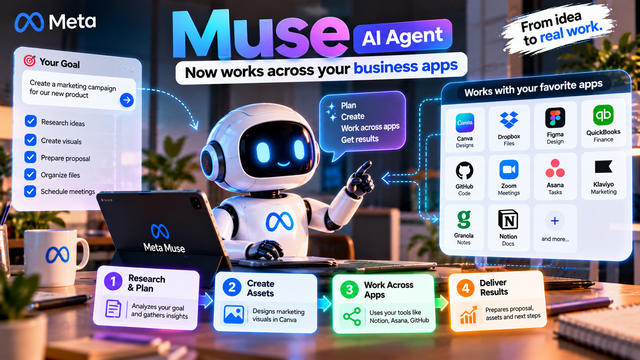
Meta Muse Expands Into a Business AI Agent
Meta is pushing its Muse AI agent beyond simple conversations and toward something much more useful for businesses: an AI system that can work across the software companies already use.
The latest expansion gives Muse connections to a growing collection of business tools, including Canva, Dropbox, Figma, QuickBooks, GitHub, Zoom, Asana, Klaviyo, Granola and Notion. Meta says businesses can give Muse a goal and let it work with connected tools to help move that goal forward.
Muse has also expanded to the iPad, giving users another way to access the agent while working across devices. The iPad update comes alongside the new business-focused integrations.
The bigger change, however, isn't the iPad app.
It is the shift from AI that answers questions to AI that works across business software.
From chatbot to business agent
A traditional chatbot works something like this:
User → asks question → AI → gives answer
For example, a business owner could ask:
“Create a marketing plan for my new product.”
The AI might generate a document containing ideas, campaigns and suggested social posts.
That's useful, but the human still has to take those ideas and move them into the tools they actually use.
An agentic system can go further.
The workflow becomes:
Business goal → AI creates a plan → checks connected tools → creates or organizes work → prepares deliverables → asks for approval when needed
That is the direction Meta is taking Muse.
Meta describes Muse as a personal AI agent that can understand goals, create action plans, work through multiple steps and connect with applications and services.
What can the business integrations do?
The value of these integrations comes from giving Muse access to the context surrounding a business.
Consider Canva.
Instead of simply asking an AI to write:
“Give me five Instagram post ideas.”
A business could give Muse a broader objective, such as launching a new product.
Muse could potentially use connected business information and tools to help develop the marketing work, including ideas and creative assets through connected services.
Meta says its Canva integration can bring a user's existing Canva templates and tools into conversations with Muse, allowing ideas to become editable, on-brand content.
The same concept applies to other integrations.
Notion can provide access to business documents and information.
Asana can connect the agent with task and project workflows.
GitHub can connect it with software-development work.
QuickBooks can provide business-finance context.
Klaviyo can connect marketing and customer-engagement workflows.
Dropbox can provide access to stored business files.
Zoom can connect with meetings and collaboration.
Instead of AI being another separate tab, the goal is to make it part of the existing workflow.
Why this is different from simply adding plugins
The interesting part is the combination of connectors + goals + agentic planning.
A normal integration might allow an AI assistant to retrieve one piece of information from another application.
An agent can potentially use several tools as part of one larger task.
Imagine a small business owner says:
“Help me prepare a launch campaign for our new product.”
The AI could potentially reason about what needs to happen first.
It might organize information, develop campaign ideas, prepare content, work with connected creative tools and organize tasks.
The user doesn't necessarily have to provide a separate prompt for every step.
That is what makes agentic AI different.
The user gives the objective, while the agent determines the sequence of actions needed to work toward it.
Meta is targeting small businesses
Meta's September announcement specifically positions Muse as a tool for small businesses.
The company says business owners often have limited time and need to handle many different roles themselves. Muse is designed to help with some of that workload by working with the tools they already use.
Meta also says Muse can connect to Facebook Pages, Instagram professional accounts and Meta advertising accounts, giving it business-specific context around products, brand voice and customer questions.
This could make the system especially interesting for businesses that operate heavily through social media.
For example, a small online business might use social platforms for marketing, Canva for design, Notion for planning, Dropbox for files and a task-management platform for operations.
Previously, a person would move information between each service.
An agentic system attempts to become the layer connecting those workflows.
Humans still stay in control
There is an important limitation to this idea.
Giving an AI access to business systems creates security and privacy risks.
A business would not want an AI agent to automatically publish something publicly, send an important message, spend money or make a major business decision without oversight.
Meta says users remain in control of Muse and that nothing publishes, sends or spends without approval.
Meta's broader Muse documentation also says users can review and approve important actions, manage permissions and see an audit trail of what the agent has done or plans to do.
This approval layer is important because agentic AI isn't just generating information anymore.
It can potentially take actions.
The more actions an agent can take, the more important permissions and human oversight become.
What this means for Indian creators and startups
This trend could be particularly useful for India's growing creator economy, freelancers, agencies and small businesses.
A solo creator might need to handle content planning, design, client communication, file organization and marketing.
A small agency might need to coordinate proposals, creative work, project management and client meetings.
A startup might have developers working in GitHub, designers working in Figma, marketers using Canva and customer teams working across several other services.
The traditional approach requires people to constantly switch between these applications.
An AI agent could eventually reduce some of that context switching.
Instead of asking:
“Write a proposal.”
A business could potentially give an agent a larger objective:
“Prepare everything we need for this client proposal.”
That is a much more powerful interaction model.
The bigger AI trend
Muse is part of a much larger shift happening across the AI industry.
AI assistants are increasingly being designed around tasks and goals, rather than individual prompts.
The next generation of AI products may therefore look less like search boxes and more like digital coworkers.
The difference can be summarized simply:
Chatbot:
“Tell me how to launch a product.”
AI assistant:
“Create a launch plan.”
AI agent:
“Help me launch this product.”
That final version implies planning, tool use, execution and follow-up.
Meta's Muse expansion shows how companies are trying to turn that idea into a practical product.
For businesses, the most important question may soon stop being:
“Which AI chatbot should we use?”
Instead, it could become:
“Which AI agent can actually work with the software our business already uses?”
That is why Muse's integrations may be more important than the iPad app itself.
The real story is not simply that Meta added another device.
It is that Meta is trying to make an AI agent capable of moving between the applications where real business work happens.
And if this approach succeeds, the future of business AI may look less like asking AI for answers and more like giving AI a goal and letting it help get the work done.