India's cinematical AI Market Is Shifting From Hype to Measurable ROI
India's AI industry is moving beyond experiments, with businesses focusing on measurable results, efficiency and revenue.
By @admin
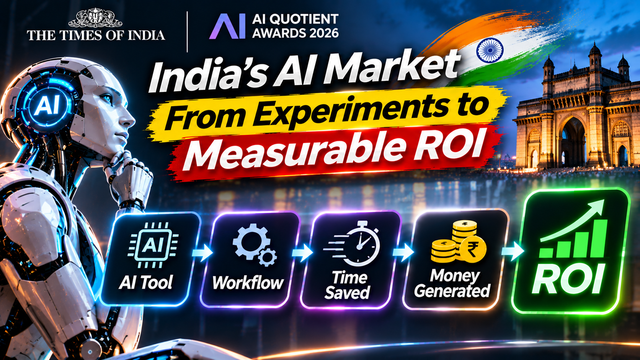
India's AI Market Is Shifting From Experiments to Measurable ROI
Artificial intelligence has become one of the biggest technology conversations in India. Startups are launching AI products, enterprises are testing automation, marketing teams are experimenting with generative AI, and businesses are looking for ways to use intelligent systems in their daily operations.
But an important question is changing the conversation:
Is your business actually making money, saving time or improving performance because of AI?
That was the central theme of the Times of India's AI Quotient Awards 2026, held in Mumbai on September 10.
The event brought together AI innovators, technology leaders, enterprises and startups to recognise organisations using artificial intelligence to create measurable business outcomes.
The message was clear: the industry needs to move beyond simply experimenting with AI and start demonstrating what the technology actually achieves.
This represents an important change in how businesses should think about artificial intelligence.
1. From AI hype to real business results
When generative AI became widely accessible, businesses rushed to experiment with new tools.
Employees started using AI to write emails, create presentations, generate images, summarize documents and automate small tasks.
Companies began testing chatbots, AI assistants and machine-learning systems.
These experiments were useful because they helped people understand what AI could do.
However, experimentation alone does not guarantee business value.
A company might purchase ten AI subscriptions, run several demonstrations and introduce a chatbot without improving its revenue, customer experience or operational efficiency.
That is the difference between AI adoption and successful AI implementation.
AI adoption means using the technology.
Successful implementation means solving a real problem and producing a measurable improvement.
This is the change highlighted by the AI Quotient Awards: the conversation is moving from asking whether organisations use AI to asking how effectively they use it.
2. What happened at the AI Quotient Awards 2026?
The Times of India's AI Quotient Awards 2026 took place in Mumbai on September 10.
The event recognised organisations, teams and individuals working on AI-powered business applications.
According to the event coverage, the awards included 34 categories across four major tracks:
Industry Awards: Recognising AI applications across industries such as banking, financial services, healthcare, retail, manufacturing and other sectors.
Functional AI Excellence: Recognising applications in business functions such as customer experience, marketing, operations, decision intelligence, risk management and human resources.
Maturity-Based Awards: Highlighting organisations at different stages of AI transformation, including AI-native businesses and companies transforming traditional operations.
Special Jury Awards: Recognising leadership, responsible AI, social impact and women in AI leadership.
The event also included panel discussions and fireside chats focused on India's changing AI landscape.
What made the event particularly relevant was its emphasis on real-world implementation rather than simply celebrating the number of AI tools a company uses.
3. How were AI businesses evaluated?
One particularly interesting aspect was the award evaluation methodology.
The official AI Quotient Awards methodology assigned different weights to five areas:
- AI business value and impact — 25%: Improvements in operational efficiency, cost reduction and revenue growth.
- Technical innovation — 20%: Creativity and originality in the AI solution.
- Scalability and integration — 20%: Whether the solution can expand across teams, business units and datasets.
- Governance and guardrails — 20%: Responsible AI practices, security, bias mitigation and compliance.
- Human-machine collaboration — 15%: How effectively AI improves human work and decision-making.
These criteria reveal something important.
A business does not receive meaningful value simply because it has access to an advanced AI model.
The technology must solve a problem, work reliably, integrate with existing operations and deliver measurable benefits.
Security and human oversight are also part of successful implementation.
4. What does AI ROI actually mean?
ROI stands for Return on Investment.
It measures whether the value generated by an investment is greater than the cost of making that investment.
For AI projects, this means comparing the financial and operational benefits with the total cost of implementing and operating the system.
A simple ROI formula is:
ROI = ((Total Benefits - Total Costs) / Total Costs) × 100
Consider a small business that spends money implementing an AI-powered customer support system.
Suppose the business has the following monthly figures:
- AI software and API costs: ₹10,000.
- Additional maintenance and operating costs: ₹5,000.
- Total monthly cost: ₹15,000.
- Measurable monthly financial benefit: ₹30,000.
The calculated ROI is:
((₹30,000 - ₹15,000) / ₹15,000) × 100 = 100%
This means the project generates a 100% return over the measured period, based on those assumptions.
But there is an important detail: not every saved hour automatically becomes financial savings.
If employees save ten hours per week, the business has gained capacity. That becomes financial value only if the saved time is used productively, reduces paid overtime, avoids additional hiring or generates more revenue.
Businesses should therefore distinguish between estimated productivity gains and actual financial benefits.
5. Five metrics every business should track
Businesses implementing AI should avoid measuring success through the number of prompts, subscriptions or automated messages alone.
Instead, they should track outcomes.
1. Hours saved
How much employee time does the AI workflow save compared with the previous process?
For example, if a team previously spent 20 hours per week preparing reports and automation reduces that to 8 hours, the business saves 12 hours per week.
2. Cost saved
Has the workflow reduced expenses such as manual processing, outsourced work, repetitive labour or software costs?
Measure actual cost reductions rather than assuming every saved hour equals cash saved.
3. Revenue generated
Does the AI workflow help generate additional sales, improve conversion rates or increase customer retention?
For example, an AI-powered lead qualification workflow may help a sales team respond to potential customers faster.
4. Error reduction
Has AI reduced repetitive mistakes, missing information, incorrect data entry or document-processing errors?
This is especially important in finance, healthcare, logistics and customer operations.
5. Customer experience
Are customers receiving faster responses, better support and more consistent service?
Businesses should track response times, customer satisfaction, complaint rates and successful resolution rates.
Together, these measurements provide a much clearer picture of whether an AI project is worth continuing.
6. Example: How an Indian digital marketing agency can use AI
Consider a small digital marketing agency managing social media campaigns for multiple clients.
Its employees may spend several hours every week performing repetitive tasks:
- Collecting campaign performance data.
- Preparing reports.
- Writing content drafts.
- Sorting customer enquiries.
- Categorising leads.
- Sending routine follow-up messages.
The agency could introduce AI-assisted workflows.
First, campaign data is collected from approved advertising and analytics platforms.
Next, an AI system analyses performance and identifies important changes.
A reporting workflow generates a draft summary for the account manager.
Another workflow classifies incoming leads and prepares suggested responses.
The human team reviews the outputs, handles complex decisions and communicates with clients.
Now the agency can measure the result.
For example:
Before automation:
- Reporting takes 5 hours per client per week.
- Lead sorting takes 3 hours per week.
After automation:
- Reporting takes 2 hours.
- Lead sorting takes 1 hour.
The agency saves 5 hours every week across those two tasks.
If that time is redirected towards client strategy, acquiring customers or improving campaigns, the workflow may create additional business value.
The key is to measure the actual results instead of simply claiming that AI makes everything faster.
7. Why small businesses and startups have an opportunity
AI adoption is not limited to large technology companies.
Small businesses can also benefit from targeted automation.
A local retailer might use AI to categorise customer enquiries.
A real estate agency might automate lead collection and follow-ups.
An educational business might use AI to organise student queries and prepare learning materials.
A service agency might automate reporting, content preparation and routine customer communication.
These businesses do not necessarily need to train their own large language models.
They can combine existing AI services, business software, APIs and automation platforms to solve specific problems.
However, they should start with a clearly defined business problem rather than buying tools simply because they are trending.
A small workflow that saves five hours every week may be more valuable than an expensive AI platform that employees rarely use.
8. The next stage: From AI tools to AI-powered workflows
There is a major difference between using an AI tool and building an AI workflow.
A tool performs a particular task.
A workflow connects multiple tasks into a repeatable process.
For example, a basic AI tool can write a marketing email.
A complete AI-powered marketing workflow might:
1. Collect information about the target audience.
2. Analyse previous campaign performance.
3. Generate content ideas.
4. Prepare email drafts.
5. Send drafts for human approval.
6. Schedule approved campaigns.
7. Collect performance data.
8. Produce a report.
The business is no longer using AI only to generate text. It is using AI to support an entire operational process.
This is where automation platforms, APIs, databases and AI agents become important.
But automation should not mean removing human oversight.
Financial transactions, sensitive customer communication, legal decisions and other high-impact actions need appropriate permission controls and human review.
9. Why responsible AI is part of business ROI
An AI system can save money initially and still create serious problems if it exposes customer data, generates incorrect information or makes biased decisions.
That is why governance was included in the AI Quotient Awards' evaluation criteria.
Businesses should consider:
- What information is being shared with AI services?
- Who is permitted to access the system?
- Can important outputs be checked?
- Are customer records protected?
- Are automated decisions monitored?
- Is there a human approval process for sensitive actions?
A business that ignores these issues may face financial, legal and reputational costs later.
Responsible implementation is therefore not separate from business performance. It is part of making AI useful over the long term.
10. What does this mean for India's AI future?
India has a large ecosystem of startups, IT services companies, financial institutions, manufacturers, retailers and digital businesses.
These organisations have different requirements, but many face common challenges: rising operating costs, repetitive work, customer-service demands and the need to make decisions using large amounts of information.
AI can help address some of these challenges.
However, the level of success will depend on how effectively businesses connect AI to their existing systems, employees and processes.
The AI Quotient Awards offer a useful snapshot of the direction of the conversation in India.
The focus is increasingly on practical deployment, scalability, business value and responsible use.
That does not mean every Indian business has already completed this transformation. Many are still experimenting, and others face barriers involving data quality, skills, budgets and integration.
But the direction is clear: companies need to move beyond demonstrations and establish measurable reasons for investing in AI.
11. What should businesses do next?
A practical starting point is to select one repetitive business process.
Do not begin by automating the entire company.
Identify a task that consumes time, creates repeated errors or delays customer service.
Record how the task currently works, including the time and cost involved.
Then introduce a small AI-assisted workflow.
Measure the results over a consistent period and compare them with the original process.
A useful tracking framework is:
AI workflow → Hours saved → Cost saved → Revenue generated → Error reduction
Also measure implementation costs, ongoing subscriptions, API usage, employee training and human review.
If the workflow creates a clear benefit without introducing unacceptable risks, consider expanding it.
If it does not, improve it or stop investing in it.
This approach helps businesses avoid spending money on technology without a clear purpose.
12. The real takeaway: AI success is measured by outcomes
The AI Quotient Awards 2026 highlighted an important change in India's technology conversation.
For years, businesses have asked which AI model is best, which chatbot is more powerful and which new tool can generate the most impressive output.
Those questions still matter, but they are no longer enough.
The more important questions are:
Does the AI reduce operating costs?
Does it help employees complete work faster?
Does it improve customer experience?
Does it generate additional revenue?
Can the system scale safely and reliably?
The future of business AI will not be decided by the number of tools an organisation subscribes to. It will be decided by how effectively those tools solve real problems.
The next competitive advantage will not come from simply using more AI. It will come from turning AI into measurable business results.