Humanoid Robots Cinematic: AI Just Beat Human Records
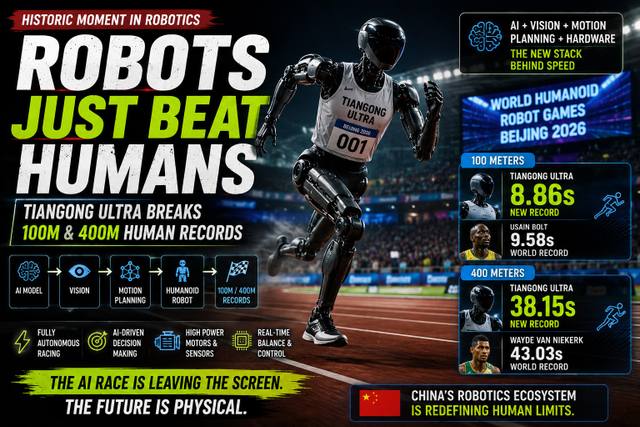
China's Tiangong Ultra humanoid robot has beaten human 100m and 400m records, reaching 8.86 seconds in Beijing.
By singamankitha
Tiangong Ultra Cinematic: Robots Are Outrunning Humans
A Chinese humanoid robot has now run the 100 metres in 8.86 seconds — faster than Usain Bolt's 9.58-second human world record. Just days earlier, the same robot had already beaten the human 400m record.
The AI race is no longer happening only on computer screens.
It is now running on two legs.
At the 2026 World Humanoid Robot Games in Beijing, Chinese humanoid robots have delivered a series of extraordinary sprint performances.
The biggest headline came from Tiangong Ultra, a humanoid robot developed by the Beijing Humanoid Robot Innovation Center.
On August 23, Tiangong Ultra completed a 100-metre preliminary heat in 9.39 seconds, beating Usain Bolt's 9.58-second men's world record. Another humanoid robot, Honor's Lightning, also finished faster than Bolt, recording 9.47 seconds.
But the story didn't stop there.
On August 25, Tiangong Ultra went even faster.
It completed the 100 metres in 8.86 seconds during the semifinals of the large-size robot division, improving its previous 9.39-second mark by more than half a second.
And that wasn't the robot's only human-record performance.
The 400-Metre Record Fell Too
On August 23, Tiangong Ultra won the large-group 400-metre final in 38.15 seconds.
The human men's 400m world record is 43.03 seconds, set by South African sprinter Wayde van Niekerk at the 2016 Rio Olympics.
That means Tiangong's recorded time was almost five seconds faster than the human benchmark.
The result is particularly interesting because the 400m is much more demanding for a humanoid robot than a short sprint.
A robot has to maintain balance, coordinate multiple joints, manage motor temperatures and keep its power system operating throughout the race.
And unlike a wheeled machine, it has to repeatedly control its body while running on two legs.
This Isn't Just a Robot Race
It would be easy to look at the footage and think this is simply a futuristic sporting event.
It isn't.
The World Humanoid Robot Games are becoming a testing ground for technologies that could eventually matter outside the stadium.
Beijing's official information about the 2026 event says the 100-metre competition was upgraded to a fully autonomous event.
The broader games also include scenario-based competitions involving tasks such as housekeeping, firefighting and retail assistance, with robots being tested in environments designed to resemble real-world workplaces.
That changes the significance of the competition.
The question isn't only:
“How fast can a robot run?”
It's:
“Can AI-controlled machines reliably understand and interact with the physical world?”
The New AI Stack
For years, the AI industry focused primarily on digital intelligence.
Language models learned to understand text.
Image models learned to understand pictures.
Coding agents learned to work with software.
But a humanoid robot requires another layer.
It needs to connect intelligence with physical action.
The stack starts looking more like:
AI model
↓
Vision
↓
Perception
↓
Planning
↓
Motion control
↓
Motors + sensors
↓
Physical action
That's a completely different challenge from generating a paragraph or writing a line of code.
A chatbot can make a mistake and produce a bad answer.
A robot can make a mistake and fall over.
Why Running Is So Difficult
Human running looks simple because our brains have spent millions of years optimizing it.
We don't consciously calculate every movement.
When you sprint, your body constantly adjusts:
Balance.
Stride length.
Foot placement.
Joint angles.
Body position.
Acceleration.
Deceleration.
A humanoid robot has to reproduce these kinds of coordinated movements using sensors, control systems, motors and software.
A tiny error can cause the robot to lose balance.
And that's exactly what makes the recent performances so interesting.
The robots aren't simply moving their legs.
They're maintaining dynamic balance while operating at high speed.
But There Is a Huge Caveat
Here's where the viral headlines need some context.
A robot beating Usain Bolt's 100m time does not mean the robot is a better athlete than Bolt.
Human and robot competitions are fundamentally different.
Robots have different mechanical systems, power sources, control strategies and safety requirements.
The robot event also uses its own competition rules and track setup.
And the machines have demonstrated some very non-human behavior.
During the earlier 9.39-second run, Tiangong Ultra and Lightning reportedly crashed into the padded stopping area after crossing the finish line.
The latest 8.86-second run also ended with the robot hitting the stopping mat, according to Reuters reporting.
So yes:
The robot is faster.
But it isn't necessarily more graceful, more adaptable or more capable than a human.
That's an important distinction.
Speed Is Only One Part of Robotics
Running fast makes for an incredible headline.
But the real challenge for humanoid robots is usefulness.
Imagine a robot working inside a factory.
It needs to:
Recognize objects.
Understand instructions.
Pick things up.
Move around obstacles.
Use tools.
Recover from mistakes.
Work safely around humans.
Repeat the task thousands of times.
And potentially learn new tasks.
That is much harder than running in a straight line.
A sprint has a clear objective.
Go from point A to point B as quickly as possible.
Real-world work is messy.
The environment changes.
Objects move.
People get in the way.
Lighting changes.
Machines fail.
The robot needs to adapt.
China Is Pushing Humanoid Robotics Hard
The Beijing games are also a demonstration of China's growing humanoid-robotics ecosystem.
The 2026 event features more than 2,000 robots from 666 teams competing across 51 disciplines, according to Reuters reporting.
The competitions go beyond running.
Robots compete in activities including football, dancing and other physical tasks.
That creates something unusual.
Instead of testing robots only inside research laboratories, developers can compare machines in standardized public competitions.
It's almost like a sporting league for robotics.
Why Competition Matters
Competition creates pressure.
If one team develops a better walking algorithm, another team has an incentive to beat it.
If one company improves motor control, another can try a different approach.
If a robot becomes faster, the next team tries to make its robot faster while keeping it stable.
That creates a rapid feedback loop.
The same dynamic has driven progress in many human technologies.
Competition can accelerate engineering.
And humanoid robotics is entering a phase where hardware and AI are improving together.
From AI Models to Embodied AI
This is where the story connects directly to the broader AI revolution.
Traditional AI operates mostly in digital environments.
It reads text.
It generates images.
It writes code.
It searches databases.
Humanoid robots bring AI into the physical world.
The AI now needs to understand:
Where am I?
What am I looking at?
What is moving?
What should I do next?
How much force should I use?
Where should I place my foot?
How do I recover if I lose balance?
This is often called embodied AI.
The intelligence isn't separated from the body.
The intelligence controls a physical machine.
Why Humanoid Form Matters
You might ask:
Why build a robot with two legs?
Wheeled robots are often much more efficient.
Four-legged robots can be extremely stable.
So why humanoid?
Because humans built the world for humans.
Factories have stairs.
Buildings have doors.
Homes have kitchens.
Workplaces have desks.
Tools have handles designed for human hands.
If a robot can move and interact using a human-like body, it may eventually be able to operate in environments that weren't designed specifically for robots.
That's the long-term attraction of humanoid machines.
The Real Test Is the Workplace
This is where the sprint records become less important.
Imagine Tiangong Ultra running 100 metres in 8.86 seconds.
Impressive.
Now ask it to work an eight-hour shift in a warehouse.
Can it safely lift boxes?
Can it recognize damaged products?
Can it navigate crowded aisles?
Can it recharge itself?
Can it recover after dropping something?
Can it understand a human worker's instructions?
Can it perform reliably every day?
That's the real benchmark.
The next generation of humanoid robotics will be judged less by how fast robots can run and more by how reliably they can work.
AI + Robotics Could Become the Next Major Platform
The AI industry has already transformed digital work.
Now robotics companies are attempting to bring similar capabilities into physical work.
The potential applications are enormous.
Manufacturing
Robots could perform repetitive assembly and handling.
Warehousing
They could move goods and interact with inventory.
Logistics
They could assist with sorting and transportation.
Hospitality
They could potentially support hotels and service environments.
Emergency response
They could enter dangerous environments where humans face high risks.
Home assistance
Eventually, humanoid robots could perform household tasks.
But every one of these applications requires much more than speed.
It requires reliability.
The Race Is Just Beginning
The most impressive part of Tiangong Ultra's performance may actually be how quickly the technology is improving.
At the inaugural World Humanoid Robot Games, Tiangong won the 100m event in 21.50 seconds.
This year's opening-day performance was 9.39 seconds.
Then the robot reached 8.86 seconds in the semifinal.
That is a dramatic improvement over a very short period.
Of course, competition conditions and engineering changes make direct comparisons imperfect.
But the trajectory is still remarkable.
What Happens When Robots Get Smarter?
Hardware alone won't determine the future.
The next leap could come from better AI.
Imagine combining:
Vision models
Reasoning models
World models
Motion planning
Real-time control
Powerful motors
Better batteries
The robot could potentially become far more capable.
Instead of following a fixed routine, it could understand what is happening around it and choose actions dynamically.
That's the point where humanoid robotics could become truly transformative.
Are Robots Ready to Replace Humans?
No.
Not yet.
The sprint records don't prove that humanoid robots are ready to replace humans in general physical jobs.
In fact, the machines still have obvious limitations.
They can fall.
They can crash.
They can struggle with unexpected environments.
They can require extensive testing and specialized hardware.
The jump from “robot can run fast” to “robot can reliably do human work” is enormous.
But the technology is clearly progressing.
And that's what makes these competitions worth watching.
The Bigger Picture
The AI revolution started with intelligence inside computers.
Now it's moving into machines that can see, move and interact with the physical world.
That's a major transition.
The new stack isn't just:
Model → Answer
It's:
Model → Vision → Reasoning → Planning → Motion → Action
And when those pieces work together, AI stops being something you only interact with through a screen.
It becomes physical.
Final Takeaway
Chinese humanoid robots have just demonstrated something that would have sounded ridiculous a few years ago.
They are running faster than the fastest human sprint records.
Tiangong Ultra's 8.86-second 100m run is faster than Usain Bolt's 9.58-second human record, while its 38.15-second 400m performance is faster than Wayde van Niekerk's 43.03-second record.
But the real story isn't that robots have suddenly become better humans.
They haven't.
The real story is that machines are becoming increasingly capable of controlling their bodies at speeds that were previously difficult for humanoid robots to approach.
And the technology behind that involves far more than motors.
It requires:
AI
Vision
Sensors
Motion planning
Control systems
Hardware
Real-time decision-making
That's why these races matter.
They're not just sporting events.
They're public demonstrations of how quickly embodied AI is developing.
The next question isn't:
“Can a robot outrun a human?”
We've already seen the answer.
The much harder question is:
“Can a robot understand the world well enough to work alongside humans?”
That's the race that really matters.