GPT-5.6 Cinematic: The 82% Cheaper Coding Stack
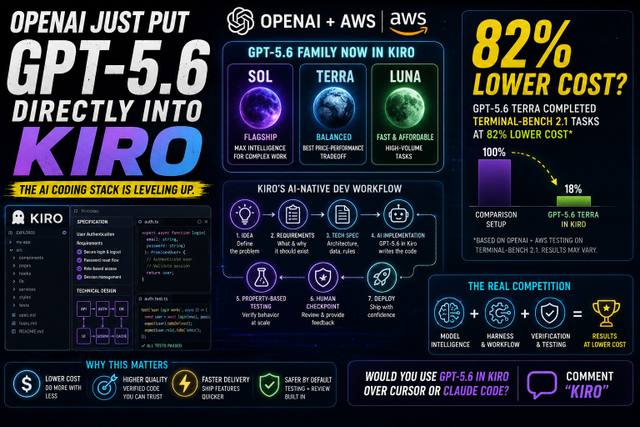
OpenAI and AWS report that GPT-5.6 Terra completed Terminal-Bench 2.1 tasks in Kiro at roughly 82% lower cost in their testing.
By singamankitha
Source: https://openai.com/index/gpt-5-6-in-kiro/?utm_source=chatgpt.com
GPT-5.6 Cinematic: The 82% Cheaper Coding Stack
OpenAI has brought its GPT-5.6 model family deeper into AWS's Kiro coding environment, and OpenAI and AWS report an 82% cost reduction for successful Terminal-Bench 2.1 tasks using GPT-5.6 Terra. The bigger story isn't simply a new model inside another coding tool — it's the combination of AI models, structured specifications and automated verification.
AI coding is entering a new phase.
The competition isn't only about:
“Which AI model is smartest?”
It's increasingly becoming:
“Which AI system can actually finish the work at the lowest cost?”
That distinction matters.
A powerful model can generate impressive code.
But software development isn't just about generating code.
You need requirements.
You need architecture.
You need context.
You need implementation.
You need testing.
You need debugging.
And eventually, someone needs to decide whether the result is actually correct.
That's the idea behind the latest OpenAI and AWS collaboration around GPT-5.6 and Kiro.
OpenAI says the GPT-5.6 family — Sol, Terra and Luna — is available in Kiro, AWS's AI-native software-development environment. The companies say they optimized the models and Kiro environment together and found that GPT-5.6 Terra completed successful Terminal-Bench 2.1 tasks at roughly 82% lower cost in their testing.
But there's an important detail:
82% is not a universal claim that all AI coding is now 82% cheaper.
It is a reported result from a specific benchmark and testing setup.
And that distinction is important.
This Isn't Just About GPT-5.6
If the announcement were simply:
“GPT-5.6 is now available in Kiro.”
that would be interesting.
But it wouldn't be the most important part of the story.
The interesting part is the combination of:
Model
Specification
Codebase context
Agent
Testing
Human checkpoints
That creates something much closer to an AI software-development workflow.
Instead of asking a model to:
“Build this feature.”
and hoping for the best, Kiro can structure the development process around explicit requirements and technical plans before implementation.
OpenAI says Kiro can turn high-level intent into structured requirements, technical designs and executable tasks, giving GPT-5.6 more context about what needs to be built and how it should work.
That's the real story.
What Is Kiro?
Kiro is an AI-powered software development environment from AWS.
Its approach is different from simply putting a chatbot inside an IDE.
Kiro emphasizes spec-driven development.
The idea is straightforward:
Before the AI starts writing large amounts of code, it should understand what you're actually trying to build.
That means moving through stages such as:
Idea
↓
Requirements
↓
Technical design
↓
Tasks
↓
Implementation
↓
Testing
↓
Review
This structure can reduce ambiguity.
And ambiguity is one of the biggest problems with AI coding agents.
Why Specifications Matter
Imagine telling an AI:
Build a dashboard for my business.
That's extremely vague.
What data should it display?
Who can access it?
What happens when data is missing?
What authentication system should it use?
What database should store the information?
What happens on mobile?
What are the performance requirements?
What does “dashboard” even mean in this particular product?
A coding agent can make assumptions.
And those assumptions can lead to rework.
Now imagine giving it a detailed specification first.
The AI knows:
What to build
Why it is being built
How it should behave
What constraints exist
What success looks like
That gives the model a much stronger foundation.
GPT-5.6 Brings Three Tiers
OpenAI's GPT-5.6 family contains three main models:
GPT-5.6 Sol
The flagship model.
Designed for the most demanding tasks and complex workflows.
GPT-5.6 Terra
The balanced option.
OpenAI positions Terra around the intelligence-versus-cost tradeoff.
GPT-5.6 Luna
The fastest and most affordable tier.
Designed for higher-volume and less demanding work.
OpenAI describes the three models as different capability tiers rather than simply three versions of the same model.
Kiro's current model documentation lists all three, with different credit multipliers reflecting their relative cost.
Why the 82% Number Matters
Now we get to the headline.
OpenAI and AWS say their testing found that GPT-5.6 Terra completed successful Terminal-Bench 2.1 tasks in Kiro at roughly 82% lower cost.
That's a huge number.
But it needs context.
This isn't saying:
“GPT-5.6 makes every coding task 82% cheaper.”
It means that in the companies' testing setup, the combination of GPT-5.6 Terra and Kiro produced successful benchmark tasks at roughly that lower cost.
That's a very different statement.
Still, it's strategically important.
Because the AI coding market is increasingly becoming a price-performance competition.
The Real Metric Is Work Per Dollar
Imagine two AI coding systems.
System A costs $1 to complete a task.
System B costs $0.20.
If both produce a working result, System B has a huge economic advantage.
Now imagine doing that across:
1,000 tasks.
10,000 tasks.
1 million tasks.
The difference becomes enormous.
This is why AI companies increasingly talk about:
Performance per dollar.
Not just benchmark scores.
A model that is slightly smarter but dramatically more expensive may not be the best choice for everyday development.
A model that is slightly less capable but far cheaper could become the workhorse.
That's where Terra and Luna become particularly interesting.
AI Coding Is Becoming a Stack
The old AI coding workflow looked something like:
Prompt
↓
Model
↓
Code
↓
Human fixes it
The new workflow is becoming:
Requirements
↓
Specification
↓
AI agent
↓
Codebase context
↓
Implementation
↓
Tests
↓
Verification
↓
Human checkpoint
That's a much more sophisticated system.
The model is no longer operating alone.
It's part of a harness.
And the harness can have a major effect on how useful the model is.
The Model Isn't the Whole Product
This is one of the biggest lessons from modern AI coding.
People often compare:
GPT vs Claude vs Gemini
as if the model itself determines the entire experience.
It doesn't.
The surrounding system matters.
How does the tool provide context?
How does it search the codebase?
How does it handle tool calls?
How does it recover from errors?
How does it test its work?
How does it maintain project requirements?
How does it let humans intervene?
How efficiently does it use tokens?
These things can dramatically affect the final outcome.
That's why the phrase:
Model + harness
is becoming increasingly important.
Verification Changes Everything
There's another major component in Kiro:
Property-based testing.
Traditional tests might check specific examples.
For example:
Input: 5
Expected:
25
Property-based testing takes a broader approach.
Instead of checking only a few known examples, it can test whether the software continues to satisfy defined properties across many generated inputs.
For AI coding agents, that can be extremely useful.
Why?
Because AI-generated code can look correct while containing subtle bugs.
Testing gives the system a way to challenge its own implementation.
That creates a feedback loop:
AI writes code
↓
Tests run
↓
Failure discovered
↓
AI investigates
↓
Code modified
↓
Tests run again
That's much closer to how an experienced developer works.
Human Checkpoints Still Matter
Kiro's workflow also emphasizes checkpoints.
That's important because full autonomy isn't always desirable.
Imagine an AI agent changing a production database.
You probably don't want:
“Go ahead, do whatever you think is best.”
You want:
Plan → Review → Approve → Execute
Human checkpoints allow developers to inspect what the agent intends to do before significant changes happen.
That's especially important for production systems.
Why This Could Be Big for Vibe Coding
This fits directly into the rise of vibe coding.
Vibe coding made it possible for people to describe an application in natural language and let AI handle much of the implementation.
That's powerful.
But it also created a problem.
If you don't understand what the AI is doing, large projects can quickly become messy.
You might get:
Duplicate code.
Inconsistent architecture.
Broken dependencies.
Poor error handling.
Unnecessary components.
Security issues.
Technical debt.
The more complex the project becomes, the more important structure becomes.
Kiro's spec-driven approach is essentially an attempt to bring more engineering discipline into AI-native development.
From “Prompt and Pray” to “Specify and Verify”
That's perhaps the simplest way to describe the transition.
Old approach:
Prompt → Generate → Hope
New approach:
Specify → Plan → Generate → Test → Review
That doesn't mean the AI will never make mistakes.
It means the system has more opportunities to catch those mistakes.
And that's important for long-running development tasks.
Why Terminal-Bench 2.1 Matters
Terminal-Bench is designed to evaluate AI agents performing real terminal-based tasks.
Instead of simply asking a model a question, these environments require an agent to interact with a computer environment and complete a task.
That makes it more representative of agentic coding than a simple question-answer benchmark.
OpenAI's GPT-5.6 launch page reports strong Terminal-Bench 2.1 performance across the GPT-5.6 family, including 87.4% for Terra and 84.7% for Luna in OpenAI's broader model evaluation.
The Kiro announcement is different because it focuses on cost of successful completion within the Kiro environment.
That distinction matters.
One benchmark measures capability.
The Kiro test adds an economic question:
How much does it cost to get the task successfully completed?
The Economics of AI Coding
This could become one of the biggest battles in AI.
Imagine three coding tools.
Tool A:
Extremely intelligent.
Very expensive.
Tool B:
Slightly less intelligent.
Much cheaper.
Tool C:
Uses different models depending on the task.
Cheap model for simple work.
Expensive model for difficult work.
The third approach could be extremely powerful.
You don't need a frontier model to rename variables.
You don't need the cheapest model to design an entire software architecture.
You need the right intelligence for the job.
That's the philosophy behind OpenAI's broader GPT-5.6 pricing strategy as well.
OpenAI has reduced GPT-5.6 Luna's price by 80% and Terra's by 20%, while positioning Sol as the higher-capability option.
AI Coding Could Become More Like Cloud Computing
There's an interesting parallel here.
Cloud computing isn't simply:
“Which server is fastest?”
Companies choose different hardware depending on the workload.
AI coding may evolve similarly.
You might use:
Luna
for high-volume simple tasks.
Terra
for everyday implementation.
Sol
for difficult architecture and complex debugging.
And the coding environment can decide which model is appropriate.
Kiro's documentation already describes an Auto option that can route tasks to an appropriate model.
That could become increasingly important.
The Future Coding Agent
Imagine giving your AI developer a project.
You say:
Build a customer-management platform.
The system could automatically:
Understand requirements.
Create a technical specification.
Break the project into tasks.
Choose the appropriate AI model.
Implement each task.
Run tests.
Detect failures.
Fix errors.
Ask for approval when necessary.
Then continue.
That's much closer to an autonomous software-development team than a chatbot.
And cost becomes a critical part of making that model commercially viable.
What Developers Should Take From This
The biggest lesson isn't:
“Use GPT-5.6.”
It's:
Give your coding agent structure.
Before asking an AI to build something complicated, define:
Requirements
What exactly should happen?
Constraints
What should never happen?
Architecture
How should the system be organized?
Acceptance criteria
How will you know it's finished?
Tests
How will you verify the result?
Checkpoints
When should a human review the work?
This can improve the reliability of almost any AI coding workflow, regardless of which model you use.
A Practical AI Coding Workflow
For your own projects, you can use this structure:
Step 1 — Idea
Describe the product.
Step 2 — Requirements
List exactly what the system must do.
Step 3 — Technical specification
Define architecture, data flow and constraints.
Step 4 — Implementation
Let the AI agent build one task at a time.
Step 5 — Testing
Run automated tests.
Step 6 — Review
Inspect the changes.
Step 7 — Approval
Approve significant modifications.
Step 8 — Deployment
Only deploy after verification.
This is much safer than:
“Build my whole app.”
The Bigger Competition
This is why the OpenAI-Kiro announcement matters.
The competition in AI coding is moving beyond raw model intelligence.
The real battlefield is becoming:
Model
Context
Agent
Tools
Workflow
Testing
Cost
A model can be excellent in isolation and still perform poorly inside a badly designed agent.
Conversely, a slightly cheaper model can become extremely valuable when paired with a strong development harness.
That's the strategic lesson.
Is 82% Lower Cost Guaranteed?
No.
Don't publish it that way.
The accurate statement is:
OpenAI and AWS report roughly an 82% cost reduction for successful GPT-5.6 Terra tasks in Kiro on Terminal-Bench 2.1.
That's it.
It doesn't mean:
Every developer saves 82%.
It doesn't mean:
Every coding task costs 82% less.
It doesn't mean:
Kiro is universally cheaper than Cursor or Claude Code.
And it certainly doesn't mean:
GPT-5.6 is automatically the best coding model.
It's a specific reported result.
That's actually enough to make the story interesting without exaggerating it.
What Happens Next?
Expect AI coding platforms to compete heavily on cost per completed task.
Not just:
Tokens per dollar.
But:
Working software per dollar.
That's a much better metric.
If one agent generates 10,000 lines of code but requires extensive human repair, it may be less valuable than another agent that generates 5,000 lines and gets the feature working correctly on the first attempt.
The real goal is not:
More tokens.
It's:
More useful work.
Final Takeaway
OpenAI's latest Kiro announcement shows where AI coding may be heading.
GPT-5.6 Sol, Terra and Luna are now available in Kiro, while OpenAI and AWS say their testing found that GPT-5.6 Terra completed successful Terminal-Bench 2.1 tasks at roughly 82% lower cost in the optimized Kiro environment.
But the important story isn't the number alone.
It's the architecture around the model.
Requirements
↓
Specification
↓
AI agent
↓
Code
↓
Testing
↓
Review
↓
Deployment
The AI coding race is becoming less about simply asking:
“Which model is smartest?”
And more about asking:
“Which combination of model, agent, context, verification and workflow can deliver working software for the lowest cost?”
That's a much bigger competition.
And it could change how developers build software.
Because the future of AI coding may not be:
Human → Prompt → AI → Code
It could become:
Human → Requirements → AI Engineering System → Tested Software
And if that system can produce reliable software at dramatically lower cost, the biggest winner may not be the model with the highest benchmark score.
It may be the system that gets the most working code per dollar.