Google Playground Lets You Create Games With AI
Google Playground lets users create, play and share custom games with text prompts, without needing coding skills.
Source: https://blog.google/innovation-and-ai/technology/ai/playground-experimental-gaming-platform/
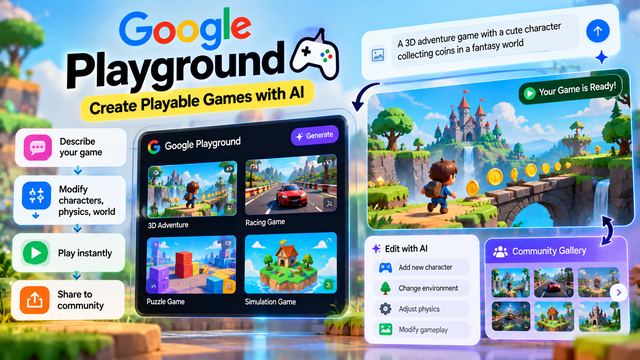
Google Playground Lets You Create Games With AI
Google has officially launched Playground, an experimental gaming platform that lets people create, play and share custom games using simple text prompts instead of traditional coding.
The platform was announced by Google on October 7, 2026, with the goal of making game creation accessible to people who may not have programming or game-development experience. Users can describe the type of game they want, experiment with the result and then continue modifying it conversationally.
The basic idea is simple:
Describe a game → AI creates it → Play it → Ask AI to change it → Share it
That makes Playground different from a traditional game engine where creators usually need to understand programming, assets, physics systems and other development tools before building something playable.
Create games with text
Google says Playground has a conversational interface that lets users direct the game by typing what they want.
A creator can start with a blank canvas, use starter prompts or receive guided support while developing an idea. Once the first version is created, the user can continue asking for changes.
For example, a creator could ask for a platform game with a particular character and environment.
After seeing the result, they could ask the AI to change the physics, modify the character, rewrite the rules or redesign the environment.
The important part is that the creator can continue the development process through natural-language instructions rather than manually changing every technical component.
Google describes Playground as a way to turn an idea into a playable game through prompts, without requiring coding experience.
From idea to playable game
The biggest opportunity here is the speed of experimentation.
Traditionally, someone with a game idea might need to learn a game engine, understand programming concepts, create assets and build a prototype before other people can even try the idea.
Playground changes the starting point.
A person could begin with something as simple as:
“Create a racing game where players drive through a futuristic Indian city.”
The creator can then experiment with the result.
They might ask:
“Make the cars faster.”
Then:
“Add obstacles.”
Then:
“Change the environment to a night-time city.”
Then:
“Add a leaderboard.”
This conversational approach makes game development feel more like directing an AI creative partner.
Play, compete and share
Playground is not only about creating games.
Google says users can play games created by the community, share their own creations and publish games to the Playground Explore gallery.
Creators can also keep a game private or share it with friends through a link.
Google says Playground supports multiplayer gameplay in select genres and includes leaderboards. Users with a Play Games profile can also use a custom handle, like games, compete for leaderboard positions and follow creators.
Published games go through safety screening aligned with Google's Community Guidelines, along with user reporting mechanisms.
This means Playground is being designed not just as an AI generation experiment, but as a community where people can create and discover playable experiences.
Unity Spark is coming
Google is also pointing toward something bigger.
Playground will eventually integrate with Unity Spark, which Google says is intended to provide more advanced professional-level game creation capabilities.
According to Google, Unity Spark will bring more robust mechanics, higher-fidelity 3D capabilities and flexibility through the Unity runtime.
Unity Spark is currently being tested, with a closed beta planned.
This could create an interesting path for creators:
Simple prompt → Playground prototype → More advanced development → Unity
Instead of AI game creation being limited to simple experiments, the technology could eventually become an entry point into more sophisticated game development.
Why creators should watch this
For content creators, Playground creates an extremely easy-to-understand AI demonstration.
Instead of making a video explaining how AI-generated games work, creators can simply show the process.
Start with:
“I gave AI one sentence and it built me a playable game.”
Then show the prompt.
Show the generated game.
Change something with another prompt.
Finally, play the result.
That before-and-after transformation is much more visually interesting than a normal AI news explanation.
It also opens opportunities for gaming creators, educators and developers to experiment with interactive content.
What this means for students
Students interested in programming or game development can use tools like Playground to experiment with ideas before learning more advanced development environments.
A student could prototype a game concept, understand how game mechanics work and then use the experience as motivation to learn programming, 3D design or professional game engines.
However, AI-generated game creation should not be confused with replacing the skills needed for professional game development.
Complex commercial games still require engineering, design, art, testing, performance optimization and production expertise.
Playground is better understood as a new way to prototype and experiment quickly.
Availability
There is an important limitation with the current launch.
Google says Playground is initially launching for users in the U.S. who are 18 or older, with tiered creation access rolling out based on Google One membership.
So users in India should not assume that the service is already available to everyone locally.
The larger trend, however, is clear.
AI is moving from generating text and images toward generating interactive experiences.
Google Playground takes that idea into gaming:
You describe the idea → AI builds the experience → You play it → AI changes it.
That could make game prototyping dramatically more accessible and gives creators another powerful format to experiment with.