Google Playground Lets You Create Games From Text
Google and Unity have launched Google Playground, a new platform that lets users describe game ideas with natural-language prompts and turn them into interactive, playable experiences.
Source: https://www.ft.com/content/0cb02773-d207-4920-8c74-d9707d2622a0
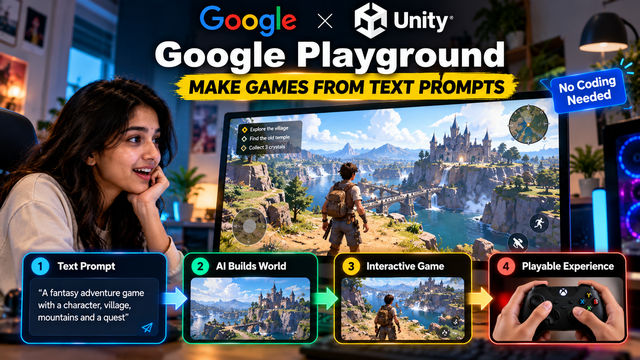
Google Playground Turns Text Prompts Into Playable Games
AI-generated images and videos have already changed how creators turn ideas into visual content. Now Google and Unity are pushing the concept further by exploring something much more interactive: creating playable game experiences from natural-language prompts.
Google and Unity have launched Google Playground, a platform designed to let users describe a game concept using text and generate an interactive experience from that description. The technology uses Google's world-model approach to understand environments and interactions instead of simply generating separate images or game assets.
The important shift is from generating content to generating an interactive world.
For example, instead of manually building a game environment, a creator could describe an adventure world with a character, locations, objects and goals. The system can then turn that concept into an experience that users can interact with.
This represents a different direction for generative AI. Earlier AI tools focused heavily on individual outputs:
Prompt → Image
Prompt → Video
Prompt → 3D Asset
Google Playground points toward another model:
Prompt → Interactive World → Playable Experience
That could make experimentation much faster for students, indie developers, designers and people who have game ideas but don't have extensive programming or game-development experience.
The collaboration with Unity is particularly important because Unity is one of the world's major game-development platforms. Google says a more advanced version called Unity Spark is planned for later in 2026, potentially expanding the possibilities for AI-assisted game creation.
However, this does not mean traditional game development is disappearing overnight. Commercial games still require design, programming, testing, performance optimization, art direction, sound, multiplayer infrastructure and many other development tasks.
The bigger change is the prototype stage.
A developer could have an idea in the morning and potentially test an interactive version of that concept much faster than with a traditional development workflow. Students could experiment with game mechanics, while creators could use AI-generated worlds to demonstrate ideas before investing significant development time.
For India's growing community of game developers, students and AI creators, this could lower the barrier to experimenting with interactive experiences.
The emerging workflow is simple:
Describe the idea → AI builds the world → Interact with it → Test the game
The bigger story is that generative AI is moving beyond pictures and videos. The next major interface may be describing a world and actually being able to play inside it.