Google Playground: Create Playable Games With AI Prompts
Google Playground lets users explore AI game creation through prompts. Discover the Google–Unity partnership, playable prototypes, and opportunities for game creators.
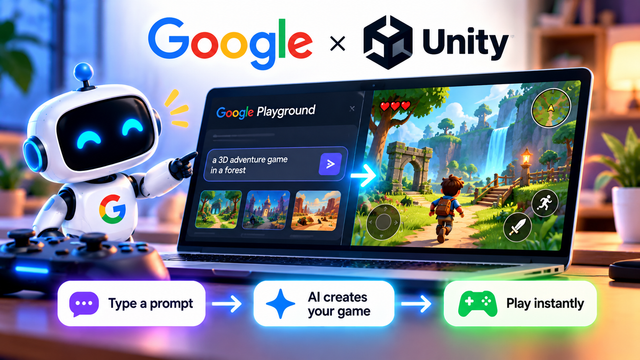
Google Playground: How AI Prompts Could Change Game Creation
Introduction
What if you could describe a game in simple English and watch an AI-powered tool turn your idea into something you can play? You could imagine a colourful racing game, a platform adventure, or a puzzle challenge without first learning an entire programming language.
This is the idea behind Google's experimental Playground platform, introduced as part of a partnership between Google and Unity announced on October 7, 2026, according to the announcement supplied for this article.
The partnership highlights a growing trend in artificial intelligence: making interactive experiences easier to create through natural-language instructions. Instead of beginning with complex code, users can start by describing what they want to build and then experiment with the result.
The announcement is particularly interesting for students, aspiring game developers, content creators, and people who have creative ideas but limited programming experience.
However, an important distinction remains. Creating a playable prototype is not the same as developing a complete commercial game. Professional game development still involves testing, performance optimisation, visual design, sound, accessibility, security, and many other tasks.
What Is Google Playground?
Google Playground is described as an experimental platform that allows users to generate playable games using natural-language prompts.
A natural-language prompt is an instruction written in everyday language rather than a programming language. For example, someone might describe a simple game in which a character runs through a forest, collects coins, and avoids obstacles.
A prompt-based tool can use that description to help generate an interactive experience, depending on the platform's available capabilities.
Traditional game development commonly requires developers to work with programming languages, game engines, assets, physics systems, animations, and user-interface components. Beginners often need time to understand how these parts fit together.
Prompt-based game creation aims to lower the initial barrier by letting users begin with an idea and refine the result through instructions.
The platform is experimental, so users should not assume that every type of game or feature can be generated perfectly. The quality and complexity of the result depend on the system's actual capabilities.
How Does Prompt-Based Game Creation Work?
The process can be understood through five basic stages.
1. Describe your game idea
The first step is to explain the game you want to create.
For example:
"Create a colourful 3D adventure game in which a player explores a forest, collects ten glowing coins, jumps over obstacles, and reaches a finish line."
This description communicates the environment, objective, basic mechanics, and winning condition.
A more specific prompt generally gives the tool a clearer starting point. Users can describe the camera perspective, visual style, difficulty, character movement, and controls when those options are supported.
2. Generate an initial playable experience
The platform attempts to turn the instructions into an interactive game.
Rather than receiving only a picture or a written design, the user aims to obtain something they can play and evaluate.
For beginners, this can make experimentation more engaging. They can see how their instructions affect an interactive result instead of having to build every component manually from the beginning.
Nevertheless, the generated experience may contain bugs, incomplete mechanics, or visual inconsistencies. Users should test it rather than assuming the first result is finished.
3. Play and evaluate the result
The next step is to interact with the game.
Does the character move correctly? Can the player collect the coins? Are the obstacles positioned properly? Is the objective understandable?
Testing helps reveal the difference between what the user requested and what the generated game actually does.
4. Improve the game using additional prompts
If something does not work as expected, the user can try a more specific instruction.
For example:
"Make the character move faster, reduce the number of obstacles, add a visible score counter, and display a winning message after collecting ten coins."
This approach turns game creation into an iterative process: describe, generate, play, identify problems, and refine.
The available editing capabilities will depend on the platform and the features provided to the user.
5. Share the experience
The announcement describes sharing creations with other players. Sharing can make it easier for users to demonstrate their ideas and receive feedback.
For a student, a small game could become a creative project. For a content creator, it could provide an interactive demonstration for an educational video.
Sharing options and access conditions should be checked within the actual platform before planning a public release.
Why Is the Google and Unity Partnership Important?
Google brings AI research and development capabilities, while Unity is a major platform in the game-development ecosystem.
Unity's development tools are used to build interactive experiences across different devices and platforms. A partnership involving AI-assisted creation could connect easier experimentation with more advanced development workflows over time.
According to the supplied announcement, Google Playground is available to users aged 18 and older, while the more advanced Unity Spark experience is planned for later in 2026.
These offerings should be distinguished. Playground is described as the experimental prompt-based creation platform, while Unity Spark represents a planned later-stage experience.
The long-term significance will depend on how these tools develop, how much control creators have over generated games, and how easily prototypes can be incorporated into more advanced workflows.
The announcement alone does not establish that a complete professional game can be produced automatically from one prompt.
What Could This Mean for Indian Students?
India has students interested in computer science, animation, game design, digital art, and interactive storytelling.
For students who have never written code, prompt-based tools could provide an accessible introduction to the logic behind games. They could experiment with objectives, scoring, obstacles, movement, and difficulty before studying how those systems are implemented in a game engine.
For example, a student could begin with a simple coin-collection game. After testing the basic experience, they could explore different levels, introduce a timer, or change the game's theme.
This type of experimentation can help students develop problem-solving skills and understand how interactive systems behave.
However, students should not treat AI-generated games as a replacement for learning programming fundamentals. Understanding variables, conditions, loops, functions, physics, and debugging remains valuable for anyone who wants to become a professional developer.
AI tools can make it easier to start, while technical knowledge makes it easier to understand, customise, and maintain more complicated projects.
Opportunities for Indian Game Creators and Startups
Small teams and independent creators often face limitations involving time, budgets, and technical resources.
An AI-assisted game-creation tool could help them explore more ideas before committing to a full development project.
For instance, an indie creator might want to compare several versions of a puzzle game. Instead of investing significant time in every concept, they could use prompt-based prototyping where supported to explore different mechanics and decide which idea deserves further development.
An educational startup could investigate interactive learning activities. A creator could experiment with a short playable experience for a social-media audience. A design team could use a prototype to communicate an idea before a larger production effort.
These are potential applications, not guarantees of commercial success. Creators still need to consider game quality, originality, user experience, distribution rights, platform requirements, and production costs.
Can AI Replace Game Developers?
Prompt-based game generation may reduce the effort required to produce some initial experiences, but it does not mean that game developers are no longer needed.
A polished game often requires careful level design, responsive controls, balanced difficulty, animation, sound, performance testing, accessibility, and quality assurance.
A generated prototype might demonstrate an interesting concept while still containing broken interactions or repetitive gameplay.
Professional developers also make decisions that go beyond implementing a feature. They determine which mechanics are enjoyable, how players learn the rules, how difficulty progresses, and how the overall experience feels.
AI-assisted tools are therefore better understood as potential additions to a developer's toolkit rather than proof that human expertise has become unnecessary.
The most useful combination may be a creator who understands game design and uses AI to experiment more quickly while retaining control over the final experience.
Important Limitations to Understand
Because Playground is described as experimental, users should approach it with realistic expectations.
First, complex prompts may not produce the exact intended result. Game mechanics can interact in unexpected ways, and additional testing may be necessary.
Second, generating a playable experience does not automatically provide the tools required for professional deployment. Exporting, publishing, maintaining, and monetising a game may involve separate processes.
Third, users should check the platform's age requirements, availability, sharing rules, and applicable terms before using or distributing their creations.
Finally, AI-generated content should be reviewed for originality, quality, and suitability. Creators should not assume that every generated asset or experience can be used commercially without restrictions.
How Creators Can Demonstrate This in a Reel
A short screen-recorded demonstration could explain the concept in approximately 30 seconds.
Start with the hook: "Coding raadhu ani aagipoyava? Ippudu prompt tho playable game create cheyochu!"
Next, show a simple game prompt, the generated result, and one specific change to a game mechanic. Finish by explaining that prompt-based tools can make prototyping easier but do not eliminate the work required to build a polished game.
Use real platform footage where possible. If the actual interface is unavailable, label any mock-up or illustration clearly instead of presenting it as genuine product footage.
Conclusion
Google and Unity's announced partnership highlights an exciting direction for AI-assisted interactive entertainment. Google Playground is described as a way to create and customise playable games through natural-language prompts, potentially allowing more people to experiment with game design.
For Indian students, it could provide a new way to explore interactive programming concepts. For creators and startups, it could help with early-stage prototyping and experimentation. For experienced developers, AI-assisted tools may offer additional ways to explore ideas and accelerate selected parts of a workflow.
The important distinction is between generating an initial playable experience and delivering a complete, reliable, polished game.
As these tools evolve, their real value will depend on the quality of the games they produce, the control they give users, and how well they fit into practical development workflows.
Sources: Unity's Google–Unity partnership announcement and the associated Unity investor announcement.