Google Launches New AI Chips to Challenge Nvidia
Google introduces its next-generation TPU 8tx and 8i Max AI chips to strengthen its position in AI computing, cloud infrastructure and advanced machine learning.
By Gangothri
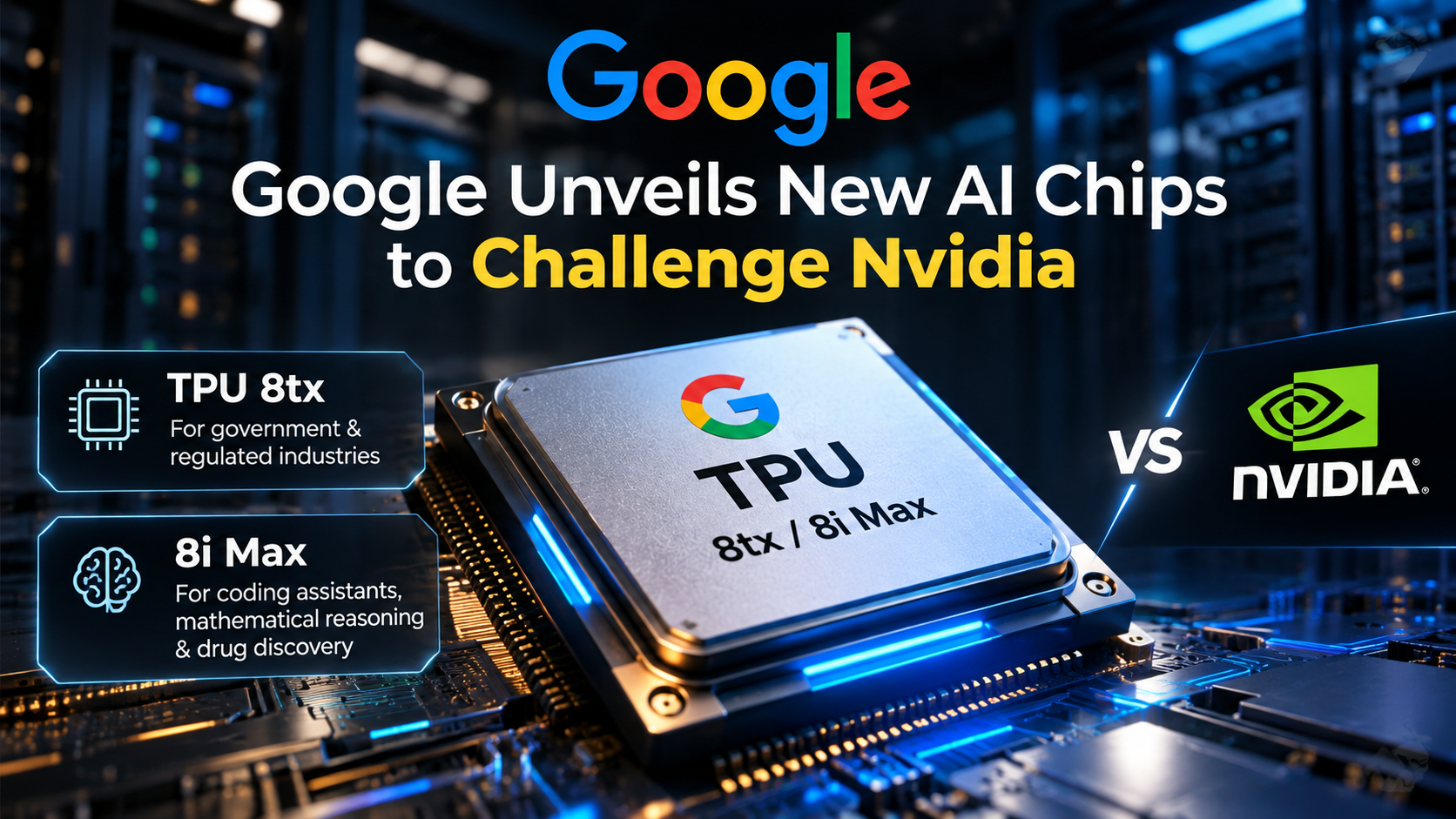
Google Unveils New AI Chips to Challenge Nvidia: TPU 8tx and 8i Max Explained
Google is taking another major step in the global artificial intelligence hardware race. On November 9, 2026, Google announced two new additions to its eighth-generation Tensor Processing Unit (TPU) portfolio: TPU 8tx and TPU 8i Max.
The announcement highlights Google's growing ambition to compete in the AI infrastructure market, where Nvidia currently holds a powerful position. As businesses increasingly depend on artificial intelligence, demand for faster, more secure and more efficient computing hardware continues to increase.
Rather than introducing two completely new chip architectures, Google has developed specialized systems based on its existing eighth-generation TPU technology. Each is designed to address a different challenge in modern AI computing.
The TPU 8tx focuses on confidential computing and secure AI processing, while the TPU 8i Max is designed for demanding AI workloads that require massive amounts of memory and computing power.
This development could influence how companies build AI applications, operate autonomous agents and access cloud computing resources.
1. What Are Google's New TPU 8tx and TPU 8i Max?
Google's Tensor Processing Units are specialized processors designed to accelerate machine learning workloads.
Unlike traditional CPUs, which are designed to perform a wide variety of computing tasks, TPUs are optimized for the mathematical operations used extensively in artificial intelligence.
These operations include matrix multiplication, neural network processing, model training and AI inference.
Google originally developed TPUs for its own internal products, including Search, translation and other AI-powered services. Over time, the company expanded their capabilities to support Gemini models, enterprise applications and Google Cloud customers.
The eighth-generation TPU family now includes four systems:
TPU 8t – Designed for large-scale AI model training.
TPU 8i – Designed for low-latency AI reasoning.
TPU 8tx – Designed for secure and confidential AI processing.
TPU 8i Max – Designed for massive context windows and higher computing density.
The latest announcement expands Google's hardware portfolio to address different requirements across the AI industry.
2. TPU 8tx: A New Direction for Secure AI Computing
One of the most important announcements is the TPU 8tx system.
As artificial intelligence becomes more common in banking, healthcare, government and enterprise environments, protecting sensitive information has become a major concern.
Traditional security methods protect information while it is stored or transferred across networks. However, information must often be decrypted while a processor actively works with it.
This creates an additional security challenge.
Google's TPU 8tx addresses this problem through hardware-level confidential computing.
The system is designed to protect sensitive information and model weights even while they are being processed.
According to Google, TPU 8tx combines its existing TPU 8t silicon with AMD EPYC CPU hosts and specialized networking capabilities.
The company says the system can deliver up to twice the speed of its predecessor for relevant inference workloads, with almost no performance penalty from its security features.
Who can benefit from TPU 8tx?
Several industries could benefit from this approach:
Government organisations: Government agencies often process confidential information. Hardware-level protection can help them deploy AI applications while maintaining stronger security controls.
Banking and financial services: Financial institutions can explore AI-powered fraud detection, risk analysis and customer services while protecting sensitive financial information.
Healthcare: Hospitals and research organisations can investigate AI applications involving confidential medical information.
Enterprise businesses: Companies developing private AI assistants and autonomous agents can benefit from secure infrastructure.
The important point is that AI performance alone is no longer enough. Businesses also need reliable security and privacy.
3. TPU 8i Max: Designed for Larger AI Workloads
The second system, TPU 8i Max, focuses on another major challenge in artificial intelligence: memory limitations.
Modern AI applications increasingly work with enormous amounts of information.
Consider an AI coding assistant that needs to understand an entire software project. It may need to process thousands of files, identify relationships between different functions and remember information across a long conversation.
Similarly, an AI research system may need to analyse lengthy scientific documents, datasets and experimental results.
These applications require substantial memory bandwidth and computing resources.
Google designed TPU 8i Max to address this challenge.
The system combines two low-latency TPU 8i chips into a single package.
According to Google, TPU 8i Max provides:
Double the computing capacity of TPU 8i.
Double the SRAM.
Double the high-bandwidth memory bandwidth.
Greater computing density within the existing rack footprint.
This design helps keep processors supplied with the information they need, reducing delays caused by memory bottlenecks.
Where could TPU 8i Max be useful?
Potential applications include:
AI coding assistants: Processing larger software projects and maintaining context across complex development tasks.
Mathematical reasoning: Supporting computationally demanding reasoning workflows.
Drug discovery: Helping process large scientific datasets and support computational research.
Autonomous AI agents: Supporting systems that coordinate multiple agents and handle large amounts of contextual information.
As AI applications become more complex, memory and data movement are becoming just as important as raw processing power.
4. Google vs Nvidia: Why This Announcement Matters
Nvidia has become one of the most important companies in the global AI industry because its GPUs power a large portion of modern AI training and inference infrastructure.
Its hardware, software ecosystem and CUDA platform have made it a preferred choice for many AI developers and businesses.
However, Google is pursuing a different strategy.
Instead of depending entirely on commercially available GPUs, Google has invested in designing its own custom AI processors.
Its TPUs are closely integrated with Google Cloud infrastructure, software frameworks and Google's internal AI development systems.
This gives Google greater control over how its hardware and software work together.
Key differences
Area | Google TPUs | Nvidia GPUs |
|---|---|---|
Hardware | Custom AI accelerators | General-purpose GPUs with strong AI capabilities |
Main ecosystem | Google Cloud and TPU software | CUDA and broader GPU ecosystem |
Focus | Specialized AI workloads | Broad AI and accelerated computing |
Availability | Google Cloud and expanding customer access | Multiple cloud and hardware providers |
Main advantage | Hardware-software integration | Mature developer ecosystem |
This does not mean Google has replaced Nvidia.
Nvidia continues to have a substantial developer ecosystem, and customers choose hardware according to performance, cost, compatibility and availability.
Google's strategy is to provide another powerful option for companies that want to build and operate AI systems.
The competition could encourage improvements in performance, accessibility and infrastructure pricing across the industry.
5. Why Google Is Expanding Its AI Hardware Business
The AI industry is moving beyond simple chatbot applications.
Businesses are developing systems that can write code, analyse documents, interact with databases and perform complex tasks with limited human intervention.
These systems are commonly described as AI agents.
Unlike a basic chatbot, an AI agent may perform multiple steps before completing a task.
For example, an AI software development agent might:
Read a software requirement.
Analyse an existing codebase.
Identify a programming issue.
Generate or modify code.
Run tests.
Review the results.
Suggest improvements.
Every step requires computing resources.
When thousands or millions of these operations happen simultaneously, companies need powerful and efficient infrastructure.
This is one reason Google is investing in specialized TPU systems.
The company says its eighth-generation portfolio is designed to support different stages of the AI lifecycle, from model training to real-time reasoning and confidential agent execution.
Google also reports that its TPU business now serves nearly 100 customers, including research organisations, retailers, trading firms and other companies.
Expanding access through Google Cloud is an important part of its strategy.
6. Google Wants More Developers to Use TPUs
Hardware alone cannot build a successful AI ecosystem.
Developers also need software tools, frameworks, documentation and accessible development environments.
Google is working to make its TPU platform easier to use.
Its announcement highlights support for PyTorch developers through TorchTPU, along with integrations involving open-source inference systems such as vLLM and SGLang.
This is important because many AI developers already use PyTorch to build and experiment with machine learning models.
If developers can use familiar tools without completely rewriting their applications, adopting alternative hardware becomes easier.
Google is also investing in tools to help developers identify performance bottlenecks and optimize their workloads.
This could reduce some of the technical barriers that have historically made specialized AI accelerators difficult to adopt.
For businesses, easier access to TPU infrastructure could create more choices when selecting computing platforms.
7. What Does This Mean for India's AI Industry?
India is becoming an important market for artificial intelligence, cloud computing and digital services.
Indian startups, IT companies, universities and research organisations are exploring AI-powered products across multiple sectors.
However, building advanced AI applications requires more than access to powerful models.
It also requires computing infrastructure, networking, storage, data management and security.
Developments such as Google's TPU expansion highlight the importance of these technologies.
Opportunities for Indian startups
Indian startups developing AI products could benefit from greater competition among cloud and hardware providers.
Potential application areas include:
AI-powered customer support.
Enterprise automation.
Financial fraud detection.
Healthcare research.
AI coding assistants.
Multilingual AI applications.
Autonomous business workflows.
Access to different AI computing platforms could help startups evaluate performance and infrastructure costs before choosing a long-term technology stack.
Opportunities for engineering students
For engineering students, this announcement is a reminder that artificial intelligence is not limited to building prompts or using model APIs.
The technology depends on several connected engineering fields.
Students interested in AI and machine learning can explore:
1. Python programming: Learn Python fundamentals and libraries used in machine learning.
2. Computer architecture: Understand processors, memory, parallel processing and how computers execute operations.
3. GPU and TPU computing: Learn how specialized processors accelerate AI workloads.
4. Cloud computing: Explore Google Cloud and other cloud platforms.
5. Machine learning: Understand model training, inference, neural networks and optimization.
6. Data structures and algorithms: Build the programming foundation needed for software and AI engineering.
7. AI infrastructure: Explore how models are deployed, monitored and scaled in production environments.
These skills can help students understand the complete AI technology stack rather than focusing only on application development.
8. GPU vs TPU: Understanding the Technology Simply
A common question among beginners is: What is the difference between a GPU and a TPU?
A GPU, or Graphics Processing Unit, was originally developed to process graphics. Its parallel-processing capabilities later made it extremely useful for machine learning and artificial intelligence.
A TPU, or Tensor Processing Unit, is a specialized processor designed by Google to accelerate machine learning calculations.
Think of a GPU as a highly flexible team that can perform many different kinds of parallel tasks.
A TPU is more like a specialized team designed to perform particular AI-related calculations efficiently.
Both can be powerful tools for artificial intelligence.
The best choice depends on the application, software compatibility, workload, cost and infrastructure requirements.
Understanding this difference is a useful starting point for anyone interested in AI hardware.
9. What Could Happen Next in the AI Chip Industry?
Google's announcement is part of a much larger transformation in computing.
Companies are increasingly developing custom processors, specialized accelerators and integrated software platforms.
The future of AI infrastructure will likely depend on several factors.
Computing efficiency: Companies will look for ways to process more AI workloads using fewer resources.
Memory performance: Larger AI models and autonomous agents will increase demand for high-bandwidth memory.
Data security: Businesses will need stronger protection when using private information with AI systems.
Cloud accessibility: More developers will need convenient access to advanced computing resources.
Software compatibility: Hardware providers will compete to make their platforms easier to use.
Energy efficiency: As AI data centres expand, power consumption and operating costs will become increasingly important.
These factors will influence the next generation of AI hardware.
10. Final Thoughts: AI Competition Is Moving Beyond Software
Google's TPU 8tx and TPU 8i Max announcement demonstrates how the AI industry is evolving.
The competition is no longer limited to developing better AI models or launching more advanced chatbots.
Companies are also competing to build the infrastructure that makes artificial intelligence possible.
From secure computing to massive memory capacity, specialized hardware is becoming increasingly important.
Nvidia remains a major force in the industry, but Google's growing TPU ecosystem gives businesses another option for building advanced AI systems.
For students, developers and entrepreneurs, this is an opportunity to look beyond popular AI applications and understand the technology powering them.
The next generation of AI opportunities may come not only from developing intelligent software but also from building the hardware, cloud infrastructure and systems that support it.
The biggest lesson: The future of AI belongs to both the people building intelligent applications and the engineers building the infrastructure behind them.