Google Gemini Free Access Changes From October 9
Google is changing Gemini model access from October 9, 2026. Learn what free and paid users can access and how to prepare.
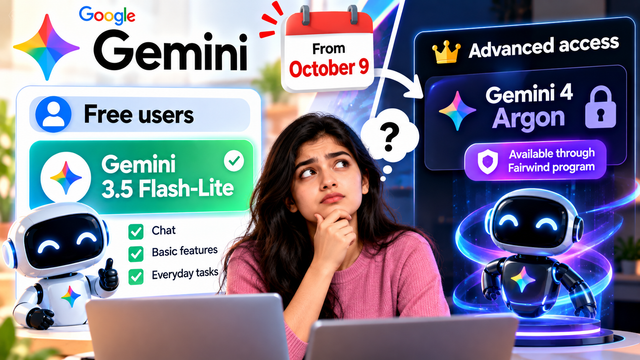
Google Gemini Free Access Changes: What Happens From October 9?
Google is changing the availability of AI models in the Gemini app, making access more dependent on a user's subscription plan. According to Google's official Gemini Apps Help Center, the changes begin taking effect for users without an AI subscription on October 9, 2026. Users on Google AI Plus are expected to receive an email explaining when the changes will apply to their accounts.
The update matters because Gemini is used for everyday questions as well as more demanding tasks such as coding, writing, research and working with long documents.
The key point is that this is a change in which models users can access, not simply a reduction in the number of prompts they can send.
Here is what the official information says, what it means for free users, and how Indian students, creators and businesses can prepare.
1. What is changing in Google Gemini?
Gemini offers access to different AI models designed for different levels of speed and capability. The availability of these models can depend on a user's Google AI subscription.
Google's updated support page lists three model families: Flash-Lite, Flash and Pro. From October 9, users without a paid AI subscription will no longer have access to Flash and Pro through their personal Gemini accounts once the change takes effect.
Flash-Lite will remain available to free users.
Google AI Plus users will retain access to Flash-Lite and Flash but will no longer have access to Pro once their account's change takes effect. Google's help page says AI Plus subscribers should receive an email explaining the timing.
Google AI Pro and Google AI Ultra continue to list access to all three model families in Google's published availability table.
These changes concern the consumer Gemini app and personal accounts described in Google's help information. They should not automatically be interpreted as changes to every Google AI product, enterprise offering or developer API.
2. Which Gemini models will free users be able to use?
The main change for free users is that Flash-Lite becomes their available model from the listed model families.
Here is a simplified view of the availability described by Google:
Google AI plan | Flash-Lite | Flash | Pro |
|---|---|---|---|
Free, no subscription | Available | Not available | Not available |
Google AI Plus | Available | Available | Not available |
Google AI Pro | Available | Available | Available |
Google AI Ultra | Available | Available | Available |
Availability can roll out at different times, particularly for AI Plus users. Check the official support page and your account for the latest status.
The practical implication is that free users may have less choice when selecting a model for a particular task. A user who previously selected Pro for a demanding question will need to use the available model or consider another option.
3. What is Flash-Lite, and what can it do?
Flash-Lite is positioned as a lightweight model intended for fast, everyday AI tasks.
For many common activities, a lightweight model may be sufficient. Users can ask general questions, brainstorm ideas, draft simple messages, summarize short passages and get explanations of familiar topics.
For example, a student might ask for a simple explanation of a programming concept. A creator might request caption ideas. A small business owner might draft a polite customer response.
These tasks do not always require the most capable model available.
However, model performance varies by task. More demanding work can involve complicated reasoning, lengthy context, multiple constraints or several connected steps. A lightweight model may need more guidance or produce results that require additional review.
This does not mean Flash-Lite is useless or that every response will be worse. It means users should evaluate whether the available model meets the needs of their particular task.
4. Will coding, research and writing be affected?
Potentially, depending on the task and the model you previously used.
Coding: Simple questions about syntax or short code snippets may remain manageable with a lightweight model. Complex debugging, architectural decisions and multi-step coding tasks may benefit from a more capable model, so developers should test their usual workflow.
Research: A lightweight model can help organize questions or summarize supplied text. Research involving complex comparisons, long documents or several reasoning steps may need more checking and additional tools.
Writing: Captions, short emails, outlines and basic drafts can often be created with lightweight models. Long-form analysis, nuanced editing or work involving many constraints may require more iteration.
Education: Students can still use AI to explain concepts and generate practice questions, but they should verify important information and use the tool to support learning rather than simply copy answers.
The important distinction is between losing access to a particular model and losing access to Gemini entirely. Google's update describes a change in model availability; it does not say that free users can no longer use the Gemini app.
5. Why might Google use subscription-based model access?
Google's official support page explains the access changes but does not provide a detailed public explanation of the business rationale for this specific update.
Running advanced AI models requires computing resources. Different models and features can have different operating costs, and providers often manage demand through usage limits and subscription tiers.
Google has already described compute-based usage limits for Gemini. Its help page says usage depends on factors such as prompt complexity, the features used and the length of a conversation. Premium models and features can consume more of a user's allowance.
It is reasonable to view model access and usage limits as part of the broader challenge of managing AI computing resources. However, the specific reason for this change should not be presented as confirmed unless Google states it directly.
For users, the observable effect is clearer: the model options available in Gemini depend more directly on the subscription plan.
6. What about Gemini 4 Argon and the Fairwind program?
Some online reports have discussed Gemini 4 Argon and restricted access through a security-focused program called Fairwind alongside the changes to free Gemini access.
These are separate claims and should not be presented as the confirmed reason for the October 9 access change.
The official Gemini Apps Help Center page describing the subscription update lists Flash-Lite, Flash and Pro. It does not identify Gemini 4 Argon or the Fairwind program as the cause of the free-tier change.
For an accurate news article, keep the focus on the model-access changes that Google documents. If discussing Argon separately, link to a reliable source specifically covering that model and clearly explain its availability without implying a connection that has not been established.
This distinction is important for creators who want to report AI news responsibly. A story can contain a confirmed product change alongside other claims that remain unverified.
7. What does this mean for Indian students?
Many Indian students use free AI assistants to understand engineering subjects, practise programming, prepare presentations and clarify difficult concepts.
The change does not mean they must immediately purchase a subscription.
Start by testing the model still available to your account on the tasks you actually perform. For routine explanations, short summaries and simple programming questions, it may be enough.
For a difficult topic, provide context and ask the model to explain its reasoning in manageable steps. Ask follow-up questions and verify important answers using textbooks, course materials or official documentation.
Students should also explore other legitimate free resources, including educational websites, documentation and alternative AI services. Compare their capabilities and limits rather than assuming one model is always best.
If you are considering a paid subscription, first identify the specific feature you need and how often you will use it. A subscription is worthwhile only if the added capability justifies the cost for your own needs.
8. What should creators and small businesses do?
For creators, the effect depends on how much they rely on Gemini for their content workflow.
Simple caption ideas, topic brainstorming and first drafts may still be possible with the available model. More complicated tasks, such as comparing multiple sources or building a detailed content plan, may require additional prompts and verification.
Small businesses should review the tasks where model choice makes a meaningful difference. If Gemini is used for customer messages, product descriptions or basic summaries, test whether the available model meets the required quality standard.
For financial, legal, health-related or other consequential decisions, do not rely on an AI answer without appropriate professional review.
A practical approach is to maintain a flexible workflow. Keep source documents, prompts and important outputs organized so you can move between tools when needed. Avoid building an entire business process around a single model's availability.
9. Does paying for Google AI Plus solve the problem?
Google AI Plus continues to offer access to Flash-Lite and Flash in the published table, but Pro access is no longer included once the change takes effect for the account.
That means a paid plan does not necessarily provide access to every model.
Before subscribing, check the current plan comparison in your region. Confirm which models and features are included, what usage limits apply and whether the specific task you need is supported.
Also distinguish between model access and usage allowance. Being able to select a model does not mean it can be used without limits.
Google says usage limits depend on factors including task complexity and features. Those limits can matter for users who frequently generate media, work with long conversations or use advanced reasoning features.
Because plan details can change, use Google's current subscription information rather than relying on old screenshots or prices quoted in social media posts.
10. How to prepare for the change
If you use Gemini regularly, take these steps:
Check your account. Confirm which Google AI plan you have and which models are currently available.
Identify important workflows. List the tasks for which you specifically need Flash or Pro.
Test Flash-Lite. Try it on everyday questions, writing and coding tasks that matter to you.
Review the results. Compare accuracy, completeness and the amount of editing required.
Explore alternatives. Consider other free tools or official documentation when a task needs a different capability.
Compare subscription plans carefully. Pay only if the included features justify the expense.
Verify important information. Whatever model you use, check factual claims, code and high-impact recommendations.
These steps can help you adapt without making an unnecessary purchase or assuming that every task will become impossible.
Final takeaway
Google is changing model availability in the Gemini app based on subscription tier, with changes beginning for users without an AI subscription on October 9, 2026. Free personal-account users will retain Flash-Lite, while Flash and Pro access will depend on a paid plan. Google AI Plus users are expected to receive account-specific timing by email, and Pro and Ultra remain listed with access to all three model families.
For Indian students, creators and small businesses, the best response is to test the available model, understand your actual requirements and compare alternatives before paying.
Important reporting note: The official support page documents the subscription-access changes. It does not establish that Gemini 4 Argon or the Fairwind program caused those changes.
Official source: Google Gemini Apps Help — Changes to Gemini model access and limits.