Google EmbeddingGemma 2 Enables Local AI Search
Google’s EmbeddingGemma 2 can search text, code, images, audio and video on-device using one multimodal embedding model.
Source: https://blog.google/innovation-and-ai/technology/developers-tools/embeddinggemma-2/
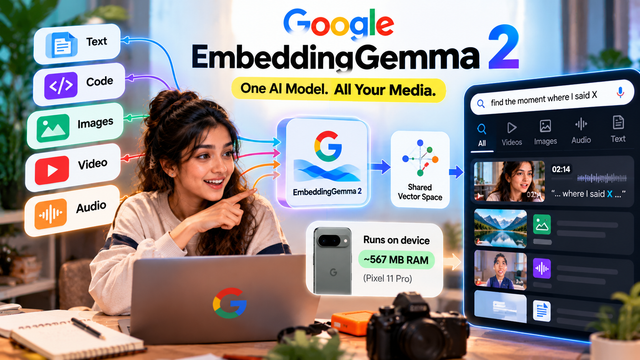
Google EmbeddingGemma 2 Enables Local AI Search
Google has released EmbeddingGemma 2, a lightweight open multimodal embedding model designed to bring AI-powered search and retrieval directly to devices.
The interesting part is not simply its size. EmbeddingGemma 2 can map different types of information—including text, code, images, audio and video—into a shared embedding space. This allows developers to build applications that can search across different kinds of media using a single multimodal model. Google announced the model on October 6, 2026.
That creates a much more interesting possibility for creators.
Imagine having thousands of videos, voice recordings, photographs and documents stored on your computer or phone. Instead of manually opening every file, you could search for something like:
“Find the video where I talked about AI agents.”
A local application could compare the meaning of the query with the content stored in your media library and return the most relevant video moments.
Google specifically highlights use cases such as finding a video clip from a voice memo and searching hours of audio using a text query. The company also provides examples such as Instant Media Search and Video Moments Finder through Google AI Edge.
Small enough for on-device AI
EmbeddingGemma 2 has 740 million parameters and is released under the commercially permissive Apache 2.0 license. Google designed it for efficient on-device inference rather than requiring a large cloud infrastructure setup.
Google reports that, with quantization, the full multimodal model can use approximately 567 MB of active RAM on a Pixel 11 Pro, while the text-only configuration can require as little as about 191 MB of active RAM.
The model also supports an 8K-token context window, allowing it to process combinations of audio, images and video frames within a local workflow.
Why local search matters
Running embeddings locally can provide several advantages.
First, sensitive files do not necessarily need to be uploaded to a cloud service just to create searchable representations. Google says local embedding generation can improve privacy, reduce latency and enable cross-modal search that works entirely offline.
Second, developers can build specialized applications around their own data.
A content creator could organize a large video library. A student could search lecture recordings and notes. A business could create local document retrieval systems. Developers could also use the model for semantic code search and retrieval inside local coding workflows.
Google says EmbeddingGemma 2 improves code performance compared with the previous EmbeddingGemma model and can support local codebase indexing, semantic code search and coding-agent retrieval.
Multimodal RAG on a device
Another important application is retrieval-augmented generation, or RAG.
EmbeddingGemma 2 can be used to find relevant information locally, while another model such as Gemma 4 can provide the reasoning or generation layer. Google describes this combination as an on-device RAG pipeline for multimodal data.
This means developers could potentially build AI applications where searching and reasoning happen much closer to the user's device.
For example:
Your media library → EmbeddingGemma 2 → Find relevant content → Generative AI → Answer
A creator could ask a question about their own recordings and retrieve the relevant clips. A company could search internal documents without sending the entire library through a remote AI service.
Why creators should watch this
For AI creators, the easiest way to understand EmbeddingGemma 2 is not through a technical explanation of vector embeddings.
The better demonstration is:
“Search my entire video library using AI without uploading the videos.”
That immediately shows why small multimodal models matter.
Google is effectively pushing AI search closer to the device. Instead of relying on one huge cloud model for every task, developers can combine lightweight local models with larger models only when deeper reasoning is necessary.
EmbeddingGemma 2 therefore represents a broader trend toward private, multimodal and on-device AI.
The future of AI search may not always look like uploading a file to a cloud chatbot. Increasingly, your own phone or computer could understand, organize and search your personal collection of text, images, audio and video locally.