Google Cloud and Zip Build an AI-Native Product Factory
Google Cloud and Zip are using Gemini Enterprise to bring AI agents into product development and business workflows at scale.
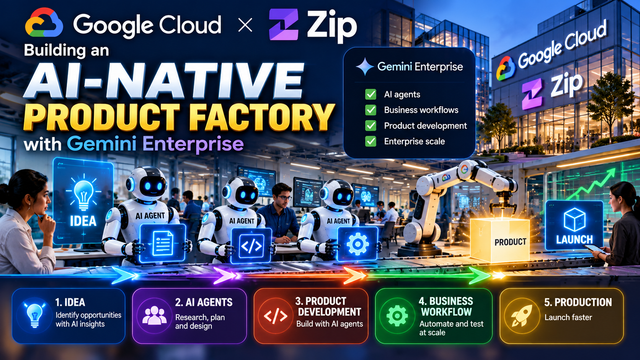
Google Cloud and Zip Build an AI-Native Product Factory
Companies are moving into a new phase of enterprise AI.
The first wave of business AI was largely about chatbots, copilots and individual employees using AI to complete specific tasks. The next phase is much bigger: companies are beginning to connect AI agents directly to business processes and product-development systems.
A new collaboration between Google Cloud and Zip is an example of this shift.
On October 8, 2026, Zip announced that it is working with Google Cloud to build an AI-Native Product Factory powered by Gemini Enterprise. The initiative is designed to change how Zip creates, develops, tests, launches and continuously improves products and customer experiences in the United States.
The idea is simple but significant.
Instead of treating AI as a tool that individual employees open when they need help, Zip wants AI agents to become part of the company's broader product-development environment.
The planned system connects areas such as customer research, design, engineering, risk, legal, compliance and customer experience through a shared, governed agentic environment.
That means the company is looking beyond a single AI assistant.
It is building an AI-supported operating model for creating products.
From AI assistants to AI-native companies
For several years, businesses have experimented with generative AI through chatbots and productivity assistants.
An employee might ask an AI system to summarize a report, write an email, analyze information or generate some code.
Those use cases are useful, but they are still mostly individual tasks.
Agentic AI changes the model.
An AI agent can be connected to tools, information and business systems so it can perform a sequence of tasks toward a larger objective.
For product development, that could mean an AI system helping teams research customer needs, organize information, generate ideas, support design work, assist engineers, analyze risks and prepare information for different teams.
The human employees do not necessarily disappear from the process.
Instead, the AI becomes another layer of intelligence working alongside them.
This is the larger idea behind Zip's Product Factory.
What is an AI-Native Product Factory?
Think about a traditional product-development process.
A company identifies an opportunity.
Then research teams investigate the market.
Designers create concepts.
Engineers build the product.
Risk and compliance teams review it.
Legal teams check requirements.
Customer teams prepare for launch.
After launch, the company collects feedback and begins improving the product.
Each stage can involve different teams, systems and information.
Zip describes the traditional model as a relay race, where work is handed from one team to another. Each handoff can introduce delays and require people to repeat or transfer information.
The Product Factory aims to create a more connected environment.
Instead of treating every product as a completely separate project, AI agents and shared enterprise knowledge can potentially help teams work in parallel.
The basic concept can be visualized as:
Idea → AI agents → Research → Design → Development → Risk & Compliance → Launch → Improvement
The important change is that AI is present across the workflow rather than appearing in only one step.
Gemini Enterprise becomes the foundation
Google Cloud says Gemini Enterprise will underpin Zip's AI-Native Product Factory and its broader AI industrialization environment.
The platform is intended to provide the foundation for agents working alongside Zip employees across internal workflows. Zip can also use different frontier and open-weight AI models depending on the requirements of a particular task.
This is an important aspect of enterprise AI.
A company does not necessarily need one AI model to perform every job.
Different tasks may require different capabilities.
One agent could focus on research.
Another could support software development.
Another could help analyze customer information.
Another could assist with compliance or risk.
The goal is to connect these capabilities through a common enterprise environment.
Why businesses are interested in this model
The biggest potential advantage is speed.
If AI agents can help multiple teams work simultaneously, companies may be able to move from an idea to a product faster.
But speed is not the only goal.
Zip says the Product Factory is designed to create reusable intelligence and capabilities. Every product developed through the system can potentially add knowledge and reusable processes that help with future products.
That creates a compounding effect.
Imagine a company launches its first AI-assisted product.
During development, the organisation learns which customer signals matter, which workflows are effective, which risks need to be checked and which processes can be automated.
If that knowledge becomes part of the company's AI environment, the next product may be easier to develop.
Then the third product can build on the first two.
The company is not simply using AI to complete individual tasks.
It is attempting to build an organisational memory around product development.
AI agents and human employees
One important point is that Zip is not presenting the Product Factory as a completely autonomous system.
The announcement emphasizes security, governance, traceability and human oversight. These controls are intended to govern how agents access data, interact with systems and execute work.
That matters particularly because Zip operates in financial services.
Financial products involve sensitive information, regulatory requirements and decisions that can have real consequences for customers.
An AI agent that can create or modify something inside a financial business needs much stronger controls than a simple chatbot answering general questions.
The challenge therefore becomes balancing automation with control.
Companies want agents to move quickly.
At the same time, they need to know:
What data can the agent access?
What systems can it use?
What actions can it take?
Which decisions require human approval?
Can every important action be traced?
What happens if an agent makes a mistake?
These questions will become increasingly important as businesses move from AI experimentation to production.
Zip is also bringing agents into customer experiences
The partnership is not limited to internal product development.
Zip says its customer-facing AI assistant, Zia, will also be enabled by Gemini Enterprise.
The company plans to evolve Zia from an AI support assistant toward a more agentic experience embedded within its products. Specialized agents could work together behind a single customer experience to understand requests, take appropriate actions and resolve increasingly complex customer needs.
This is another important trend.
Customers may not know which AI agent is working behind the scenes.
They may simply tell the system what they want.
For example, instead of navigating multiple menus, a customer could describe a problem or request in natural language.
Behind the interface, multiple specialized systems could potentially work together to produce the result.
The user sees one simple experience.
The underlying system becomes much more complex.
This is bigger than one Google Cloud partnership
The Zip announcement is interesting because it represents a broader movement in enterprise AI.
Businesses are gradually moving from:
“We have an AI assistant.”
to:
“Our business processes are becoming AI-native.”
That is a much bigger change.
A chatbot sits beside an employee.
An AI-native workflow sits inside the company's operating process.
That difference could determine how businesses adopt AI over the next several years.
Companies that successfully connect agents with their data, applications and workflows could potentially automate much larger portions of their operations.
But companies that connect agents without adequate governance could also create significant security, privacy and operational risks.
What this means for Indian businesses
This trend is highly relevant to India.
Indian startups and enterprises already use AI for customer support, software development, marketing, analytics, finance and operations.
The next opportunity is connecting these AI capabilities together.
For example, an Indian e-commerce company could theoretically have agents supporting product research, inventory analysis, customer support, marketing and software development.
A fintech company could use specialized agents across research, customer experience, compliance and internal operations.
A startup could potentially use AI agents to perform parts of the work that previously required several separate tools and manual handoffs.
This does not mean every business should immediately give autonomous agents access to everything.
The important lesson is that companies should think about AI as an operating layer rather than only as a chatbot.
What this means for students and creators
The same trend matters for students and AI creators.
If AI agents become normal inside companies, future jobs may increasingly involve working with AI systems rather than simply using traditional software.
Students learning programming, data science, business analysis, design, cybersecurity and product development can benefit from understanding how AI agents connect to real workflows.
The valuable skill may not simply be knowing how to write prompts.
It may be knowing how to design a workflow where humans and AI agents work together safely.
For creators, this trend also creates a strong content opportunity.
Instead of making another post about an AI model's benchmark score, creators can explain how businesses are actually deploying AI.
Stories about AI factories, agentic workflows, autonomous systems and enterprise AI can help audiences understand where the technology is going beyond the chatbot era.
The bigger shift: AI becomes the operating system
The most interesting part of the Google Cloud and Zip announcement is not simply the partnership.
It is the direction it represents.
Companies are beginning to think about AI as infrastructure.
The model is no longer:
Employee → AI chatbot → answer
It is becoming:
Business goal → AI agents → company data → business systems → actions → human oversight → result
That is a much more powerful model.
If this approach works, businesses could potentially develop products faster, reuse organisational knowledge and automate more complex workflows.
At the same time, governance will become increasingly important because more powerful agents require more carefully controlled access.
Zip's AI-Native Product Factory is therefore an example of a larger transition taking place across enterprise technology.
The future may not be about every employee having a separate AI assistant.
It may be about companies building entire networks of AI agents that work together across the organisation.
The big question is no longer simply:
“How smart is the AI?”
It is:
“How effectively can a business turn AI intelligence into a safe, repeatable operating system?”