Gemini 4 Carbon: Google’s New AI Agent Model
Google has released Gemini 4 Carbon, a powerful AI model designed for complex coding, research and multi-step tasks.
By Gangothri
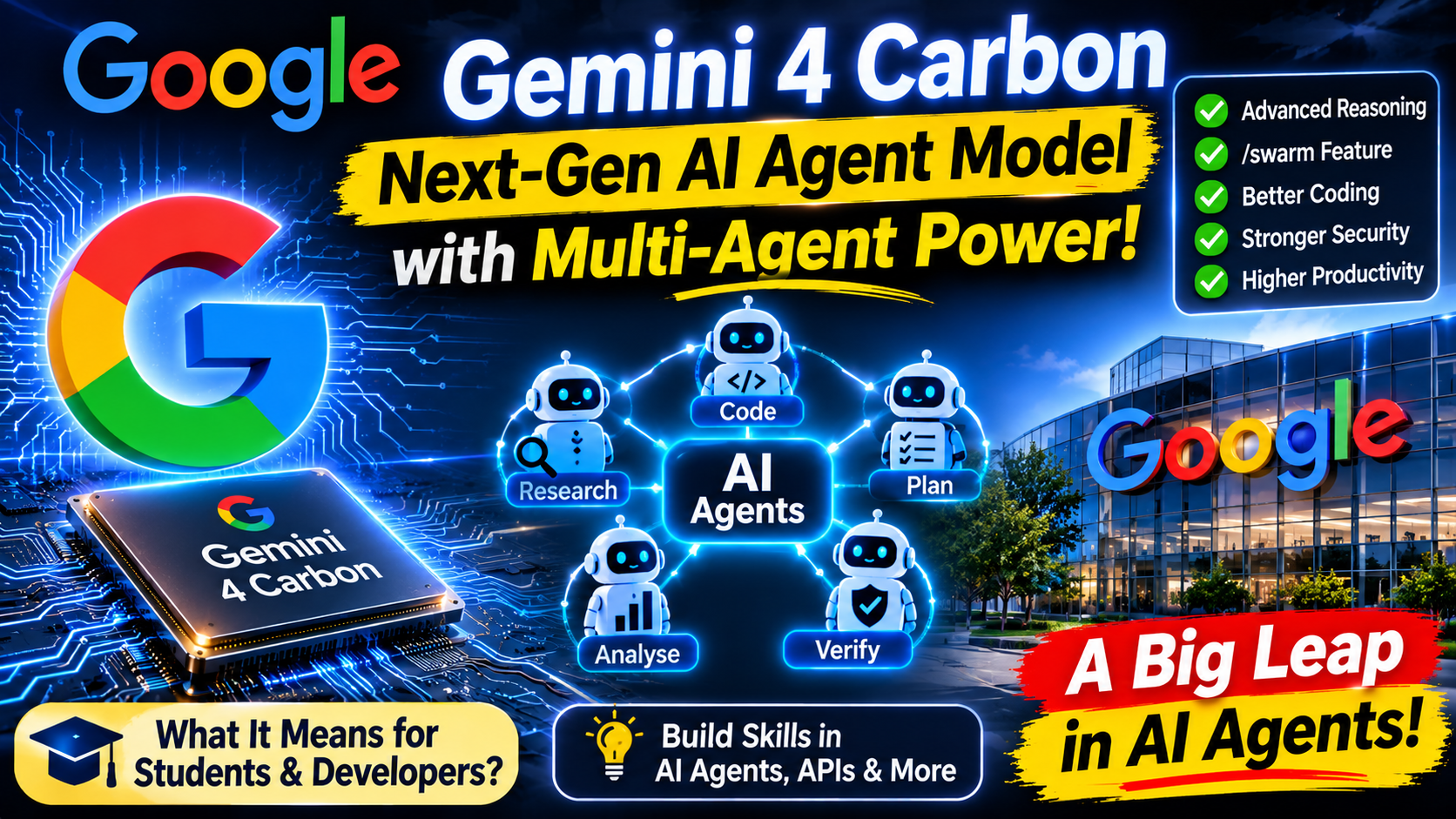
Google Launches Gemini 4 Carbon: A New Step Toward AI Agents Working Together
Published: November 11, 2026
Artificial intelligence is moving beyond answering questions and generating text. The next major development is AI that can plan complex tasks, use tools, write and test code, analyse information, and coordinate with other AI systems to complete larger projects.
Google has taken another step in this direction with the public release of Gemini 4 Carbon, its latest frontier AI model. Announced on November 10, 2026, the model is designed for demanding tasks involving complex software engineering, scientific research, cybersecurity and long-running workflows.
One of the most interesting parts of this announcement is Google's preview of a new feature called /swarm on its Antigravity development platform. The feature allows a single prompt to launch a coordinated team of AI agents that can work on different parts of a project.
This development could change how developers build software, how researchers analyse information and how businesses automate complicated workflows.
1. What is Gemini 4 Carbon?
Gemini 4 Carbon is Google's latest advanced AI model, designed for tasks that require deeper reasoning and multiple stages of work.
Traditional AI chatbots usually respond to a question with an answer. For example, a user might ask an AI tool to write a Python program, explain a mathematical concept or summarise a document.
However, complex professional tasks require much more than one response. A software project may involve understanding requirements, planning an architecture, writing code, testing different components, identifying errors and correcting them.
Gemini 4 Carbon is designed to handle these more demanding workflows. Google describes it as a model for tasks that test the limits of AI reasoning, including complex multi-step coding, debugging and open-ended scientific research.
Google also explains that its earlier Gemini 4 Argon model remains suitable for many everyday software engineering and knowledge-work tasks. Carbon is intended for situations where more extensive reasoning and verification are needed.
This distinction is important: a more powerful model is not necessarily the best choice for every task. Developers may choose a lighter model for routine work and a more advanced model when a project requires deeper analysis.
2. The biggest announcement: AI agents working as a team
The most interesting feature in Google's announcement is the preview of /swarm in Google Antigravity.
An AI agent is a system that can work toward a goal by planning steps, using available tools, observing results and deciding what to do next. Unlike a basic chatbot, an agent can carry out a sequence of actions rather than simply provide a written response.
A multi-agent system takes this idea further by coordinating multiple agents.
Imagine that a student wants to develop a complete college management application. The project may require a frontend, backend, database, authentication system and testing.
Instead of asking one AI assistant to complete everything in a single response, a coordinated team could divide the work:
One agent could plan the application architecture.
Another could develop the user interface.
A third could work on backend APIs.
Another could inspect database design.
A testing agent could check whether the components work correctly.
A review agent could identify errors and suggest improvements.
Google says developers can assign Gemini 4 Carbon to demanding roles such as architectural design, coordination and auditing, while pairing it with faster, lighter models for parallel work.
The goal is to make AI systems more useful for larger projects.
However, multiple agents do not automatically guarantee a better result. Their work must be coordinated, checked and integrated. Incorrect assumptions made by one agent can affect the entire project if nobody verifies them.
3. How the swarm approach could change software development
Software development is one of the areas where AI agents could have a major impact.
A typical software project involves several stages: requirement analysis, system design, coding, debugging, testing, deployment and maintenance.
AI coding assistants already help developers write functions, explain code and identify common errors. More advanced agent systems aim to connect these activities into a longer workflow.
For example, a developer could describe a web application and ask a coordinated agent team to build an initial version.
One agent might create the frontend, another might prepare the backend, and another might design the database. A verification agent could then run tests and inspect the output.
Google says Carbon can work on multi-package migrations, investigations involving multiple software components and complex architectural redesigns. It can also perform build-and-verify loops, recover from errors and check both code and the rendered user interface.
This is important because writing code is only one part of software engineering. A program must also work correctly, handle unexpected situations and remain maintainable.
For students, this means learning how to review AI-generated code is becoming just as important as learning how to generate it.
4. AI agents could help with research and scientific discovery
Another important area highlighted by Google is scientific research.
Research projects often involve large amounts of information, including academic papers, experimental results, spreadsheets, images, laboratory records and technical documents.
Researchers must compare evidence, identify patterns, test hypotheses and verify conclusions.
Google says Gemini 4 Carbon is designed to reason through difficult problems in mathematics, physics and life sciences. Its announcement describes examples involving experimental data analysis, protein research and mathematical code verification.
One example described by Google involved researchers using Carbon alongside other models to support formal verification work related to the cryptographic protocol used by Signal.
Google says the agents generated large amounts of Lean code to help prove important security properties. The company presents this as an example of how AI could assist expert teams with work that traditionally takes much longer.
Another example involved protein research. Google reported that its researchers used a multi-agent setup to search large biological sequence archives for remote protein relatives, potentially improving the information available to existing structure-prediction systems.
These are company-reported examples, not proof that AI can independently replace scientific experts. Scientific findings still require careful validation, reproducible methods and human expertise.
Nevertheless, the direction is significant. AI could become a research assistant that helps scientists explore possibilities faster and spend more time evaluating important discoveries.
5. A major focus on cybersecurity
Gemini 4 Carbon also has a strong cybersecurity focus.
Modern software systems contain vulnerabilities that attackers may exploit. Security professionals need to identify weaknesses, understand how they could be used and develop fixes before they cause serious damage.
Google says Carbon has been developed with advanced cybersecurity capabilities, including identifying vulnerabilities, investigating how weaknesses connect across systems and generating patches.
The company also described its Fairwind Program, through which selected cybersecurity defenders received earlier access to the model.
Google reported that Carbon performed strongly on several security evaluations and described examples where its systems helped identify vulnerabilities in software. It also said the model's safeguards were strengthened to reduce the risk of misuse.
This area requires particular care. A powerful AI system that can understand vulnerabilities may help defenders secure software, but similar capabilities could potentially be misused.
For that reason, responsible access, safety testing, permission controls and human oversight are essential.
Students interested in cybersecurity can learn about secure coding, network security, vulnerability assessment, responsible disclosure and AI-agent safety.
6. Can Gemini 4 Carbon create complete applications?
Google says Carbon performs well on engineering tasks that require multiple agents to collaborate.
Its announcement describes examples involving interactive 3D applications, visualisation tools and web development.
In one demonstration, a team of agents used historical photographs and engineering drawings to create an interactive 3D exhibition about the construction of the Eiffel Tower.
Google also described a project in which agents used public planning documents and engineering drawings to build a 3D reconstruction of an office environment.
These examples show the potential of combining AI reasoning with development tools.
A user may begin with a high-level description, while the AI system handles several connected tasks: interpreting source material, planning the project, generating code, creating visual elements and checking the output.
This does not mean that every application can now be built perfectly with one prompt. Real-world projects still involve requirements, data security, performance, accessibility, testing and deployment decisions.
But it does suggest that developers may increasingly work by supervising AI-assisted workflows rather than manually writing every component.
7. Pricing and availability
Google announced that Gemini 4 Carbon is available through the Gemini API in Google AI Studio and Gemini for business for paying developers and enterprises.
It is also rolling out to Google AI Ultra subscribers through the Gemini app, Google Antigravity and AI Mode in Search.
Access for free and lower-tier users was not confirmed in The Verge's report.
Google announced introductory API pricing of:
Input: $2 per million tokens.
Output: $10 per million tokens.
Google's published pricing information says that after the introductory period ends on November 30, 2026, the public-access model price will become $4 per million input tokens and $20 per million output tokens.
Token pricing is not the same as the total cost of completing a project. A complicated task may use many tokens, multiple model calls and additional tools. The actual cost depends on how the application is designed and how much work the agents perform.
For developers and startups, comparing cost per completed task may be more useful than comparing the price of a single API request.
8. What does this mean for Indian students?
This development is particularly relevant to students studying Computer Science, Artificial Intelligence and Machine Learning, Data Science and related fields.
The software industry is increasingly exploring AI-assisted development and automation. Students who understand how to use these systems responsibly may have an advantage when building projects and preparing for technical roles.
Here are some useful skills to develop:
1. Python programming
Python is widely used in AI, automation, data science and backend development. Build a strong foundation in functions, object-oriented programming, APIs and data handling.
2. Large Language Models
Understand how LLMs work at a practical level. Learn about tokens, context windows, embeddings, prompting, model limitations and hallucinations.
3. AI agents
Study how agents plan tasks, use tools, maintain context and interact with external systems. Learn the difference between a simple chatbot and an agentic workflow.
4. API integration
Learn how to connect applications with AI models through APIs. Understand authentication, API keys, request formats, response handling, error management and rate limits.
5. Software engineering
Do not depend only on AI-generated code. Learn Git, debugging, testing, database management, system design and deployment.
6. Cybersecurity
Understand authentication, authorisation, secure API design, prompt injection and the risks of giving AI agents access to sensitive tools or data.
7. Human verification
Learn to test AI outputs, check sources, review code and identify incorrect assumptions. The ability to verify AI-generated work will remain important.
9. A practical project students can build
A useful way to understand multi-agent AI is to create a small AI-powered study assistant.
The project could have three separate agents:
Agent 1: Study Planner
This agent accepts a subject name and syllabus, then prepares a weekly study plan.
Agent 2: Notes Assistant
This agent converts uploaded study material into summaries, definitions and practice questions.
Agent 3: Quiz Evaluator
This agent generates questions, checks student answers and identifies topics that need revision.
A coordinating system can manage the tasks and combine the results into one dashboard.
Students can build a basic version using Python, an LLM API and a simple web interface. They can then add features such as document retrieval, user accounts and progress tracking.
The important learning outcome is not simply creating a chatbot. It is understanding how different AI components communicate, share information and complete a larger objective.
10. Important limitations to remember
Despite the excitement around advanced AI agents, there are several challenges.
Accuracy: AI systems can produce incorrect answers or misunderstand instructions. Important results need verification.
Security: Agents with access to files, APIs or external tools can create risks if permissions are poorly configured.
Cost: Long-running tasks may require many model calls and can become expensive.
Coordination: Multiple agents may produce conflicting results, duplicate work or depend on incorrect information from another agent.
Privacy: Businesses must consider what data is shared with AI services and how sensitive information is protected.
Human responsibility: AI-generated decisions should not automatically be accepted in areas involving money, security, health or other high-impact outcomes.
These challenges show why AI engineering requires more than knowing how to write prompts.
11. The bigger picture: From chatbots to coordinated AI systems
The release of Gemini 4 Carbon reflects a broader direction in the AI industry.
The first major wave of generative AI introduced tools that could generate text, images, code and other content. The next wave is increasingly focused on systems that can perform multi-step tasks and interact with software.
Instead of asking an AI to explain how to build an application, users may increasingly ask an agent system to create a working first version, test it and report what needs improvement.
Instead of manually searching through large collections of documents, researchers may use AI systems to organise evidence and identify promising research directions.
Instead of automating only one repetitive task, businesses may connect several agents into a larger workflow.
Google's Gemini 4 Carbon and its Antigravity swarm preview are examples of this direction. The technology is still developing, and the company's performance claims should be evaluated through independent testing and real-world use.
Final takeaway: AI is moving from answering questions toward completing coordinated work. For students and developers, the opportunity is to learn programming, AI agents, APIs, software engineering and cybersecurity together. The future may not belong only to people who know how to use AI, but also to people who know how to build, manage and verify AI-powered systems.