FreeToken Cinematic: Run Huge AI Models Locally
Berkeley and MIT researchers developed FreeToken to serve massive MoE models locally by dynamically moving experts across GPU and CPU memory.
By singamankitha
Source: https://arxiv.org/abs/2508.14035?utm_source=chatgpt.com
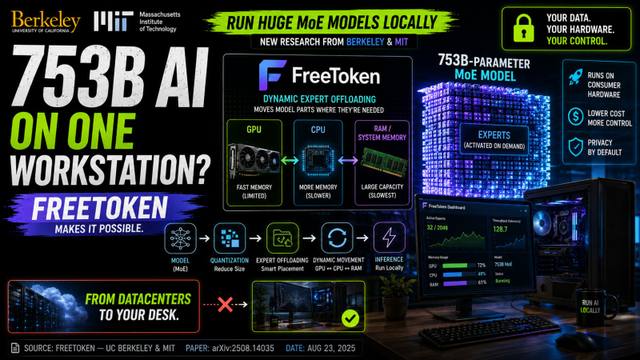
FreeToken Cinematic: Run Huge AI Models Locally
What if massive AI models didn't always need massive data centers? Researchers from UC Berkeley and MIT have developed FreeToken, a system designed to make large Mixture-of-Experts models more practical to run on limited hardware by intelligently managing where model components are stored and executed.
For most people, running a huge AI model locally sounds almost impossible.
You need a powerful GPU.
Then you need enormous amounts of VRAM.
And if the model is hundreds of billions of parameters, the hardware requirements can quickly move beyond what an ordinary workstation can provide.
That's why most large AI models are accessed through the cloud.
The model lives inside a data center.
The data center provides the GPUs.
You send a request.
The server processes it.
You receive the response.
But researchers are exploring a different possibility:
What if the model could intelligently use the hardware you already have?
That's the idea behind FreeToken, a research system designed to serve large Mixture-of-Experts, or MoE, models by dynamically managing model components across GPU and CPU memory.
The research explores how enormous models can be served despite limited GPU memory, including experiments involving models as large as 753 billion parameters on a single workstation GPU. (arxiv.org)
That doesn't mean a typical laptop can suddenly run a 753B model at comfortable speeds.
The important breakthrough is the memory-management strategy.
The Problem With Huge AI Models
Modern AI models can be enormous.
Some contain billions or even hundreds of billions of parameters.
Those parameters have to be stored somewhere when the model is running.
A powerful data-center GPU might have a huge amount of high-speed memory.
A consumer GPU might have only 8GB, 12GB, 16GB or 24GB of VRAM.
That creates an obvious problem.
Imagine trying to put a 753-billion-parameter model into a GPU that only has a fraction of the required memory.
It simply doesn't fit.
Traditionally, you would need more GPUs or a cloud server with enough memory.
FreeToken takes a different approach.
Instead of requiring the entire model to sit inside GPU memory at once, it focuses on moving the pieces that are needed between different levels of memory.
What Is a Mixture-of-Experts Model?
To understand why this works, you need to understand Mixture-of-Experts models.
An MoE model doesn't necessarily activate every part of the network for every token.
Instead, it contains multiple specialized components called experts.
When you send a prompt to the model, a routing mechanism determines which experts should process each token.
Think of it like a company with hundreds of specialists.
You don't send every problem to every employee.
You send the problem to the people who are most relevant.
The same basic idea can make enormous AI models more computationally efficient.
A model might contain hundreds of billions of parameters, but only a smaller subset of those experts may be active for a particular token.
That creates an interesting opportunity.
If you don't need every expert at the same time, perhaps you don't need every expert sitting in expensive GPU memory at the same time either.
That's where FreeToken comes in.
GPU + CPU + RAM
FreeToken's core idea is to treat available hardware memory as a coordinated system.
Instead of thinking:
GPU memory = entire model
the system can think:
GPU + CPU memory + system memory = available model storage
The most important experts can be brought into faster GPU memory when they're needed.
Other experts can remain in CPU or system memory until they're required.
The system then dynamically manages these transfers during inference.
Conceptually:
Huge MoE model
↓
Identify required experts
↓
Move useful experts closer to the GPU
↓
Run computation
↓
Move or replace experts
↓
Continue inference
This is a very different approach from simply buying a larger GPU.
Why This Matters for Local AI
The local-AI movement has been growing rapidly.
People want to run models on their own machines for several reasons.
Privacy is one.
If the model runs locally, data doesn't necessarily need to be sent to a cloud provider.
Cost is another.
Once you own the hardware, local inference can potentially reduce recurring API costs for some workloads.
There is also control.
You can choose which models to run, how to configure them and where your data goes.
But hardware remains one of the biggest barriers.
The most capable models can require more memory than consumer computers provide.
FreeToken attacks that barrier.
The 753B Demonstration
This is the part that makes the research headline-worthy.
The researchers report that FreeToken can serve a 753-billion-parameter MoE model on a single workstation GPU under their experimental setup. (arxiv)
That sounds almost absurd at first.
A 753B model is vastly larger than what most people would normally associate with local AI.
But remember:
753B parameters does not mean 753B parameters must all be actively processed for every token.
MoE architectures activate only selected experts.
FreeToken takes advantage of that sparsity while also managing memory movement.
The result is a system capable of handling models that would otherwise exceed the available GPU memory.
Does This Mean Your 8GB Laptop Can Run a 753B Model?
No.
This is where the viral version of the story can become misleading.
The paper evaluates FreeToken across hardware configurations, including limited-memory GPUs, but the 753B demonstration is not equivalent to saying an 8GB consumer laptop can comfortably run a 753B model.
Hardware capability, system RAM, bandwidth, model format, quantization, workload and latency all matter.
A system can technically serve a model without making it pleasant to use.
That's an important distinction.
The breakthrough is not:
“Every laptop can now run every giant AI model.”
It's:
“Researchers found a way to use limited GPU memory much more intelligently when serving enormous MoE models.”
That's still a significant result.
Why Expert Offloading Matters
Imagine your GPU has 8GB of VRAM.
Your model needs far more memory.
Instead of giving up, you could keep much of the model in slower system memory and move the currently useful parts into GPU memory.
This is called offloading.
It isn't entirely new.
AI researchers have been exploring model offloading, quantization and memory optimization for years.
FreeToken's contribution is in how it manages these operations specifically for large MoE models.
The system is designed around the fact that only a subset of experts are needed at any particular time.
That means memory can be managed around what the model needs right now rather than trying to keep everything available at maximum speed.
The Hidden Cost: Data Movement
There is a catch.
Moving data between CPU memory and GPU memory isn't free.
GPU memory is extremely fast.
System memory is slower.
Moving model components across the hardware boundary takes time and consumes bandwidth.
So FreeToken has to make decisions about which experts should be available and when.
If the wrong expert isn't ready, the system may have to wait for it.
That can reduce performance.
This is why intelligent scheduling matters.
The challenge isn't simply:
“Can we fit the model?”
It's:
“Can we move the right pieces quickly enough to make the system useful?”
That's a much harder problem.
FreeToken Is Essentially a Traffic Controller
One way to visualize FreeToken is as a traffic controller for AI model components.
Imagine thousands of cars trying to move between different roads.
The GPU is the fast highway.
CPU memory is a slower road.
System memory is another storage area.
The AI model contains thousands of expert components.
FreeToken decides which ones need to move closer to the GPU and which ones can stay elsewhere.
The better those decisions are, the less time the system wastes waiting for data.
This becomes especially important for MoE models because the system doesn't need every expert simultaneously.
Why MoE Models Are So Important
Mixture-of-Experts architectures have become increasingly popular because they offer a way to build very large models while keeping the amount of computation per token relatively controlled.
A model can have a huge total parameter count while activating only a fraction of those parameters for each token.
That creates a useful tradeoff:
Huge total capacity
with
Smaller active computation
But MoE models create a new systems challenge.
Where do all those experts live?
And how do you make sure the experts you need are available quickly?
FreeToken is essentially attacking that infrastructure problem.
Local AI Could Become More Ambitious
If systems like FreeToken continue improving, local AI could become much more capable.
Today, running a relatively small language model locally is already possible on many consumer systems.
The next challenge is pushing that boundary.
Could your workstation run a model that previously required several GPUs?
Could a laptop access a model that previously required a data center?
Could a developer run a large coding agent locally?
Could businesses deploy powerful AI internally without sending every request to a cloud provider?
These are the kinds of questions this research makes more interesting.
Privacy Could Be a Major Advantage
Local AI isn't only about saving money.
For some users, privacy is the bigger reason.
Consider a company working with confidential documents.
Instead of sending those documents to an external AI API, the organization could potentially run an appropriate model inside its own infrastructure.
That can provide greater control over data.
Of course, local deployment doesn't automatically make a system secure.
Organizations still need to protect the hardware, software and model environment.
But reducing dependence on external AI APIs can be valuable for certain workloads.
What This Means for AI Developers
For developers building local AI systems, the lesson is important.
Don't think only about model size.
Think about the entire inference stack.
A useful local-AI workflow might look like:
Model selection
↓
Quantization
↓
Expert offloading
↓
GPU / CPU / RAM management
↓
Inference
↓
Performance optimization
The model itself is only one part of the problem.
Memory management can be just as important.
The Cloud Isn't Going Away
It's also important not to overreact.
FreeToken doesn't mean data centers are becoming obsolete.
They aren't.
Large cloud AI systems still have enormous advantages.
They can combine many GPUs.
They can provide high throughput.
They can serve millions of users.
They can run the largest frontier models.
Local systems have different advantages.
Privacy.
Control.
Offline operation.
Potentially lower recurring costs.
Customization.
The future is likely to include both.
Cloud AI will continue to dominate many large-scale workloads.
Local AI will continue pushing toward more capable models on smaller hardware.
The Bigger AI Race: Memory
There is an interesting lesson hidden inside this research.
AI progress isn't only about GPUs.
It's also about memory.
As models become larger, memory becomes one of the biggest bottlenecks.
Developers need to figure out:
Where should model parameters live?
Which parameters need to be on the GPU?
Which can stay in RAM?
Which experts should be loaded?
When should they be moved?
How can data movement be minimized?
These questions can determine whether a huge model is actually usable.
FreeToken is an example of researchers attacking that problem from the systems side.
Could This Challenge the Cloud-First AI Model?
Maybe.
If local inference systems continue improving, the definition of “powerful AI hardware” could change.
You may not need a giant data center.
You may need:
A capable GPU
Enough system memory
Efficient model compression
Smart scheduling
A model architecture designed for sparse activation
That combination could make surprisingly large AI systems accessible to smaller teams.
It won't make every model practical on every device.
But it could significantly expand what's possible.
What Happens Next?
FreeToken is research, not a magic button that turns any laptop into an AI data center.
There are still major questions around latency, memory bandwidth, hardware configurations and real-world workloads.
But the direction is exciting.
Instead of asking:
“How can we buy a bigger GPU?”
researchers are increasingly asking:
“How can we make the hardware we already have work harder?”
That's a powerful question.
And as AI models continue growing, memory optimization may become just as important as model architecture.
Final Takeaway
The most important part of FreeToken isn't the sensational 753-billion-parameter number.
It's the underlying idea.
Huge AI models don't necessarily need to live entirely inside GPU memory.
For sparse Mixture-of-Experts models, only certain experts are active at a time.
If a system can intelligently move those experts between GPU memory, CPU memory and system memory, models far larger than the available GPU memory can potentially become serviceable.
FreeToken demonstrates this concept in a research setting, including a reported 753B-parameter MoE model served on a single workstation GPU. (arxiv)
That doesn't mean your 8GB laptop will suddenly run a 753B model like a cloud data center.
But it does challenge one assumption:
Local AI doesn't have to mean small AI.
With better architectures, quantization, memory management and expert offloading, consumer and workstation hardware could keep pushing the boundaries of what can run locally.
The future of AI might not be:
Cloud OR local.
It could be:
Cloud for scale.
Local for control.
And smarter systems deciding how to use every gigabyte of memory.