DeepSeek: The Future of AI Coding Agents
Deep Seek Harness shows how tools, memory, skills, sandboxes and verification can turn a language model into a capable coding agent.
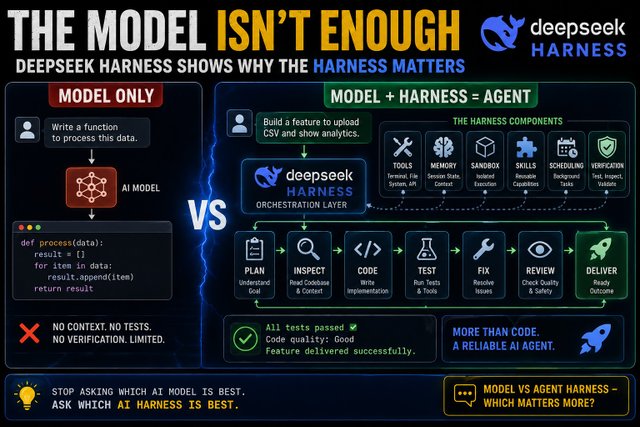
The Model Isn't the Whole AI Agent
When people compare AI coding tools, they usually ask:
"Which model is better?"
GPT vs Claude vs Gemini vs DeepSeek.
But DeepSeek Harness highlights a different idea:
The model is only one component of an AI agent.
A model can generate code, but it doesn't automatically know how to inspect your entire project, run tests, use a terminal, remember previous actions, recover from failures or verify whether its changes actually work.
That's where the harness comes in.
Model Only
User:
"Build this feature."
↓
Model:
Generates code
That's useful—but limited.
Model + Harness
Goal
↓
Plan
↓
Inspect codebase
↓
Write code
↓
Run tools
↓
Test
↓
Detect failure
↓
Fix
↓
Verify
↓
Deliver
Now the model is operating inside a complete environment.
What Is a Harness?
Think of a harness as the operating environment around the AI model.
It can provide:
Tools — terminal, filesystem, browser, APIs
Memory — previous context and session state
Skills — reusable procedures and capabilities
Sandbox — controlled execution environment
Scheduling — background or repeated tasks
Permissions — what the agent is allowed to access
Verification — checking whether the result actually works
Orchestration — managing multiple steps or agents
Observability — recording what the agent did
DeepSeek Harness takes this modular idea particularly far: its architecture treats components as plugins that can be swapped, extended or recomposed rather than locking everything into one monolithic system.
Why This Changes AI Coding
Consider two developers using the same underlying model.
Developer A
Gives the model a prompt:
"Fix this bug."
The model generates a patch.
Developer B
Uses a harness that lets the model:
Understand the repository
↓
Search relevant files
↓
Inspect dependencies
↓
Modify code
↓
Run tests
↓
Read errors
↓
Fix the implementation
↓
Run tests again
↓
Review the final changes
The underlying model could be identical.
But the system around it is completely different.
That's why measuring only the model's benchmark score may not tell you how useful the resulting coding agent will be.
The Harness Can Change the Result
Recent research on agentic harnesses makes this point even more interesting.
A 2026 study found that skill-use performance varied depending on the harness, with model rankings also changing across harness configurations. The researchers describe skill use as a capability conditioned by the model + harness, rather than simply a fixed property of the model.
Another 2026 paper argues that software-engineering agents should be evaluated as a model-harness-environment system, including context selection, tools, memory, verification, permissions and observability.
So the question becomes:
"Which model is smartest?"
but also:
"Which system helps that model perform useful work reliably?"
The Future of AI Coding
This could lead to a new way of thinking about AI coding tools.
Instead of:
Model → Answer
we move toward:
Model + Tools + Memory + Environment + Skills + Verification → Agent
And eventually:
Agent + Other Agents + Workflows → Autonomous Software System
That's a much bigger shift.
The model provides intelligence.
The harness provides the environment in which that intelligence can act.
Reel Hook
"Stop asking which AI model is best. Ask which AI harness is best."
Reel Flow
Model
↓
Tools
↓
Memory
↓
Skills
↓
Sandbox
↓
Verification
↓
Agent
CTA
"Model vs AI harness—which do you think matters more?"