Companies Turn to Cheaper Open-Weight AI Models
Rising AI costs are pushing major companies towards cheaper open-weight models like DeepSeek and Mistral.
By Gangothri
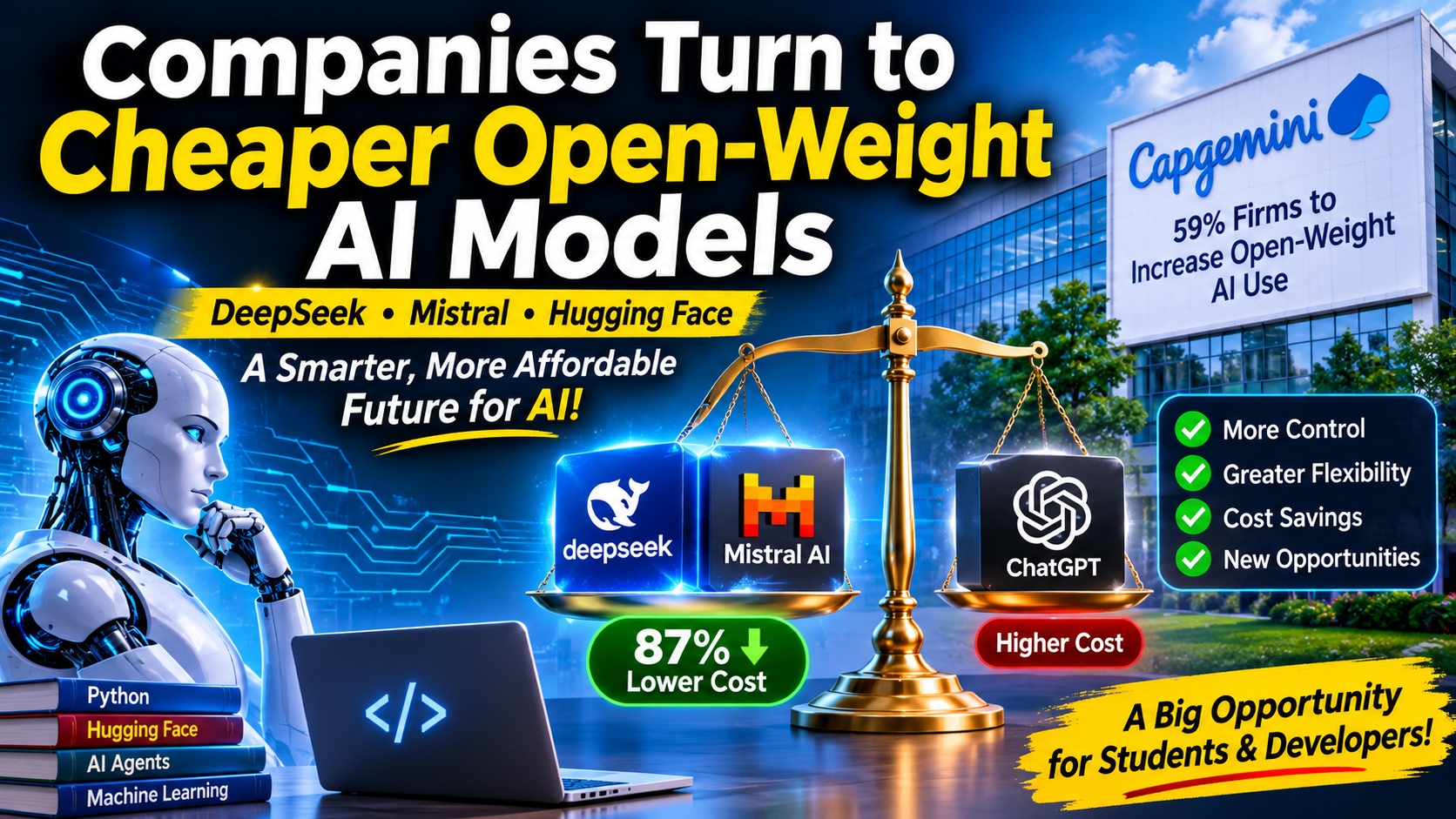
Companies Turn to Cheaper Open-Weight AI Models as AI Costs Rise
Introduction: The next big shift in artificial intelligence
Artificial intelligence is developing rapidly. Businesses are using AI to write reports, analyse information, support customers, generate software code, automate workflows and make decisions. However, as companies increase their use of AI, they are discovering a major challenge: running AI systems can become expensive.
For a long time, many businesses focused on using the most powerful AI models available. They adopted premium services and paid for large amounts of computing capacity. But as AI usage grows, the bills grow too.
Now, companies are beginning to reconsider their approach.
A new Capgemini Research Institute study has found that 59% of executives at large organisations reported that their AI-related expenditure was significantly higher than expected or budgeted over the previous year. The study also found that nearly three in five organisations plan to increase their use of open-weight AI models over the next year.
This development could change how businesses build AI applications, how developers choose models and how students learn artificial intelligence.
The important question is no longer simply, "Which AI model is the most powerful?" It is increasingly becoming, "Which model delivers the best results at a reasonable cost?"
1. What exactly happened?
According to a Capgemini study reported by Reuters on November 12, 2026, major companies are increasingly interested in open-weight AI models because they offer another way to control AI expenses.
The survey included 500 senior executives from organisations with annual revenues exceeding $1 billion across ten countries and thirteen industries.
Here are the major findings:
59% of executives said their organisation's AI expenditure was significantly higher than expected or budgeted.
Among organisations reporting higher-than-expected spending, expenditure was approximately 24% above expectations or budgets on average.
53% of executives expressed concern about AI costs.
Nearly three in five organisations plan to increase their use of open-weight AI models.
Capgemini estimated that open-weight models cost approximately 87% less per token on average than closed-model alternatives.
These figures highlight an important change in the AI industry. Companies still want powerful AI technology, but they also want to control the cost of using it.
The report does not suggest that every company will stop using premium AI services. Instead, it indicates that businesses are exploring a combination of different models.
2. What are open-weight AI models?
To understand this news, we first need to understand what an open-weight AI model is.
An AI model is a computer system trained using large amounts of information. During training, it learns patterns, relationships and ways to generate useful responses.
The model contains numerical parameters called weights. These weights help determine how the model processes information and produces answers.
In an open-weight model, the trained model weights are made publicly available under the developer's chosen terms. Developers can download the weights and, where the licence permits, run the model on their own computers or servers.
This gives developers more control over how they use the model.
For example, imagine that you want to build an AI chatbot for a college.
You could use a commercial AI API. Your application would send questions to an external service and receive responses.
Alternatively, you could download a suitable open-weight model and run it on infrastructure that you control. You could then configure it for your college's needs, subject to the model's licence and technical requirements.
This can offer greater control over deployment, data handling and customisation.
However, open-weight does not automatically mean completely free. You may still need computing hardware, electricity, storage, maintenance and technical expertise.
3. Open-weight AI vs closed AI models
There are two broad approaches to accessing AI models.
Open-weight models
These models make their trained weights available to developers under specific terms.
Examples include models from:
DeepSeek
Mistral
Meta's Llama family
Depending on the licence, developers may be able to download, customise and deploy these models independently.
Closed or proprietary models
These models are generally accessed through a company's website, application or API. Their internal model weights are not publicly released for independent deployment.
Examples include commercial offerings from OpenAI, Anthropic and Google.
These services often provide managed infrastructure, developer tools, security features and ongoing model improvements.
Key differences
Feature | Open-weight models | Closed models |
|---|---|---|
Model weights | Publicly available under licence terms | Generally not publicly released |
Deployment | Can be self-hosted where supported | Usually provider-managed |
Customisation | Often offers more flexibility | Depends on provider |
Infrastructure | May require your own hardware | Usually managed by provider |
Cost | Can be economical at scale | Often usage-based or subscription-based |
Maintenance | More responsibility for the user | More responsibility handled by provider |
Data control | Greater deployment control is possible | Depends on provider's data policies |
One important distinction: open-weight and open-source are not always identical.
Open-weight describes the availability of trained model parameters. Open-source usually involves broader access to the software or source code and the permissions required by the relevant licence. Some open-weight models have restrictions on particular uses.
Developers should always read the licence before using a model commercially.
4. Why are companies worried about AI costs?
AI applications do not operate without resources.
Every time an application sends information to an AI model and receives an answer, computing resources are required.
Many AI services measure usage through something called tokens.
A token is a small unit of text processed by an AI model. It may represent a word, part of a word or punctuation.
For example, when a customer asks a chatbot a question, the application sends the input to the model. The model processes that input and generates an answer.
Both the input and output can contribute to the total token usage.
Consider a business with 10,000 customers.
If each customer asks ten questions per day, the application must handle 100,000 questions every day.
That means the business could process millions of tokens daily.
Now imagine that the company also uses AI for:
Customer support.
Document summarisation.
Software development.
Marketing content.
Data analysis.
Internal employee assistants.
Automated business workflows.
AI usage can grow very quickly.
A small application may initially have manageable expenses. But when thousands of employees and customers begin using it, the total cost can become much higher.
This is one reason companies are looking for cheaper models.
5. Understanding the 87% cost difference
One of the most interesting figures in the news is Capgemini's estimate that open-weight model tokens cost approximately 87% less on average than tokens from closed-model alternatives.
This is an average estimate, not a guarantee that every open-weight model will be 87% cheaper.
To understand the idea, imagine a simplified example.
Suppose a company spends ₹1,00,000 on a particular amount of AI token usage with one model.
If an alternative model costs 87% less for comparable token usage, the estimated cost would be ₹13,000.
The potential saving would be ₹87,000.
However, this is only an illustration of the reported percentage. It does not account for hardware, electricity, engineering, hosting, maintenance or differences in output quality.
A company must compare the total cost of completing a task, not just the price of generating tokens.
For example, a cheaper model might require several attempts to produce a correct answer. If a more expensive model completes the task correctly on the first attempt, the expensive model may actually be more economical.
Therefore, businesses need to evaluate:
Cost per request.
Accuracy of the response.
Speed of the model.
Number of retries required.
Hardware and hosting expenses.
Security and privacy requirements.
Human review and maintenance costs.
The cheapest model is not always the best model.
The best model is the one that delivers the required result at an acceptable total cost.
6. DeepSeek and Mistral: Why are these names important?
Two names frequently associated with the open-weight AI discussion are DeepSeek and Mistral.
DeepSeek
DeepSeek is an AI company known for developing large language models and reasoning-focused AI systems.
Its models have attracted attention from developers because of their capabilities, availability and potential cost advantages.
Developers can explore suitable released model weights and tools through the official DeepSeek resources, subject to each model's terms.
Mistral
Mistral AI is a European AI company that develops language models and AI services.
Its model family includes options designed for different workloads, from smaller models to more capable systems.
Developers can explore its model releases and deployment options through its official platform.
Both companies are part of a broader movement that gives developers more choices beyond relying exclusively on a small number of closed AI providers.
This competition can encourage innovation, more affordable AI services and new opportunities for developers.
7. Why businesses may choose open-weight models
Companies are not choosing models only because of their price. There are several other reasons behind this shift.
A. Greater control
When a company runs a model on its own infrastructure, it can control many aspects of deployment.
It can decide how the model is configured, how applications communicate with it and how the surrounding systems are managed.
B. Customisation
Businesses often have specialised requirements.
A hospital may need a system that understands medical terminology. A bank may need a system that can classify financial documents. A software company may want an assistant that understands its internal coding standards.
Open-weight models can provide a foundation for customisation through techniques such as fine-tuning, adapters and retrieval-augmented generation.
C. Data privacy
Some organisations handle confidential information.
Depending on the deployment architecture, self-hosting can help businesses keep certain data within their own controlled environment.
However, self-hosting does not automatically guarantee security. Companies still need encryption, access controls, monitoring and secure infrastructure.
D. Reduced dependence on one provider
A company that relies entirely on one AI provider may face changes in pricing, usage limits or service availability.
Using multiple models can reduce this dependence.
E. Flexible infrastructure
Companies can choose models based on the hardware and computing resources available to them.
Smaller models may be suitable for routine tasks, while larger models can be reserved for complex work.
8. Why companies may continue using closed AI models
Although open-weight models offer advantages, closed AI models still have an important role.
Some tasks require advanced reasoning, strong performance, specialised tools or enterprise support.
A company may prefer a managed AI service because it does not want to maintain its own model infrastructure.
For example, a small business developing a customer-support application may not have the engineers or hardware needed to host a large model.
Using a commercial API could be easier.
Closed-model providers may also offer:
Managed infrastructure.
Developer documentation.
Reliability and service agreements.
Enterprise administration.
Safety features.
Integrated tools.
Regular model updates.
The Capgemini study indicates that companies are not necessarily abandoning closed models. Around half of the executives surveyed said their organisations would continue using them for complex tasks where the higher cost is justified.
This suggests that the future may involve using both approaches rather than choosing only one.
9. The rise of multi-model AI strategies
One of the most important developments is the movement towards multi-model AI.
A multi-model strategy means using different AI models for different tasks instead of sending every request to one model.
Imagine a company that operates an online shopping platform.
It may use:
A smaller model to classify customer messages.
An open-weight model to summarise product reviews.
A specialised model to extract information from invoices.
A more capable commercial model to handle complicated customer questions.
This approach can reduce unnecessary spending.
It also means developers need to understand model selection and routing.
What is AI model routing?
Model routing is the process of selecting an appropriate model for each request.
For example:
A user asks: "Convert this sentence into uppercase."
This is a simple task. A small model or ordinary programming function may be sufficient.
Another user asks: "Compare these two financial reports and explain the major differences."
This may require a more capable model.
An intelligent routing system can direct each request to an appropriate model based on its complexity, cost, speed and risk.
This is becoming an important area of AI engineering.
10. What does this mean for students in India?
This development is particularly interesting for students studying Computer Science, Artificial Intelligence and Machine Learning.
Students sometimes believe that developing AI applications requires expensive subscriptions or premium APIs.
That is not always true.
There are open-weight models and tools that allow students to experiment, learn and build projects with more control over their budgets.
Here are some areas worth learning.
A. Python programming
Python is widely used in machine learning and AI development.
Learn:
Variables and data types.
Functions.
Classes and objects.
File handling.
Exception handling.
Working with APIs.
NumPy and Pandas.
B. Hugging Face
Hugging Face is an important platform for exploring AI models, datasets and machine-learning tools.
Students can use it to:
Discover available models.
Read model documentation.
Explore text-generation models.
Experiment with NLP tasks.
Learn about model pipelines.
Understand model deployment.
Website: https://huggingface.co/
C. Large Language Models
Understand how large language models work.
Important topics include:
Tokenisation.
Embeddings.
Transformers.
Attention mechanisms.
Context windows.
Fine-tuning.
Quantisation.
Inference.
These concepts will help you understand why models have different costs and performance levels.
D. APIs and backend development
Learn how applications communicate with AI models.
Useful technologies include:
Python.
FastAPI.
Flask.
REST APIs.
JSON.
Database integration.
A developer who understands both AI models and backend development can build complete AI applications.
E. Deployment
Learning how to run models outside a notebook is also valuable.
Explore:
Google Colab.
Local model runtimes.
Docker.
Cloud computing.
GPU fundamentals.
Model serving.
Not every model can run efficiently on an ordinary laptop. Always check hardware and memory requirements before downloading large models.
11. Five practical AI projects students can build
Here are five project ideas that can help students understand open-weight AI.
Project 1: AI College Assistant
Build a chatbot that answers questions about a college.
It could provide information about:
Examination dates.
Course subjects.
Attendance rules.
Laboratory schedules.
College facilities.
Important notices.
You can connect a suitable language model to a collection of college documents using retrieval-augmented generation.
Project 2: AI Resume Analyzer
Create an application that accepts a resume and compares it with a job description.
Possible features:
Extract skills.
Identify missing keywords.
Summarise experience.
Suggest improvements.
Compare the resume with job requirements.
This project can help students understand document processing and language models.
Project 3: AI Notes Summariser
Build a tool that converts lengthy study notes into shorter summaries.
Features could include:
Chapter summaries.
Important questions.
Definitions.
Flashcards.
Multiple-choice questions.
Students could use it as a learning assistant, while learning how to build AI-powered applications.
Project 4: AI Customer Support Chatbot
Develop a chatbot for a small business.
It could answer questions about:
Products.
Prices.
Delivery.
Returns.
Business hours.
Frequently asked questions.
You can compare a small open-weight model with a commercial API and measure the difference in response quality and cost.
Project 5: AI Document Search System
Build a system that allows users to upload PDF documents and ask questions about their contents.
Possible technologies include:
Python.
Embeddings.
Vector databases.
Retrieval-augmented generation.
An open-weight language model.
This project is particularly useful for learning how AI applications retrieve information instead of relying only on the model's internal knowledge.
12. A practical learning roadmap for beginners
Students do not need to learn everything at once.
A structured approach can make the process easier.
Week 1: Python fundamentals
Learn basic programming, functions, lists, dictionaries and file handling.
Week 2: Machine-learning basics
Understand datasets, training, testing, classification and evaluation.
Week 3: Introduction to LLMs
Learn tokens, embeddings, transformers and prompting.
Week 4: Explore open-weight models
Visit Hugging Face, compare model documentation and experiment with a small model.
Week 5: Build an AI application
Create a chatbot, summariser or document-search application.
Week 6: Test and optimise
Compare model quality, response time, hardware requirements and cost.
At the end of this roadmap, you will have a practical project that demonstrates your understanding of AI development.
13. Challenges and risks of open-weight AI
Open-weight AI is promising, but it is not a perfect solution.
Hardware requirements
Running large models can require significant RAM, GPU memory and computing resources.
A student with an ordinary laptop may need to use smaller models or cloud-based environments.
Security risks
An organisation that deploys its own model becomes responsible for protecting the infrastructure.
It must secure APIs, manage user permissions, monitor suspicious activity and protect sensitive information.
Model quality
Different models perform differently across tasks.
A model that is excellent at summarisation may not be equally effective at coding, mathematics or complex reasoning.
Licensing
Not every publicly available model has the same usage permissions.
Some models impose conditions on commercial use or redistribution.
Developers must review the licence before building products.
Maintenance
Self-hosted systems require updates, monitoring and technical support.
Companies must consider these costs when comparing deployment options.
Accuracy and hallucinations
Open-weight models can produce incorrect or misleading information, just like closed models.
Important outputs should be checked, especially in areas such as finance, healthcare and legal services.
14. What this development means for India's AI ecosystem
India has a growing technology workforce, a large software-services industry and a rapidly expanding startup ecosystem.
More affordable AI deployment could create opportunities for Indian developers and businesses.
Small companies may be able to experiment with AI applications without depending entirely on expensive commercial services.
Startups could develop specialised solutions for Indian languages, education, agriculture, healthcare and customer support.
Educational institutions could explore AI systems for research and student services.
However, successful deployment will require more than downloading a model.
India needs engineers who understand:
AI and machine learning.
Cloud infrastructure.
Data engineering.
Cybersecurity.
Model evaluation.
Responsible AI.
Software development.
The opportunity is not simply to use existing models. It is also to build useful applications around them.
For students, learning how to evaluate, customise and deploy AI models can become an important technical advantage.
15. The future: AI will become a combination of models
The AI industry may be moving towards a future in which businesses use several models together.
A single organisation could use a small model for simple tasks, an open-weight model for private workflows and a premium model for difficult reasoning.
This could make AI systems more flexible and economical.
It may also create demand for developers who understand how to connect models, route requests, monitor performance and measure the value of AI applications.
Another important change is that businesses may start evaluating AI systems based on completed tasks rather than the number of tokens they consume.
For example, a company does not simply want an AI system that generates 10 million tokens. It wants a system that successfully processes invoices, resolves customer requests or helps employees complete work.
That distinction is important.
A cheaper model that repeatedly makes mistakes may cost more in the long run. A slightly more expensive model that completes a task correctly the first time may offer better value.
The future of AI will therefore depend on balancing cost, quality, security and usefulness.
Conclusion
The growing interest in open-weight AI models is an important development in the artificial intelligence industry.
As companies face higher-than-expected AI expenses, they are exploring more affordable and flexible ways to deploy AI. Models from developers such as DeepSeek and Mistral are part of this changing landscape.
However, closed AI services will continue to play an important role, particularly for complex tasks and organisations that prefer managed infrastructure.
The likely direction is a combination of different models, selected according to the task, budget and business requirements.
For students, this is a valuable opportunity to learn beyond basic AI theory. Understanding Python, Hugging Face, LLMs, APIs, deployment and model evaluation can help prepare for the next generation of AI development.
The future may not belong to the company using the most expensive AI model. It may belong to the company that knows how to use the right model for the right task at the right cost.