Codex Cinematic: Why AI Agents Burn Quotas Fast
Open AI investigated Codex usage issues after some users saw unusually fast quota depletion during long, tool-heavy AI agent sessions.
By singamankitha
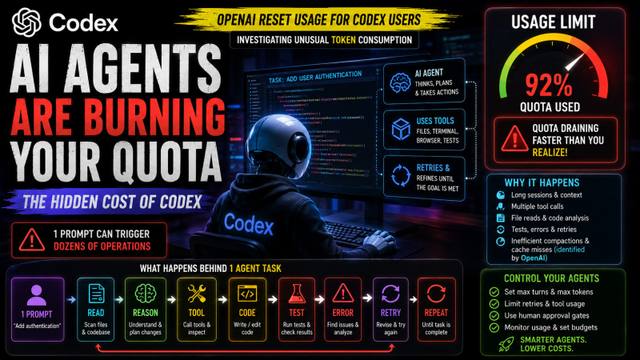
Codex Cinematic: Why AI Agents Burn Quotas Fast
OpenAI recently investigated unusual Codex usage patterns and issued a usage reset after identifying several efficiency problems. The incident highlights a bigger issue with AI agents: one instruction can trigger a surprisingly large amount of work behind the scenes.
You type one sentence.
“Build this feature.”
That's it.
From your perspective, you sent one prompt.
But an AI coding agent may see something completely different.
It might read your project files.
Search the codebase.
Inspect dependencies.
Reason about the architecture.
Open tools.
Modify files.
Run tests.
Read error messages.
Try another approach.
Run the tests again.
Inspect the results.
Make another change.
And then repeat the entire process.
Your screen may show one conversation.
Underneath it, the AI could be performing dozens or even hundreds of individual operations.
That difference is becoming one of the biggest challenges with agentic AI.
And OpenAI's recent Codex usage problems provide a useful real-world example.
What Happened With Codex?
During August 2026, some Codex users reported that their usage limits were dropping much faster than expected.
Community reports described accounts reaching usage limits after relatively short periods of intensive agent use, while others reported unexpected or confusing changes in their usage meters.
OpenAI acknowledged that it was investigating usage-rate issues.
On August 23, an OpenAI employee involved with Codex said the team had identified several sources of excess usage.
These included inefficiencies involving images in long sessions with multiple compactions, unusually high usage from Computer History, and a feature intended to generate conversation titles that was consuming more usage than intended.
The team also reported that some users had experienced worse cache-hit rates, which could contribute to faster usage depletion.
OpenAI subsequently issued a usage reset while fixes were being deployed.
This is important because it reveals something many people don't realize about AI agents.
AI agent usage isn't the same thing as chatbot usage.
One Prompt Doesn't Mean One AI Operation
A normal chatbot interaction can be relatively straightforward.
You ask:
“Explain quantum computing.”
The model generates an answer.
Done.
An agentic coding task is completely different.
You might say:
“Add authentication to my application.”
The agent could then:
Read the project
↓
Find the existing routing
↓
Inspect the database
↓
Understand authentication
↓
Plan changes
↓
Edit files
↓
Run tests
↓
Find an error
↓
Reason about the error
↓
Modify the code
↓
Run tests again
↓
Inspect the results
↓
Make another change
↓
Repeat
To the user, that's one task.
To the AI system, it can become a long chain of operations.
That's why an agent can consume significantly more usage than a simple question.
OpenAI Says Task Complexity Matters
This isn't just a theory.
OpenAI's Codex documentation explains that usage depends on several factors, including the model, task complexity, context, reasoning, speed and tools.
OpenAI also explicitly notes that a long-running task can use substantially more of the available allowance than a short request.
That's a critical difference between AI agents and traditional chatbots.
The unit of work is no longer simply:
Prompt → Response
It's closer to:
Goal → Planning → Context → Tools → Execution → Verification → Retry → Completion
The more complicated the goal, the more computation can be required.
Why Coding Agents Are Especially Expensive
Software development is almost perfectly designed to make AI agents work hard.
A coding agent has access to a large amount of information.
Your repository may contain:
Hundreds of files
Thousands of functions
Configuration files
Documentation
Dependencies
Tests
Logs
Build systems
APIs
Database schemas
The agent needs enough context to understand what it's changing.
Then it needs to actually make the change.
Then it needs to check whether the change worked.
That verification step is important.
A chatbot can give you a bad answer and stop.
A coding agent can discover that its code doesn't work and try again.
That's useful.
But every additional attempt can require more computation and more usage.
The Retry Loop
Here's one of the biggest hidden costs of agentic AI.
Imagine you ask an agent to fix a bug.
It changes the code.
The test fails.
So it reads the error.
It changes another file.
The test fails again.
It investigates.
It discovers a dependency problem.
It changes the dependency.
The test runs.
Another error appears.
It tries again.
Eventually the problem is solved.
For you, this may feel like:
“I gave the AI one task.”
For the system, it was a multi-step engineering session.
This is why agentic AI can consume resources much faster than ordinary chat.
Context Can Also Become Expensive
There's another factor that matters:
Context.
The longer an AI agent works on a task, the more information it may need to keep track of.
Large codebases generate large contexts.
Long conversations generate more history.
Tool outputs generate additional information.
Files generate more context.
Images can add even more processing.
At some point, systems may need to compress or summarize older information to continue working efficiently.
This process is often called compaction.
OpenAI specifically identified inefficiencies involving images during long sessions with multiple compactions as one of the issues affecting Codex usage.
So sometimes the expensive part isn't simply the final answer.
It's everything the agent has to carry along the way.
Caching Matters Too
AI systems can sometimes reuse previously processed information through caching.
When caching works efficiently, repeated context doesn't necessarily need to be processed from scratch in exactly the same way.
But OpenAI said that some users had experienced lower cache-hit rates during the period of the Codex usage issue.
The company indicated that this could help explain why some users were seeing usage drain faster than expected.
This is a technical detail that most users will never see.
But it has a direct effect on how much AI work their quota represents.
And that's the strange part of modern AI economics.
Two users can perform tasks that look similar on the surface while consuming very different amounts of compute.
Why the Usage Reset Matters
OpenAI didn't simply tell users:
“You used too much.”
The company investigated the issue and identified multiple sources of inefficiency.
It then issued a reset while fixes were being rolled out.
That's important because it shows the problem wasn't necessarily that users were doing something wrong.
Some of the consumption was related to how the system itself was operating.
That distinction matters.
If an agent legitimately needs more compute for a difficult task, that's one problem.
If a feature unexpectedly consumes more usage than intended, that's another.
The latter is a systems-efficiency problem.
The Bigger Problem With AI Agent Pricing
This situation exposes a bigger challenge for the entire AI industry.
How should AI agents be priced?
Chatbots are relatively easy to understand.
You get a certain number of messages.
Or you get access to a model.
Or you pay based on tokens.
Agents are more complicated.
A single user request can trigger an unpredictable amount of work.
Consider two prompts.
Prompt A:
“Explain this Python function.”
Prompt B:
“Refactor this entire application, add authentication, update the database schema, run tests and fix any errors.”
Both are technically one prompt.
But they're nowhere near equivalent in computational cost.
That creates a problem for subscription-based AI products.
Users want predictable limits.
AI companies need to manage unpredictable compute costs.
Agentic AI makes that tension much more visible.
The AI Agent Isn't Really “One AI”
When you use an advanced coding agent, it's useful to stop thinking of it as one chatbot.
Think of it more like a small digital team.
One part understands your request.
Another process handles tool calls.
Another interacts with files.
Another performs reasoning.
Another runs tests.
Another interprets errors.
Another decides whether another attempt is necessary.
The system may coordinate all of these steps behind a single interface.
That's why the phrase AI agent is so important.
The product isn't simply generating text.
It's orchestrating a workflow.
And workflows consume resources.
Why This Matters for Developers
If you're using AI coding agents, you need to understand this before starting huge tasks.
Don't give the agent an enormous goal and simply walk away.
Break large tasks into manageable stages.
Instead of:
“Build my entire SaaS application.”
Try:
“First design the database schema.”
Then:
“Implement authentication.”
Then:
“Build the dashboard.”
Then:
“Add the billing flow.”
Then:
“Run tests and fix the remaining issues.”
This gives you more control.
It also makes it easier to understand where the AI is spending its effort.
A Better AI Agent Workflow
For heavy agent tasks, think about using explicit boundaries.
1. Set a maximum scope
Tell the agent exactly what it should change.
2. Set retry limits
Don't let an agent repeatedly attempt the same failed approach indefinitely.
3. Use human approval
For important changes, require approval before the agent continues.
4. Break large projects into tasks
Smaller tasks are easier to monitor and debug.
5. Review tool activity
If your platform provides usage or activity information, look at it.
6. Stop runaway tasks
If an agent is repeatedly failing, stop it rather than letting it continue consuming resources.
The goal isn't to use less AI.
It's to use AI intentionally.
The Difference Between Automation and Autonomy
There's a subtle distinction here.
Automation usually follows a predefined workflow.
For example:
When a customer submits a form → send an email.
An AI agent has more freedom.
You might tell it:
“Investigate this customer issue and determine what needs to be done.”
The agent decides which tools to use.
It decides which files to inspect.
It decides what steps to take.
It can potentially retry when something fails.
That autonomy is what makes agents powerful.
It's also what makes their resource consumption harder to predict.
More Autonomy Means More Responsibility
This leads to another important point.
As AI agents become more autonomous, users need better controls.
A good agent platform should eventually provide controls such as:
Maximum tokens
Maximum turns
Tool-call limits
Maximum execution time
Retry limits
Approval checkpoints
Budget alerts
These controls could become just as important as model selection.
Imagine having a setting:
“Don't let this agent consume more than 10% of my weekly allowance without asking.”
That would be incredibly useful.
Instead of giving the AI unlimited freedom, you give it a budget.
AI Agents Need Budgets Like Employees
There's a useful analogy here.
Imagine hiring a human developer.
You don't tell them:
“Work forever until the problem is solved.”
You give them a project.
You give them a deadline.
You give them resources.
You check their progress.
If they're stuck for six hours, you investigate.
AI agents need similar boundaries.
Not because they're employees.
But because autonomous systems need resource constraints.
The more capable the agent becomes, the more important those controls become.
This Problem Will Get Bigger
AI agents are getting more capable.
They can browse.
Use computers.
Modify code.
Run commands.
Analyze files.
Use APIs.
Interact with applications.
And potentially continue working for long periods.
That's great for productivity.
But every new capability creates another possible source of computation.
The future AI subscription may therefore look very different from today's chatbot subscription.
Instead of:
“You get 1,000 messages.”
We may eventually see:
“You get a certain amount of agent work.”
That could be measured through compute, task complexity, execution time or some combination of factors.
The Real Lesson From the Codex Incident
The biggest lesson isn't:
“Codex is expensive.”
It's:
“Agentic AI changes what an AI request actually means.”
A request isn't necessarily one inference.
It can become an entire workflow.
That workflow can include:
Read
↓
Reason
↓
Search
↓
Call tool
↓
Edit
↓
Test
↓
Inspect
↓
Retry
↓
Repeat
That's why AI agents can be dramatically more useful than chatbots.
And it's also why they can consume dramatically more resources.
What Happens Next?
AI companies will likely continue improving the efficiency of their agents.
Better caching.
Smarter context management.
Better tool orchestration.
More efficient reasoning.
Improved model routing.
More transparent usage meters.
And stronger controls for users.
The goal is simple:
More work completed per unit of compute.
That will be critical as millions of people begin using agents for longer and more complicated tasks.
Final Takeaway
OpenAI's recent Codex usage investigation is a useful warning for anyone adopting AI agents.
The problem isn't necessarily that agents are inefficient.
In many cases, they're doing far more work than a traditional chatbot.
The problem is that users don't always see that work.
You type one prompt.
The agent might perform dozens of operations behind the scenes.
OpenAI acknowledged several usage-efficiency issues affecting Codex, including long sessions with images and repeated compactions, Computer History usage, an over-consuming conversation-title feature and weaker cache performance for some users. The company then issued a reset while fixes were deployed.
OpenAI's own documentation also confirms that Codex usage varies with task complexity, context, reasoning and tools, and that long-running tasks can consume substantially more usage than short requests.
That leads to a simple rule for the agent era:
Don't measure an AI task by the number of prompts you send.
Measure it by the amount of work the agent performs.
Because behind one innocent-looking prompt could be:
Read → Reason → Tool → Code → Test → Error → Retry → Repeat.
And that's the hidden cost of giving AI the ability to actually do the job.