Codex Cinematic: OpenAI Reports 20M Users
OpenAI reportedly says Codex has reached 20 million users as AI coding agents move into the mainstream.
By singamankitha
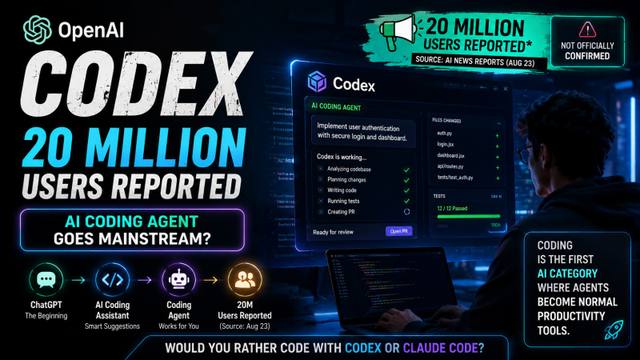
Open AI Codex Cinematic: 20M Users Reported
Open AI Codex is reportedly reaching a massive new audience, with recent AI-news reporting citing around 20 million users. If accurate, the figure would mark another major step in the transition from AI chatbots to AI coding agents.
For years, AI coding tools were mainly associated with professional developers.
Today, that is changing quickly.
AI assistants can write code, explain errors, modify existing projects, create features and increasingly operate across entire software-development workflows.
Now, a new reported figure is putting the spotlight on Open AI's Codex.
According to secondary reporting circulating on August 23, 2026, Open AI has cited roughly 20 million Codex users.
There is an important caveat: the 20-million figure should currently be treated as reported rather than independently verified, because a directly accessible primary Open AI announcement confirming that exact number was not available for this report.
Even with that qualification, the development highlights something much bigger.
AI coding agents are moving beyond niche developer tools and becoming mainstream productivity products.
What Is Open AI Codex?
Open AI Codex is an AI coding agent designed to help people work on software-development tasks.
Instead of simply generating a few lines of code in a chat window, coding agents can work through larger development tasks.
A user can describe what they want, and the agent can help with tasks such as understanding a codebase, implementing changes, debugging problems, writing tests and preparing software changes for review.
That makes Codex different from the traditional idea of an AI chatbot.
A chatbot primarily gives you an answer.
A coding agent is designed to work on the task itself.
That distinction is becoming one of the biggest themes in the AI industry.
From Chatbot to Coding Agent
The evolution is easy to understand.
The first generation of mainstream AI assistants focused heavily on conversation.
You asked a question.
The AI answered.
Then developers began using these models to generate code.
The next step was AI-assisted programming.
Now we are seeing the rise of coding agents.
The progression looks something like this:
Chatbot
↓
AI coding assistant
↓
Coding agent
↓
AI software-development teammate
The reported Codex user figure matters because it suggests that this category may be expanding beyond a relatively small group of technical users.
If the approximately 20 million figure is accurate, Codex would be operating at a scale that makes AI coding a much broader productivity phenomenon.
Why 20 Million Users Would Matter
Numbers alone don't tell the entire story.
But scale can change how a technology develops.
When only a small number of developers use a tool, it remains a specialist product.
When millions of people start using it, the expectations change.
Users begin asking for simpler interfaces.
Better reliability.
Faster workflows.
More integrations.
Better security.
Lower costs.
And support for people who aren't expert programmers.
That could push coding agents toward becoming everyday productivity software rather than specialist developer utilities.
The potential shift is significant.
Coding could become something more people do through natural language rather than traditional programming alone.
Coding Agents Are Different From Code Generators
One of the biggest misconceptions about AI coding is that these tools are simply advanced autocomplete systems.
They can be much more than that.
A code generator might produce a function from a prompt.
A coding agent can potentially work through a broader objective.
For example, instead of asking:
“Write a login page.”
A developer might ask an agent to:
“Add authentication to this application, connect it to the existing user system, update the relevant pages, test the implementation and identify anything that needs my review.”
That's a much larger task.
The AI has to understand the existing project, determine which files matter, make changes and evaluate the result.
This is where the word agent becomes important.
The goal isn't simply to generate text.
The goal is to complete work.
Why Developers Are Paying Attention
Software development contains a huge number of repetitive tasks.
Reading documentation.
Searching through code.
Writing tests.
Fixing small bugs.
Refactoring files.
Explaining unfamiliar code.
Updating configuration.
Creating boilerplate.
Reviewing changes.
These tasks can consume significant amounts of time.
AI coding agents can potentially reduce the amount of manual work required for some of them.
That doesn't mean developers disappear.
In fact, the role of the developer may become more focused on architecture, product decisions, verification and reviewing AI-generated changes.
The developer becomes less of a person who manually types every line and more of a person who directs and evaluates the software-development process.
The Bigger Competition: Codex vs Other Coding Agents
OpenAI isn't operating in isolation.
The AI coding market has become highly competitive.
Developers can choose from multiple AI-powered coding environments and agents, including tools built around different models and workflows.
That makes the competition less about simply having the smartest language model.
The bigger question is:
Which AI coding agent actually helps developers finish work faster and more reliably?
A model may perform extremely well on a benchmark.
But developers ultimately care about what happens inside a real project.
Can the agent understand a large codebase?
Can it make useful changes?
Can it recover when something goes wrong?
Can it test its work?
Can the developer easily review what changed?
Can it avoid introducing new problems?
Those practical questions may matter more than benchmark scores.
AI Coding Could Become Normal Productivity Software
If the reported 20 million Codex figure is accurate, it would be another indication that AI coding is moving toward the mainstream.
That would follow a broader pattern we've already seen with generative AI.
AI started primarily as something people used to ask questions.
Then it became a writing assistant.
Then an image-generation tool.
Then a research assistant.
Now AI agents are increasingly being designed to perform multi-step work.
Coding may be one of the first areas where this transition becomes particularly visible.
Software is structured.
Code can be tested.
Changes can be reviewed.
Errors can often be detected automatically.
That makes software development a natural environment for agentic AI.
What This Means for Beginners
You don't necessarily need to be an experienced programmer to benefit from AI coding tools.
A beginner can describe an idea in plain language and use an AI agent to explore how it could be turned into software.
For example:
“I want to build a simple expense tracker.”
The AI can help break that idea into components.
The user can then ask questions, make changes and learn how the pieces fit together.
This doesn't eliminate the need to learn programming fundamentals.
It actually makes understanding those fundamentals more important.
When AI writes code for you, you still need enough knowledge to recognize when something is wrong.
That means the future may not be:
AI replaces programmers.
It may be:
Programmers who know how to use AI become dramatically more productive.
The Human Still Matters
There is another important side to the growth of coding agents.
More autonomy means more responsibility.
An AI agent can make mistakes.
It can misunderstand requirements.
It can introduce bugs.
It can make an implementation decision that looks reasonable but creates problems somewhere else.
That's why human review remains important.
The strongest workflow isn't:
AI writes everything.
It is:
Human defines the goal → AI works → AI tests → Human reviews → AI iterates.
That combination can be much more powerful than either humans or AI working completely alone.
Could Coding Become a Normal AI Skill?
This may be the most interesting question.
If AI coding agents continue improving, coding could become accessible to a much larger audience.
Entrepreneurs could prototype ideas.
Students could build projects.
Creators could create their own tools.
Small businesses could develop internal applications.
Non-technical founders could test software concepts before hiring a development team.
That doesn't mean professional developers become unnecessary.
Complex software still requires deep technical knowledge.
But the barrier between having an idea and building a working prototype could become much smaller.
And that is a major change.
The Real Story Behind the 20M Figure
The reported 20 million figure is interesting, but it shouldn't be viewed simply as a marketing number.
The more important story is the direction it represents.
AI coding is becoming increasingly accessible.
Coding agents are becoming more capable.
Developers are increasingly comfortable delegating parts of software development to AI.
And companies are competing to make these agents faster, smarter and easier to use.
If Open AI's reported figure is accurate, Codex may already have reached a scale far beyond the traditional developer-tool market.
But regardless of whether the final verified number is exactly 20 million, the broader trend is difficult to ignore.
AI coding is moving toward the mainstream.
What Comes Next?
The next generation of coding tools may look less like code editors with AI features and more like digital software teams.
You could describe a product.
An AI agent could break the idea into tasks.
Another process could write and test the code.
The system could identify problems.
You could review the result.
Then the agent could continue improving it.
That is a very different vision from simply asking an AI to write a function.
And it explains why companies like Open AI are investing heavily in coding agents.
The competition isn't only about generating better code.
It's about building AI that can understand software projects, execute tasks and become a reliable part of the development workflow.
Final Takeaway
The reported 20 million Codex users figure should currently be treated with caution because the exact number has not been independently verified through a directly accessible Open AI announcement.
But the underlying trend is clear.
AI coding agents are becoming mainstream.
The industry is moving from:
“AI can write code.”
to:
“AI can help build software.”
And eventually, the question may become:
“How much of the software-development process can an AI agent handle?”
For developers, students, founders and creators, that could be one of the most important AI shifts to watch.
The future of coding may not be humans versus AI.
It may be humans directing AI agents to build what they imagine.
Note: The approximately 20 million Codex-user figure in this article is attributed to secondary reporting and should not be interpreted as independently verified by Open AI through a primary source.